
Key Takeaways
- Safe outpatient detox depends on three pillars working together: careful patient selection, intensive monitoring during the 24–48 hour peak, and a direct handoff into ongoing treatment 5, 12.
- Ohio’s stability criteria disqualify anyone with prior withdrawal seizures, delirium tremens, heavy benzodiazepine dependence, acute psychiatric instability, or no sober adult at home 9, 11.
- CIWA-Ar scores drive medication decisions hour by hour, with benzodiazepines like chlordiazepoxide as the workhorse for alcohol and buprenorphine, methadone, or clonidine for opioids 5, 12, 13.
- Finishing 72 hours is the doorway, not the destination — relapse and overdose risk climb sharply without an immediate bridge into counseling, MAT, and ongoing outpatient care 8, 14.
The Three Days That Decide Everything
If you’re reading this, you’ve probably already done the hardest part: you’ve decided something has to change. Now you’re trying to figure out whether you can do this from home, around your job, your kids, your life — or whether you need to check in somewhere for a few days.
Here’s the honest answer. Outpatient detox isn’t a softer version of inpatient care. It’s a tightly choreographed medical process built on three things working together: careful patient selection, front-loaded monitoring during the 24–48 hour window when alcohol withdrawal symptoms peak, and an immediate handoff into ongoing treatment once you stabilize 5. When all three are in place, ambulatory withdrawal is supported by clinical evidence and can be done safely 12. When one is missing, the right move is a higher level of care.
The next pages walk you through those first 72 hours hour by hour — what you’ll feel, what your team will be watching, which medications they’ll reach for, and the specific signs that mean you stop and go to the ER. No sugarcoating. Just what good outpatient detox actually looks like.
Who Actually Belongs in Ambulatory Withdrawal Management
The Stability Criteria Ohio Programs Use to Say Yes or No
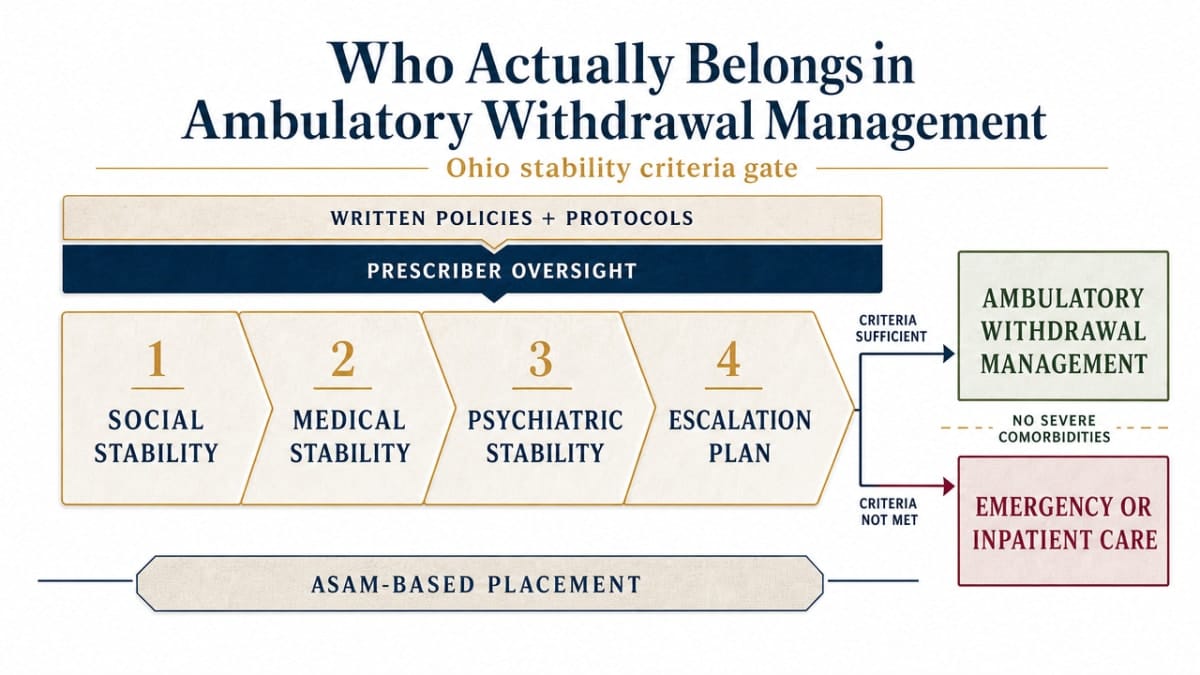
Before any program writes you a benzodiazepine taper or hands you a check-in schedule, someone has to decide you’re a safe candidate for ambulatory care. In Ohio, that decision isn’t a gut call. It’s a regulated gate.
Ohio Administrative Code 4723-9-14 only allows ambulatory withdrawal management with medication when a patient has sufficient social, medical, and psychiatric stability, no severe comorbidities that would make outpatient care unsafe, and a working plan to escalate to emergency or inpatient care if things turn 9. Programs must operate under written policies and protocols, with prescriber oversight, rather than improvising case by case 10. A parallel rule for physicians, 4731-33-02, requires the same protocol-driven approach and ASAM-based placement matching 17.
In plain language, your intake team is checking four things before they say yes:
- Are your vitals, labs, and medical history stable enough that withdrawal won’t tip a coexisting condition into crisis?
- Is your mental health stable enough that you’re not at acute risk of self-harm?
- Do you have a real human at home?
- And if your symptoms spike at 2 a.m. on day two, is there a clear path — a phone line, an after-hours clinician, a nearby ER — that gets you help fast 9?
If you can answer yes to all four, you’re inside the gate. If you can’t, the right answer isn’t to argue your way in. It’s a higher level of care, which is its own form of progress.
Disqualifiers: When Home Is Not Safe Enough
This part is hard to read if you’ve already decided you want to detox at home. Read it anyway. The disqualifiers exist because the risks are real, not because anyone is trying to talk you out of recovery.
A history of withdrawal seizures or delirium tremens puts you in a different risk category. So does significant medical illness, advanced age, or polysubstance use — particularly heavy use of alcohol combined with benzodiazepines 11. Benzodiazepine dependence itself is a separate problem: withdrawal can cause seizures and psychosis and generally requires a slow, gradual taper under closer supervision than ambulatory programs are built for 6. Acute psychiatric instability, including active suicidal thinking, also moves you to inpatient care.
If you fall into one of these categories, you haven’t failed. You’ve gotten useful information. A few days of inpatient stabilization, followed by an outpatient program, is still your recovery — just sequenced differently.
The Sober Support Person Requirement
Ambulatory withdrawal management assumes you are not doing this alone. That’s not a suggestion. It’s part of what “sufficient social support” means in the Ohio rule 9.
You need a specific, named adult who is sober, reachable, and physically present in your home for most of the first 72 hours. Their job isn’t to be a nurse. Their job is to notice — to see if you’re more confused than you were two hours ago, to hold and dispense your medication so it isn’t in your hands during a vulnerable moment, to drive you to the clinic or the ER if your team says go, and to call the number on your safety plan when something feels off.
If you live alone and the only candidate is a coworker who can swing by at lunch, that’s not enough. Naming this gap early — before intake — gives your team time to help you solve it, whether that means a family member staying over or a short inpatient stay instead.
Hours 0–24: Intake, Baseline, and the First Doses
What Happens at the First Visit
Your first appointment usually lasts longer than you expect — plan on two to three hours. You’re not just signing forms. The clinician is building a baseline they’ll measure everything else against for the next three days.
Expect a focused medical history: how much you’ve been drinking or using, when your last dose was, prior withdrawal episodes, any history of seizures or delirium tremens, other medications, and coexisting medical or psychiatric conditions 11. Vital signs come next — blood pressure, heart rate, temperature — followed in most programs by basic labs to check liver function, electrolytes, and hydration. A nurse or pharmacist will inventory what’s in your medicine cabinet at home and confirm who your sober support person is and where they’ll be sleeping for the next three nights 9.
Then comes the first CIWA-Ar assessment, your medication plan, and a written safety plan: the after-hours number, the nearest ER, and the specific symptoms that mean you call before your next scheduled check-in. You’ll leave with a small, dated supply of medication — not a full bottle — and a check-in window for the next morning. That last detail is deliberate. Day two is coming, and your team wants eyes on you before it arrives.
CIWA-Ar and How Your Score Drives Care
CIWA-Ar stands for the Clinical Institute Withdrawal Assessment for Alcohol, Revised. It’s a 10-item checklist a clinician walks through with you in about five minutes: nausea, tremor, sweating, anxiety, agitation, headache, sensitivity to light and sound, tactile and visual disturbances, and orientation 1. Each item is scored, the numbers are added up, and the total tells your team how much medication you actually need right now — not how much a textbook says someone your size should need.
The score bands are simple:
- A total under 8 to 10 indicates minimal to mild withdrawal.
- A score of 8 to 15 indicates moderate withdrawal.
- A score of 15 or higher indicates severe withdrawal 1.
In ambulatory care, those bands map to three different responses: supportive care and hydration at the low end, symptom-triggered benzodiazepine dosing in the middle band, and transfer to a higher level of care at the top 13.
You’ll likely be scored several times in the first 24 hours — at intake, by phone or video check-in that evening, and again the next morning. The point isn’t to assign you a grade. It’s to catch a rising trend early, while the medication you take at home can still keep you ahead of it. If your score is climbing visit over visit despite dosing, your team isn’t going to push through. They’re going to move you. That’s the system working, not failing.
Hours 24–48: The Peak
Why Day Two Is the Hardest Day
You’ll wake up on day two and something will be different. Not necessarily worse than the worst moment of day one, but more relentless. The tremor that came and went yesterday is steadier. Sleep, if you got any, was thin. Your skin feels wrong.
This isn’t bad luck or weakness. It’s pharmacology. Alcohol withdrawal signs begin within 6 to 24 hours after your last drink, peak in intensity between 24 and 48 hours, and generally resolve within 4 to 5 days, with medication tapers like chlordiazepoxide structured across days 1 through 3 to cover exactly this curve 5. Your team built your schedule around that shape. The morning check-in on day two isn’t a routine appointment. It’s the visit they care about most.
Expect more frequent CIWA-Ar scoring during this window, sometimes every few hours by phone or video, plus a same-day in-person visit if anything is trending up 13. Your support person will likely be asked direct questions about your sleep, your confusion, and whether you’ve kept fluids down.
Knowing day two is the peak is itself useful information. You’re not getting worse forever. You’re climbing the part of the curve that already has a top.
Medications: Benzodiazepines, Gabapentin, and What Your Team Is Choosing Between
For alcohol withdrawal in the ambulatory setting, the workhorse is still a benzodiazepine — most often chlordiazepoxide, sometimes diazepam or lorazepam — given either on a fixed taper over days 1 through 3 or, more commonly now, on a symptom-triggered schedule driven by your CIWA-Ar scores 5, 13. Symptom-triggered dosing means you take medication when your score crosses a threshold, not on a fixed clock. Studies in emergency and outpatient settings support this approach as effective when monitoring is reliable 2.
Gabapentin has entered the conversation as a non-benzodiazepine alternative. A randomized trial directly compared gabapentin with chlordiazepoxide in ambulatory alcohol withdrawal, testing whether gabapentin is non-inferior for managing symptoms with close outpatient monitoring 4. For some patients — particularly those with a history of benzodiazepine misuse, sedation concerns, or work obligations that make heavy benzodiazepine dosing impractical — gabapentin may be part of the plan, sometimes alongside lower-dose benzodiazepines rather than instead of them.
You may also see supportive medications: thiamine and folate to protect against nutritional deficits, ondansetron for nausea, clonidine for autonomic symptoms, and adequate hydration. None of these replace the core taper. They make the core taper tolerable.
One honest note about handling. Your medication will usually be dispensed in small, dated quantities rather than a full prescription. That’s not distrust. It’s protocol — and in Ohio, it reflects the written-policy requirements both nursing and physician rules impose on ambulatory programs 16, 17.
Red Flags: When to Call, When to Go to the ER
Most of day two is uncomfortable but manageable. A specific subset of symptoms is not, and you need to know them cold before they happen.
Call your team between scheduled check-ins if any of these appear:
- A CIWA-Ar score that keeps climbing despite your last dose
- Vomiting that prevents you from keeping medication down
- A heart rate that stays above 120
- Persistent fever
- New visual or tactile hallucinations 1, 13
These don’t automatically mean the ER. They mean your clinician needs to hear about them now, not at the next appointment.
If you’re unsure, call. The escalation plan your team built at intake exists for this moment, and using it isn’t a setback. It’s the system working.
Hours 48–72: Stabilization and the Handoff
What Improvement Actually Looks Like
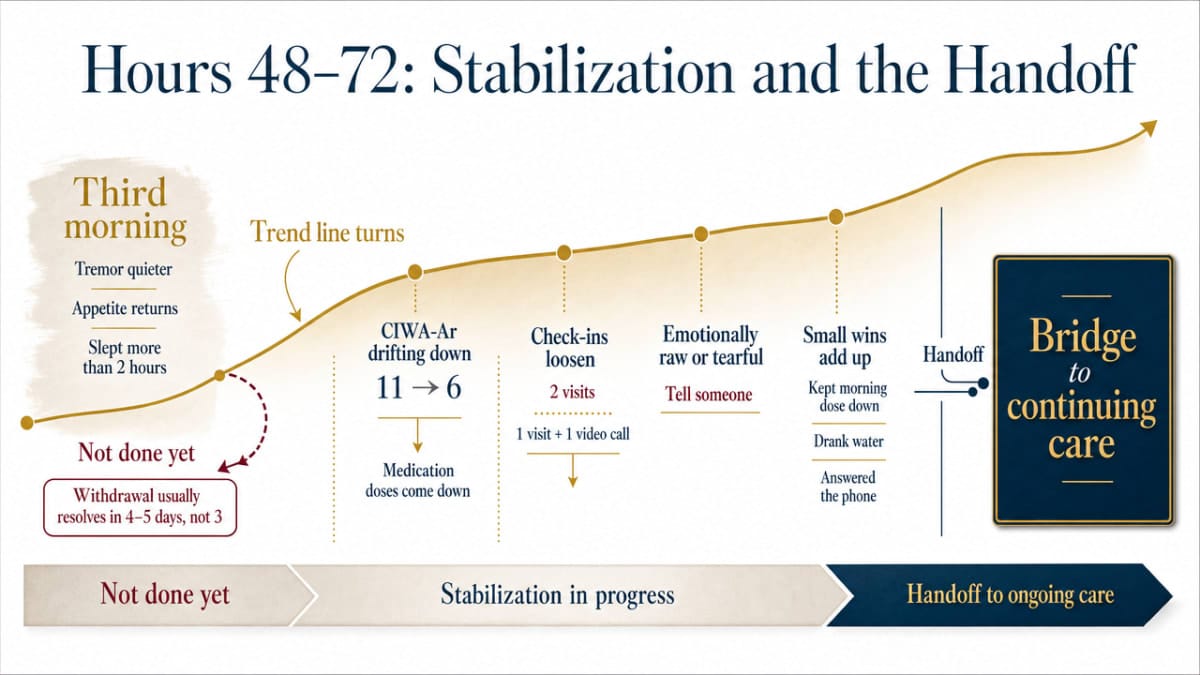
By the third morning, the curve starts bending the other way. Your tremor is quieter. Your appetite flickers back. You slept more than two hours in a row. None of this means you’re done — alcohol withdrawal generally resolves within 4 to 5 days, not 3 5— but day three is usually when the trend line turns.
Your CIWA-Ar scores should be drifting down visit over visit. If yesterday’s morning score was 11 and today’s is 6, that’s the number your team wants to see 1. Medication doses come down with the scores. The check-in cadence loosens a little — maybe one in-person visit and a video call instead of two visits. You may feel emotionally raw or unexpectedly tearful. That’s normal and worth telling someone about.
Small wins count here. You kept the morning dose down. You drank water. You answered the phone.
Why Detox Without Follow-On Treatment Fails
Here’s the part most people don’t hear at intake: finishing 72 hours of detox is not finishing treatment. It’s finishing the first three days.
National guidance is direct about this. Withdrawal management without ongoing pharmacotherapy is not an adequate standalone treatment for opioid use disorder, and medications for opioid use disorder should generally be used for maintenance rather than brief detox alone, because withdrawal without ongoing care is associated with high relapse and overdose risk 8, 14. The same logic applies to alcohol. SAMHSA names acamprosate, disulfiram, and naltrexone as the most common medications used for alcohol use disorder, and emphasizes pairing medication with counseling and behavioral therapies 7. Ambulatory detox literature flags the same concern — relapse and overdose risk climb after short-term detox if it isn’t followed by ongoing addiction treatment 12.
So before you hit hour 72, your team should already have the next thing scheduled. An intensive outpatient or standard outpatient program. A first counseling appointment. A MAT prescriber visit if that’s part of your plan. A name and a calendar slot, not a brochure.
If your discharge conversation sounds like “you’re done, good luck,” push back. The handoff is the treatment.
Opioid Withdrawal Is a Different Animal
Symptom Profile and Timeline for Short-Acting Opioids
If you’re coming off a short-acting opioid like heroin, oxycodone, or hydrocodone, your first 72 hours will not look like alcohol withdrawal. The timeline is different, the danger profile is different, and the medications your team reaches for are different.
Symptoms usually start 8 to 24 hours after your last dose and climb fast: muscle aches, abdominal cramping, nausea and vomiting, diarrhea, runny nose, watery eyes, yawning, goosebumps, restlessness, and a deep, joint-level discomfort that makes sitting still feel impossible. Anxiety and insomnia run underneath all of it. For short-acting opioids, the peak typically lands somewhere in the 36–72 hour window before the worst of it begins to ease over the following days.
Here is the most important difference. Opioid withdrawal is severely uncomfortable but is usually not life-threatening on its own, and it can be managed in ambulatory settings with opioid agonists or symptomatic medications when monitoring and follow-up are in place 6. That doesn’t mean white-knuckling it at home. It means the danger in opioid withdrawal isn’t usually the withdrawal itself — it’s what people do to make it stop.
Buprenorphine, Methadone, and Clonidine in the First 72 Hours
Ambulatory opioid withdrawal can be safely conducted using methadone, buprenorphine/naloxone, clonidine, guanfacine, and supportive care when appropriate monitoring and follow-up are provided 12. Those aren’t competing options. They’re a layered toolkit your prescriber chooses from based on what you used, when you last used, and what comes next.
Buprenorphine is the most common starting point in outpatient care. It’s a partial opioid agonist that quiets withdrawal and cravings within an hour or two of the first dose, and your induction visit will be carefully timed: you need to already be in mild-to-moderate withdrawal before the first dose, or it can precipitate worse symptoms. Methadone is the alternative for patients who need a full agonist or who haven’t tolerated buprenorphine, though it’s dispensed through licensed opioid treatment programs rather than a general outpatient clinic. Clonidine, an alpha-2 agonist, takes the edge off the autonomic symptoms — the sweating, the racing heart, the runny nose — and is often used alongside other supportive medications like ondansetron for nausea and loperamide for diarrhea 6, 12.
One non-negotiable point: SAMHSA and ASAM are direct that medications for opioid use disorder should generally be used for maintenance, not brief detox alone, because withdrawal without ongoing treatment carries high relapse and overdose risk 8, 14. If buprenorphine is started in your first 72 hours, the plan should already extend past day three — into ongoing prescribing, counseling, and an outpatient program. Detox without that bridge isn’t a finished treatment. It’s an unfinished one.
Telehealth and Remote Monitoring: What’s Real Now
A fair question if you’re juggling a job and a commute: can any of this be done by phone or video? The honest answer is yes, partly — and the evidence base is still being built.
An active clinical trial is evaluating whether symptom-triggered alcohol withdrawal management can be delivered safely through telemedicine and mobile health technology, with structured check-ins and digital symptom monitoring during the early withdrawal period 15. That’s the direction the field is moving, and it’s already showing up in real programs as a hybrid model: an in-person intake and baseline labs on day one, then video CIWA-Ar check-ins layered between in-person visits during the 24–48 hour peak.
What telehealth doesn’t replace is the in-person assessment when your score is climbing or your support person sounds worried on the phone. Ohio’s ambulatory rules still require written protocols, prescriber oversight, and a clear escalation path regardless of how a check-in is delivered 16. If a program offers fully remote detox with no in-person touchpoint and no named ER plan, that’s not telehealth done well. That’s a corner being cut.
Preparing Your Home and the People Around You
The 72 hours go better when the room around you is already set up for them. Spend an afternoon before day one doing four small things.
Lock the alcohol or remaining pills out of the house, or give them to your support person to take home. The first 48 hours are not the moment to test your willpower against a half-empty bottle in the cabinet. Stock plain food you can actually eat when you’re nauseous — broth, crackers, electrolyte drinks, fruit. Charge your phone and write the after-hours line, your prescriber’s name, and the nearest ER on paper next to it, because day two is not when you want to be searching contacts.
Then talk to the people who’ll see you. Your sober support person needs to know the check-in schedule, where the medication lives, and what symptoms mean call versus drive 9. Tell one or two others — a sibling, a close friend, your manager if work knows — that you’ll be off the grid for three days. You don’t owe anyone the full story. You do need someone besides yourself holding the plan.
Speak With a Specialist—Start Outpatient Detox Today
Connect now for guidance through the first 72 hours of outpatient detox and next steps for support.
Take the First Step Toward Safe Detox Today
Talk with a professional about your unique needs and start planning your outpatient detox with confidence.
Frequently Asked Questions
Is outpatient detox safe for alcohol withdrawal?
Yes, for the right patient. Selected patients with mild-to-moderate withdrawal, no history of seizures or delirium tremens, stable medical and psychiatric status, and a sober adult at home can be managed safely in ambulatory programs with daily monitoring and symptom-triggered medication 12, 13. Safety depends on careful selection and reliable follow-up — not on willpower.
Who should not try outpatient detox at home?
If you have a history of withdrawal seizures or delirium tremens, significant medical illness, acute psychiatric instability, heavy benzodiazepine dependence, or polysubstance use, ambulatory care is not the right fit 11, 6. Living alone without a sober support person also rules it out under Ohio’s stability criteria 9. None of this means recovery is off the table — it means starting with a higher level of care.
Can I keep working during the first 72 hours of outpatient detox?
Plan to take the first three days off. Symptoms peak between 24 and 48 hours, medication can be sedating, and your check-in schedule is front-loaded around exactly when you’d be expected at work 5. Many people return to a modified schedule by day four or five, then continue treatment in an intensive outpatient or standard outpatient program that fits around work.
What medications are used in outpatient detox for alcohol versus opioids?
For alcohol, the standard is a benzodiazepine — usually chlordiazepoxide, sometimes diazepam or lorazepam — given on a taper or symptom-triggered schedule, often with thiamine, folate, and supportive medications 5, 13. Gabapentin is being studied as a non-benzodiazepine option 4. For opioids, ambulatory care typically uses buprenorphine/naloxone, methadone (through a licensed program), or clonidine with supportive medications 12. Both should link directly into ongoing MAT and counseling 7, 8.
How do I know if I need to go to the ER instead of finishing detox at home?
Go to the ER for any seizure, loss of consciousness, new confusion about time or place, severe agitation, or hallucinations. Call your team — and likely head in — for a CIWA-Ar score climbing despite medication, vomiting that won’t stop, heart rate above 120, or persistent fever 1, 2. Using your escalation plan isn’t a failure. It’s the safety net working exactly as designed.
What happens after the first 72 hours?
Acute withdrawal generally resolves by day four or five, but treatment is just beginning 5. Your team should already have the next steps scheduled: an intensive outpatient or standard outpatient program, ongoing counseling, and — for opioid or alcohol use disorder — medication for maintenance, since withdrawal management alone is associated with high relapse and overdose risk 8, 14, 12. Detox is the doorway, not the destination.
References
- CIWA-Ar: Clinical Institute Withdrawal Assessment for Alcohol, Revised. https://www.ci2i.research.va.gov/paws/pdfs/ciwa-ar.pdf
- Management of Alcohol Withdrawal in the Emergency Department. https://pmc.ncbi.nlm.nih.gov/articles/PMC7093658/
- Impact of psychiatric pharmacist-led ambulatory alcohol withdrawal…. https://pmc.ncbi.nlm.nih.gov/articles/PMC12148008/
- Gabapentin vs Chlordiazepoxide for Ambulatory Alcohol Withdrawal. https://clinicaltrials.gov/study/NCT01573052
- Appendix A—Pharmacotherapy (A Guide to Substance Abuse Services for Primary Care Clinicians). https://www.ncbi.nlm.nih.gov/books/NBK64823/
- Clinical Guidelines for Withdrawal Management and Treatment of Drug Dependence in Closed Settings. https://www.ncbi.nlm.nih.gov/books/NBK310652/
- Treatment Options for Substance Use Disorder. https://www.samhsa.gov/substance-use/treatment/options
- ASAM National Practice Guideline for the Treatment of Opioid Use Disorder. https://www.samhsa.gov/resource/ebp/asam-national-practice-guideline-treatment-opioid-use-disorder
- Ohio Admin. Code 4723-9-14 – Standards and procedures for withdrawal management for drug or alcohol addiction. https://www.law.cornell.edu/regulations/ohio/Ohio-Admin-Code-4723-9-14
- Ohio Administrative Code 4723-9-14 (Authenticated PDF). https://codes.ohio.gov/assets/laws/administrative-code/authenticated/4723/0/9/4723-9-14_20250914.pdf
- Alcohol Withdrawal in Hospitalized Patients. https://www.ncbi.nlm.nih.gov/books/NBK604324/
- Ambulatory detoxification in alcohol use disorder and opioid use disorder. https://pmc.ncbi.nlm.nih.gov/articles/PMC7653729/
- The ASAM Clinical Practice Guideline on Alcohol Withdrawal Management: Pocket Guide. https://www.samhsa.gov/resource/ebp/asam-clinical-practice-guideline-alcohol-withdrawal-management-pocket-guide
- TIP 63: Medications for Opioid Use Disorder. https://www.samhsa.gov/resource/ebp/tip-63-medications-opioid-use-disorder
- Remote Treatment of Alcohol Withdrawal. https://clinicaltrials.gov/study/NCT04858490
- Rule 4723-9-14 – Ohio Administrative Code (Ambulatory withdrawal management by APRNs). https://codes.ohio.gov/ohio-administrative-code/rule-4723-9-14
- Rule 4731-33-02 – Ohio Administrative Code (Physician ambulatory withdrawal management). https://codes.ohio.gov/ohio-administrative-code/rule-4731-33-02