
Key Takeaways
- Shallow or irregular breathing, bluish lips, and unrousable sleep signal an active methadone overdose — call 911, give naloxone if available, and stay until paramedics arrive 3, 12.
- Pinpoint pupils combined with slurred speech or stupor often precede respiratory collapse; act before methadone peaks rather than letting them sleep it off 3, 11.
- Fainting, racing palpitations, or an unexplained seizure in someone on methadone can mean QT prolongation or torsades — treat as an emergency and bring medication lists 6, 16.
- Unaccounted take-home bottles, missing doses, or methadone from outside the program point to diversion patterns the opioid treatment program needs to know about this week 4, 5.
- Combining methadone with alcohol, benzodiazepines, or sleep aids compounds respiratory depression hours after dosing; report specific co-use to the OTP so dosing and counseling can be adjusted 11, 15.
- Doubling doses, running out early, or asking for refills ahead of schedule reflect opioid use disorder patterns that usually call for a dose review, not stopping treatment 1, 2.
- Work, parenting, and relationships quietly receding while on a stable dose signal functional impairment worth naming to the clinical team at the next appointment 1.
- Returning cravings, irritability, and repeated cycles of cutting down then ramping up suggest untreated conditions underneath — bring the pattern forward for a dose review and dual-diagnosis assessment 1, 2.
Why methadone misuse is so hard to spot at home
You already know something is off. Maybe it’s the way your husband’s voice sounded on yesterday’s voicemail, thicker and slower than usual. Maybe it’s the half-full take-home bottle you found behind the cereal boxes. Maybe it’s a feeling you can’t name yet, but you’ve learned to trust.
Here’s the part no one warns you about: methadone misuse rarely looks like what movies and pamphlets show. Your loved one isn’t nodding off in an alley. They may be sitting at the kitchen table, finishing a sentence, sipping coffee — and still be in danger. That’s because methadone is a long-acting medication, and the trouble it causes often shows up hours after a dose, not minutes.
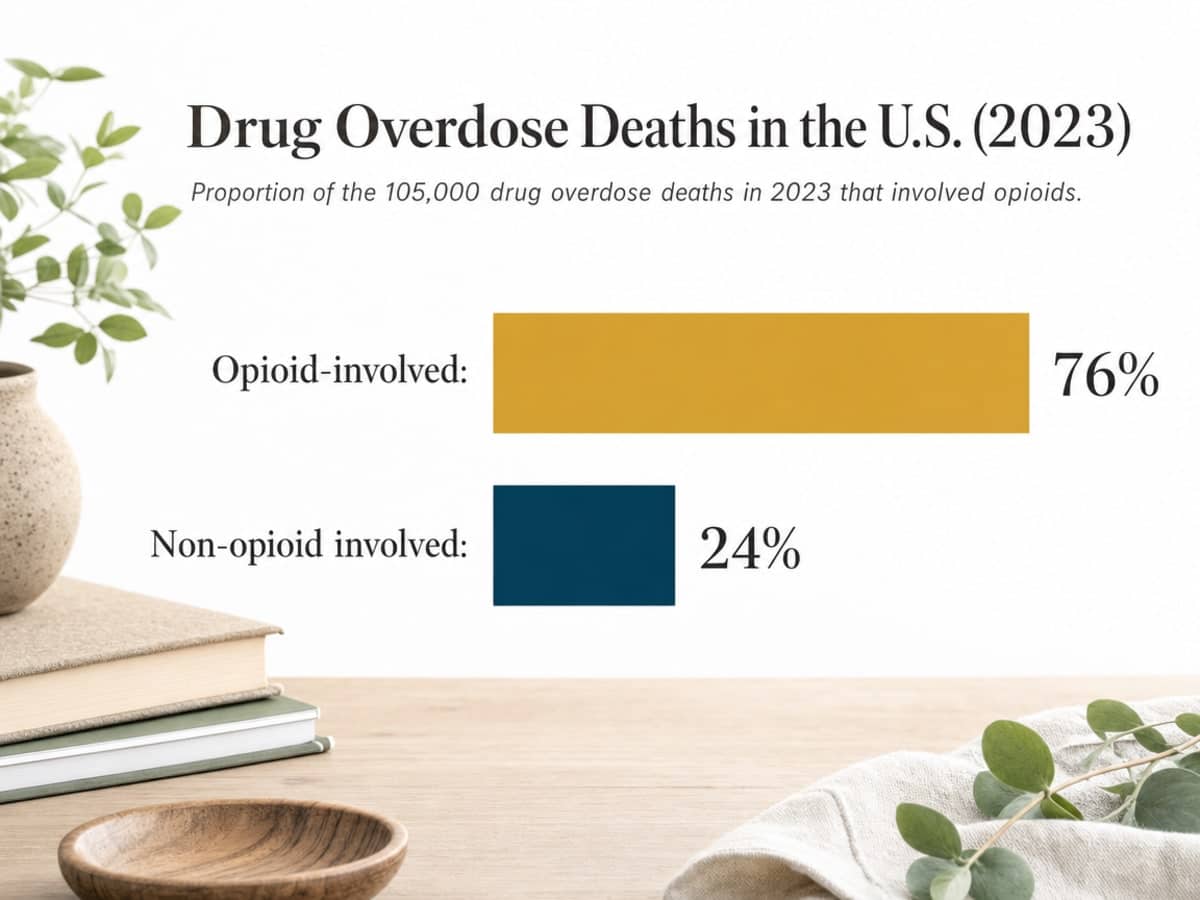
The stakes are real. Of the roughly 105,000 U.S. drug overdose deaths in 2023, nearly 80,000 — about 76% — involved opioids 7. Methadone isn’t driving most of those deaths, but when it does cause harm, the harm tends to be quiet, gradual, and easy to miss until it isn’t.
What follows are eight signs you can actually observe at home, grouped by how urgently you need to respond. You don’t need to be a clinician to recognize them. You just need to know what you’re looking at — and you’re already doing the hardest part, which is paying attention.
The pharmacology that changes everything: why methadone misuse looks different
Methadone behaves nothing like the opioids your loved one may have used before. After they swallow a dose, the effects start around 30 minutes later, but the peak doesn’t hit for about three hours — and the drug keeps working in the body for far longer than that 11. That long half-life is exactly why methadone works so well for opioid use disorder. It smooths out the cravings-and-crash cycle. It’s also why misuse can be quietly lethal.
Here’s the trap: someone who takes a second dose because they don’t “feel” the first one yet can stack methadone on top of methadone. The first dose hasn’t peaked. By bedtime, both doses are climbing together. Breathing slows. They fall asleep, and the overdose unfolds while the house is quiet 11.
Mix in a beer, a borrowed Xanax, or a sleep aid, and the math gets worse fast. Methadone is a respiratory depressant. So are alcohol and benzodiazepines. They don’t just add — they multiply.
This is why the signs you’re about to read aren’t always dramatic. With methadone, the warning often looks like “unusually sleepy after dinner,” not a crisis on the floor. Knowing the pharmacology lets you take quiet signs seriously.
A triage map: what to do tonight, this week, and at the next appointment
Before you read about each sign in detail, here’s the frame that matters most: not every warning sign needs the same response, and treating them all as emergencies — or all as something to mention later — is how families either burn out or miss the moment that matters.
Think of the eight signs in three buckets.
Tonight, call 911. If you see shallow or irregular breathing, blue or gray lips and fingernails, pinpoint pupils with stupor, or someone who won’t wake up — that’s an overdose in progress, not a conversation to schedule 3, 12. Fainting, racing palpitations, or an unexplained seizure also belong here, because methadone can prolong the QT interval and trigger dangerous heart rhythms 6.
This week, call the opioid treatment program. Extra take-home bottles you can’t account for, doses going missing, methadone showing up from a source that isn’t the clinic, or co-use with alcohol or benzodiazepines — these are diversion and polysubstance patterns the OTP needs to know about, ideally before the next dosing day 4, 5.
At the next appointment, raise it directly. Taking more than prescribed, running out early, cravings creeping back, work or family roles slipping — these are the slower-moving patterns of opioid use disorder that need a clinical adjustment, not a crisis call 1.
Keep this map in mind as you read on. You’re not just spotting signs. You’re deciding what they ask of you.
Signs that mean call 911 right now
Shallow breathing, blue lips, and unrousable sleep
This is the sign that doesn’t wait. If your loved one’s breathing has gone shallow, slow, or irregular — fewer than about 10 breaths a minute, or long pauses between breaths — that’s respiratory depression, and with methadone it can deepen for hours after the dose 3. You may notice their chest barely rising under a blanket. You may hear a gurgling, snoring sound that doesn’t match how they usually sleep.
Look at their lips and fingernails. A bluish or grayish tint means oxygen isn’t reaching tissue 12. On darker skin, check the inside of the lips, the gums, or the nail beds for a dusky color.
Now try to wake them. Say their name. Rub your knuckles firmly on their breastbone. If they don’t respond — or if they mumble and slide back under — treat this as an overdose 12.
Pinpoint pupils paired with slurred speech or stupor
Look at their eyes in normal room light. If the pupils are constricted down to a pinpoint — tiny black dots that don’t open up the way they should — that’s miosis, a hallmark of opioid toxicity 3. One pinpoint pupil on its own doesn’t tell you much. Pinpoint pupils together with thick speech, a slack jaw, or a head that keeps drifting forward is a different story.
This combination — miosis plus stupor — sits one step before the breathing changes in 4.1. Catching it here, before respiration slows, is the difference families talk about for years.
Don’t wait to see if they “sleep it off.” Methadone hasn’t peaked yet. What looks like heavy drowsiness at 9 p.m. can become unrousable sedation by midnight, especially if they took a dose earlier that hasn’t fully landed 11.
Call 911. Tell the dispatcher your loved one is on methadone, when you think the last dose was, and what else might be in their system — alcohol, benzodiazepines, sleep aids. That information shapes how the paramedics respond when they walk through your door.
Fainting, palpitations, or an unexplained seizure
Methadone can cause a heart-rhythm problem called QT prolongation — the electrical reset between heartbeats stretches out, and in some people that triggers a dangerous rhythm called torsades de pointes 6. You won’t see this on a monitor at home. What you will see is its consequences.
The warning signs feel unrelated to drugs, which is part of why they get missed. Your loved one stands up and crumples. They tell you their heart was “racing” or “flipping” for a minute and then they felt strange. They have a seizure with no history of seizures. They wake up on the bathroom floor and can’t explain how they got there 16.
Any of these in someone on methadone is a 911 call, not a next-day appointment. Adverse cardiac events on methadone can come from unintentional overdose, interactions with other medications, or methadone’s direct effect on the heart’s electrical system 16. You can’t sort that out from the couch.
When you call, say the words “on methadone” early in the conversation. Bring the prescription bottle or a photo of it to the hospital. If your loved one takes other medications — certain antidepressants, antibiotics, antifungals, or anti-nausea drugs can stretch the QT interval further — bring those too. The cardiology team will want to see an ECG and a list of everything in their system before deciding what comes next.
Signs that mean call the opioid treatment program this week
Extra bottles, missing doses, or methadone from a non-program source
Open the medicine cabinet. Look in the nightstand drawer, the glove box, the bag they brought back from a friend’s place last weekend. If you’re finding more take-home bottles than the clinic’s dosing schedule accounts for — or bottles that look unfamiliar, unlabeled, or labeled with someone else’s name — that’s a diversion sign, not a paperwork mix-up.
The Department of Justice’s review of methadone diversion found that most methadone-related deaths trace back to methadone diverted from hospitals, pharmacies, practitioners, and pain clinics rather than from structured maintenance programs 4. In other words: when methadone hurts people, it’s usually methadone that escaped the program’s chain of custody. A bottle on your loved one’s dresser that didn’t come from their OTP dosing window is the same problem, smaller scale.
The other shape this takes is doses going the opposite direction — out of the house. You notice a bottle is half-empty days earlier than it should be. The weekly count doesn’t match what they brought home Friday. A friend texts asking if your loved one can “spot them” until next week. Programs use observed dosing, urine drug testing, and bottle counts specifically to catch these patterns 5, and the OTP’s counselor wants this information.
Call the program this week. You don’t need permission to share what you’ve observed — federal privacy rules limit what staff can tell you, but they don’t limit what you can tell them. Say what you found, where, and when. Ask for a meeting that includes your loved one if possible. The goal isn’t to get them in trouble. It’s to get the dosing structure and supervision adjusted before a diverted bottle becomes a fatal one.
Mixing methadone with alcohol, benzodiazepines, or sleep medications
An empty wine bottle in the recycling on a dosing day. A borrowed Xanax from a coworker. An over-the-counter sleep aid kept by the bed. Any one of these on top of methadone is the combination that fills emergency departments — and it’s the combination methadone-experienced families learn to scan for first.
The pharmacology is unforgiving. Methadone, alcohol, and benzodiazepines all slow breathing. Stack them and the effect isn’t additive — it compounds, often hours after the last dose, when everyone in the house is already asleep 11.
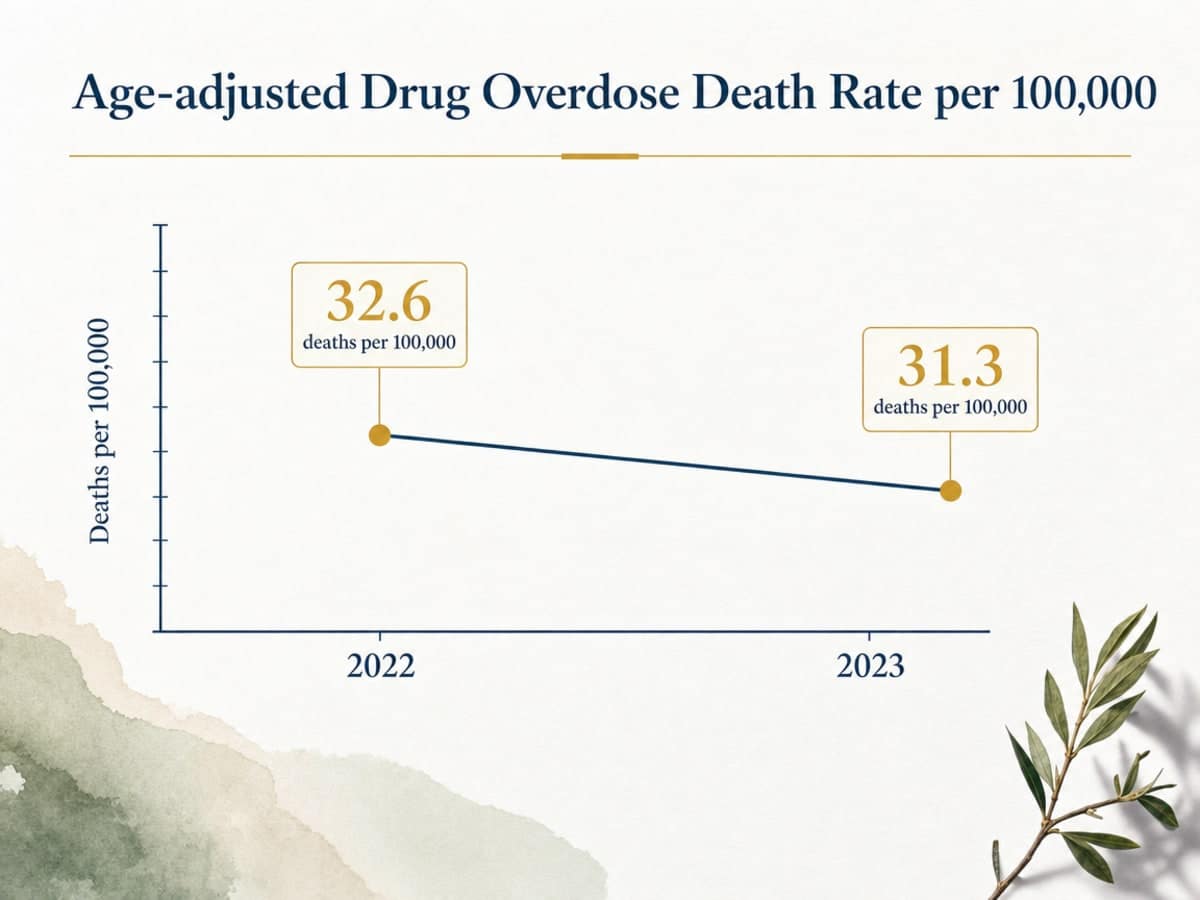
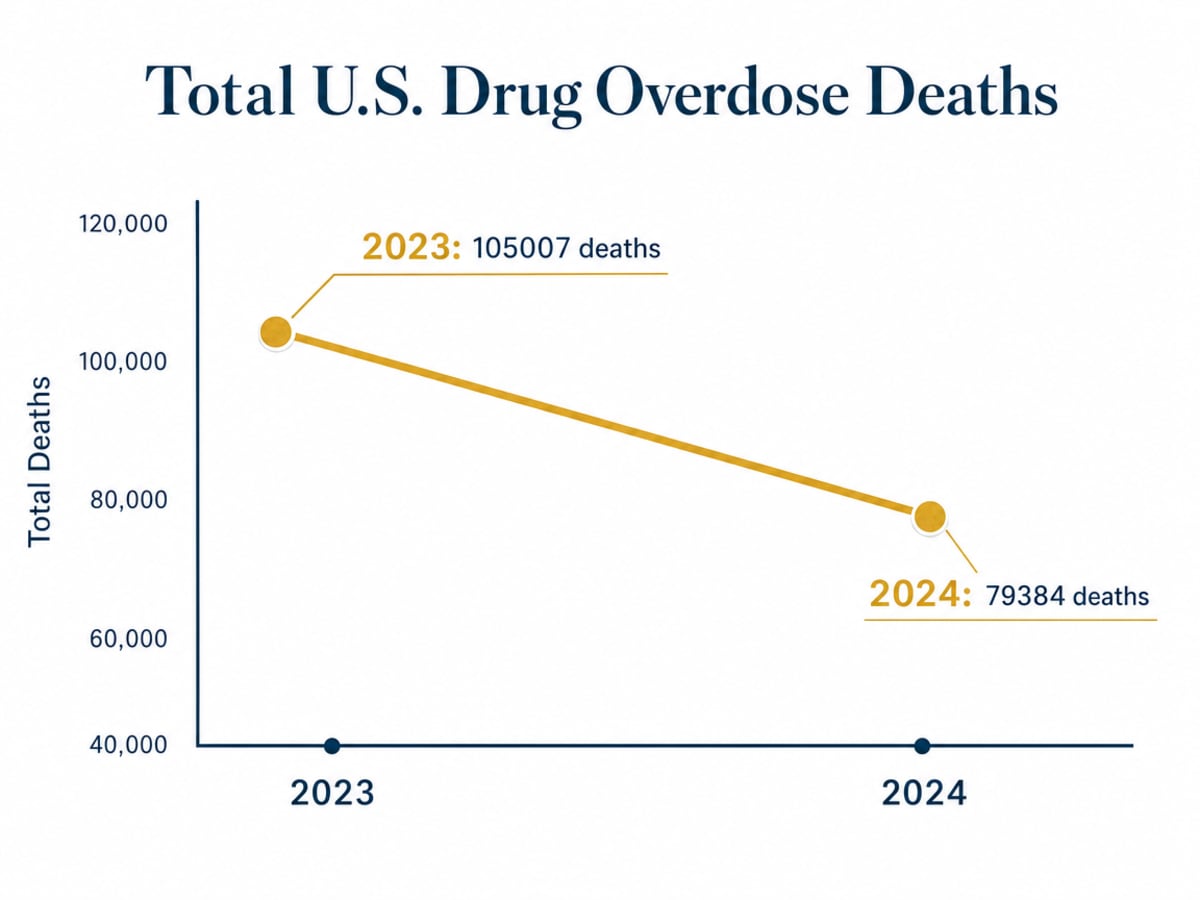
The broader overdose picture is improving, and it’s worth holding both truths at once. Between 2023 and 2024, the U.S. age-adjusted drug overdose death rate dropped from 31.3 to 23.1 per 100,000, with a 35.6% decline in deaths involving synthetic opioids other than methadone 15. Methadone-involved deaths, by contrast, did not show the same sharp decline — they held roughly steady through 2023 8. The risk you’re watching for hasn’t fallen at the same rate as the headline numbers.
Call the OTP this week. Tell the counselor specifically what you’ve seen — the drink, the borrowed pill, the bottle of Unisom. The program can adjust the dose, increase counseling intensity, screen for an underlying anxiety or sleep disorder that’s driving the co-use, or coordinate with a prescriber to taper a benzodiazepine safely. None of that happens if no one tells them.
Signs to raise at the next appointment
Taking more than prescribed or running out early
You count the days on the take-home schedule and the math doesn’t work. Friday’s bottle is empty on Wednesday. Your loved one mentions, casually, that they “doubled up” one morning because they didn’t think the dose was “holding” them. Maybe they ask the program for an early refill, or they show up to the clinic anxious about running out.
This is the slow shape of opioid use disorder, even on a medication meant to treat it. Taking opioids in larger amounts or over a longer period than intended, and unsuccessful efforts to cut down, are core diagnostic patterns 1. They don’t mean methadone has failed. They usually mean the current dose isn’t covering what’s underneath — cravings, pain, an untreated mental health condition, or a tolerance that’s shifted.
Write down what you’ve noticed: dates, amounts, what your loved one said. Bring it to the next dosing-day appointment, or ask the counselor for a session that includes you. The fix is often a dose adjustment, more frequent visits, or pulling back take-home privileges for a stretch — not stopping treatment 2.
Work, school, or family roles starting to slip
The shifts they used to pick up, they’re turning down. The morning routine with the kids has quietly become your routine. Calls from their manager start showing up on the home phone. They cancel on their sister three weekends in a row. None of it is dramatic on its own. Together, it’s a pattern.
Functional impairment — work, school, or home roles eroding because of substance use — is one of the clearest signs that misuse has tipped into an active disorder, even when the substance is a prescribed medication 1. Methadone at a stable dose shouldn’t sedate someone out of their life. When it does, either the dose has drifted, something else is on board, or the underlying condition has progressed.
You don’t have to diagnose any of that. You just have to name it. At the next appointment, tell the counselor what you’ve watched recede — the job, the parenting, the friendships — and over what timeframe. That timeline is information the clinical team can’t get from a urine screen.
Cravings, irritability, and the cycle of cutting down and starting again
Your loved one tells you they’re “fine,” then snaps at you over the dishwasher. They say they want to lower their dose. A week later they’re asking the program to raise it. They talk about quitting methadone entirely and then go quiet for days. Underneath the mood is something they may not say out loud: the cravings are back.
Craving — a strong desire or urge to use opioids — is a diagnostic feature of opioid use disorder that doesn’t disappear because someone is in treatment 1. Neither does the cycle of trying to cut down and failing. Repeated unsuccessful attempts to control use, even of a prescribed medication, point to the same disorder the methadone is treating, not to a moral failing or a reason to walk away from care 1.
This is the conversation to bring forward at the next appointment. Use plain words: “I think the cravings are louder again.” “You’ve tried to lower it twice this month.” The clinical response is often a dose review and an honest look at what isn’t being treated yet — anxiety, trauma, depression — alongside the opioid use itself 2.
How the 2024 take-home expansion changed the family’s role
For decades, methadone meant a daily trip to the clinic. A nurse handed your loved one a cup, watched them drink it, and that was the dose. Diversion was harder. So was missing the warning signs at home, because most of the medication never left the program.
That changed. After pandemic-era flexibilities were studied and made permanent, opioid treatment programs can now send patients home with longer stretches of take-home doses — sometimes a week or more at a stable point in treatment. The evidence behind the shift is reassuring: expanded take-home dosing during COVID did not produce a rise in methadone-involved overdose deaths, and some patient groups saw improved outcomes 17, 10.
What the studies don’t capture is the kitchen-table consequence. More bottles in the house means you — the parent, the spouse, the adult child — are now part of the monitoring layer the clinic used to handle alone. The nurse who would have noticed slurred speech at the dosing window isn’t there on a Tuesday night. You are.
That’s not a burden you asked for, and it doesn’t make you responsible for someone else’s recovery. It does mean the signs in this article matter more than they would have five years ago. Trust what you see. The program wants to hear from you 5.
What to say tonight without triggering a fight or a relapse
You’ve been rehearsing this conversation in your head for weeks. You’re terrified that the wrong word will send your loved one out the door, or back to using, or into a silence you can’t reach. That fear is reasonable. It’s also not a reason to stay quiet.
Start with what you saw, not what you concluded. “I found a bottle in the nightstand drawer that I didn’t recognize” lands differently than “You’re using again.” The first is a fact you can both look at. The second is a verdict, and verdicts invite defense.
Name your worry in one sentence and stop talking. “I’m scared you’re going to stop breathing in your sleep.” Then let the silence sit. You don’t have to fill it.
Ask one question, not five. “Can you tell me what’s been going on?” is enough for tonight.
Why the answer is dual-diagnosis care, not cold-turkey withdrawal
If you’ve gotten this far, you may be tempted to land somewhere simple: get them off methadone. The bottles go away, the worry goes away, the problem goes away. It’s an understandable instinct, and it’s the wrong one.
CDC clinical guidance is direct on this point. Detoxification without ongoing medication for opioid use disorder is not recommended, because it raises the risk of relapse and overdose 14. People who stay on methadone or buprenorphine are less likely to die or overdose than those who do not 13. Pulling the medication doesn’t subtract risk. It usually adds it.
What the signs you’ve been watching for actually point to is a treatment plan that isn’t quite catching everything. Cravings that won’t quiet down, doses that keep creeping up, mixing in alcohol or a borrowed benzodiazepine, withdrawal from work and family — these patterns often sit on top of an untreated mental health condition. Anxiety. Depression. PTSD. Bipolar disorder. The methadone is working on the opioid use, and something else is going untreated underneath it.
Integrated dual-diagnosis care treats both at the same time, in the same place, with one team. Medication management for OUD stays intact. Therapy — CBT, EMDR for trauma, motivational work — addresses what’s driving the misuse. Counseling and psychosocial support add measurable benefit to the medication itself 2.
That’s the conversation worth having with your loved one and their program this week. Not “stop the methadone.” Ask for an assessment that looks at everything at once. Arrow Passage Recovery and other accredited programs structure care exactly this way, because the signs you’ve been carrying alone are signs a coordinated team is built to answer.
Connect Now for Support With Methadone Concerns
Get immediate answers and guidance for a loved one showing signs of methadone abuse.
Ready to Address Methadone Concerns Together?
Gain expert support to confidently navigate methadone abuse and next steps for your loved one.
Frequently Asked Questions
Does insurance usually cover methadone treatment and dual-diagnosis care?
Most major insurance plans — including Aetna, Blue Cross, UnitedHealthcare, Cigna, and Tricare — cover medication for opioid use disorder and integrated mental health treatment, often with little or no out-of-pocket cost. Call the number on the back of the card and ask specifically about opioid treatment program coverage and dual-diagnosis residential or outpatient care. The admissions team at any accredited facility can verify benefits for you in one call.
Should I call my loved one’s opioid treatment program if I suspect misuse, even without their permission?
Yes. Federal privacy rules limit what the program can share with you, but they don’t limit what you can share with the program. Call the counselor or clinical director, describe exactly what you’ve observed, and ask for a family meeting if possible. You’re not getting your loved one in trouble — you’re giving the clinical team information they need to adjust dosing, supervision, or counseling before something worse happens 5.
Is it safe to keep naloxone in the house if my loved one is on prescribed methadone?
Yes, and it’s strongly recommended. Naloxone reverses opioid overdose, including methadone overdose, and it won’t cause harm if given to someone who isn’t actually overdosing. Because methadone is long-acting, a single dose of naloxone may wear off before the methadone does, so call 911 even if your loved one wakes up 11. Pharmacies stock it without a prescription in every state. Keep it where you can find it in the dark.
What’s the difference between physical dependence on methadone and methadone abuse?
Physical dependence means the body has adjusted to a steady dose and would go through withdrawal if it stopped — this is expected, not a sign of abuse. Abuse involves taking more than prescribed, using methadone from non-program sources, combining it with other depressants, or losing control of work, family, or relationships because of it 1. A stable patient on a maintenance dose is dependent. That’s how the medication works.
Can I lock up or hold onto my loved one’s take-home methadone bottles?
Only if they agree to it. Take-home bottles are legally dispensed to the patient, so taking them without consent can backfire — both legally and relationally. What you can do is have an honest conversation with your loved one and their counselor about temporary bottle storage at home, or ask the program to shorten the take-home window and return to more frequent observed dosing while things stabilize 5.
What if my loved one refuses to talk about it or denies anything is wrong?
Denial is common, and it doesn’t mean you stop. Keep the door open with short, specific statements rather than confrontations: “I love you, and I’m scared. When you’re ready, I’m here.” Then talk to the program yourself, schedule a consultation with a dual-diagnosis assessment team, and ask about family-focused options like a professional intervention. You don’t need their permission to gather information or to take care of yourself.
References
- Opioid Use Disorder: Evaluation and Management (StatPearls). https://www.ncbi.nlm.nih.gov/books/NBK553166/
- Treatment of Opioid Use Disorder. https://www.cdc.gov/overdose-prevention/treatment/opioid-use-disorder.html
- Methadone – StatPearls. https://www.ncbi.nlm.nih.gov/books/NBK562216/
- Methadone Diversion, Abuse, and Misuse: Deaths Increasing at Alarming Rate. https://www.justice.gov/archive/ndic/pubs25/25930/index.htm
- Methadone Diversion Control. https://www.ncbi.nlm.nih.gov/books/NBK232116/
- A Twist on Torsade: A Prolonged QT Interval on Methadone. https://pmc.ncbi.nlm.nih.gov/articles/PMC1831670/
- Understanding the Opioid Overdose Epidemic. https://www.cdc.gov/overdose-prevention/about/understanding-the-opioid-overdose-epidemic.html
- Drug Overdose Deaths in the United States, 2003–2023. https://www.cdc.gov/nchs/products/databriefs/db522.htm
- Drug Overdose Deaths in the United States, 2003–2023. https://pubmed.ncbi.nlm.nih.gov/40623710/
- Changes in methadone program practices and fatal methadone overdose following a relaxation of take-home dosing restrictions during the COVID-19 pandemic. https://pmc.ncbi.nlm.nih.gov/articles/PMC9758251/
- Methadone maintenance treatment. https://www.ncbi.nlm.nih.gov/books/NBK310658/
- Methadone: MedlinePlus Drug Information. https://medlineplus.gov/druginfo/meds/a682134.html
- Medications for Opioid Use Disorder. https://nida.nih.gov/research-topics/medications-opioid-use-disorder
- Opioid Use Disorder: Treating. https://www.cdc.gov/overdose-prevention/hcp/clinical-care/opioid-use-disorder-treating.html
- Drug Overdose Deaths in the United States, 2023–2024. https://www.cdc.gov/nchs/products/databriefs/db549.htm
- QT Interval Screening in Methadone Maintenance Treatment. https://pmc.ncbi.nlm.nih.gov/articles/PMC4078896/
- Methadone Take-Home Policies and Associated Mortality. https://pmc.ncbi.nlm.nih.gov/articles/PMC11331457/