
Key Takeaways
- Smoked DMT peaks within about two minutes, but blood pressure, heart rate, and body temperature spike on the same clock, dose-dependently 13.
- Clinical trials have documented hypertension, chest pain, fainting, seizures, and transient psychosis tied to DMT, with a case report describing psychosis that led to injury and property damage 12, 15.
- DMT does not build tolerance to its psychological effects 11, and its long-term effects and addiction liability remain poorly characterized 1, which lets repeated use quietly slide into a pattern.
- Preexisting neuropsychiatric conditions shift the risk math — about 4% of those participants experienced serious adverse events in monitored studies, compared to zero among healthy participants 5.
The “Short Trip, Small Risk” Story Doesn’t Hold Up
If you’ve smoked DMT, you’ve probably heard some version of this: it’s over in fifteen minutes, so how bad can it really be? Maybe a friend said it. Maybe you told it to yourself the first time, right before the lighter clicked.
Here’s the part that gets left out. The subjective effects of DMT begin within seconds of inhalation and peak within about two minutes, then taper off over roughly 20 to 30 minutes 3, 13. That compressed window is the whole reason smoked DMT gets called safe. It’s also the reason it isn’t. Your blood pressure, heart rate, body temperature, and pupil size all climb in that same short span, dose-dependently, whether or not you feel them climbing 13. The high ends. The physiological hit already happened.
You are not reckless for believing the short-trip story. It sounds reasonable, and plenty of people repeat it. But if you’re reading this after a session that rattled you, or because someone close to you keeps disappearing into ten-minute pipe hits, that instinct to look closer is worth trusting. What follows is the honest version — what smoked DMT actually does to a body and mind, especially one already carrying the weight of active use.
What Actually Happens in the First Two Minutes
Onset in Seconds, Peak in Two Minutes
Here’s what the timeline actually looks like when you exhale. Within seconds, DMT crosses into your bloodstream and brain. The classic human dose-response work found that peak blood levels and peak subjective effects both landed within about two minutes, and effects tapered off across roughly 20 to 30 minutes 13. That’s the window everyone talks about when they say it’s short.
But in that same two-minute window, your body is doing more than seeing colors. In the same study, DMT dose-dependently raised blood pressure, heart rate, pupil diameter, and rectal temperature 13. The bigger the dose, the bigger the jump. A more recent clinical review put it plainly: subjective effects begin within seconds and subside within about 30 minutes, but the physiological changes ride the same wave 3.
Think about what that means for the pipe or the vape. You’re not gently warming your system up over an hour like alcohol at a bar. You are asking your cardiovascular system to spike almost immediately, hold, and then come back down — sometimes multiple times in a night, if you’re chasing another hit. If you’ve ever felt your chest pound or your face flush right as the visuals came on, that wasn’t the trip. That was your body registering a rapid, dose-dependent stress load. The high timed out. The strain on the system it just squeezed doesn’t disappear on the same clock.
The Heart Doesn’t Get a Break Just Because the High Is Short
There’s a reasonable question buried in the short-trip argument: if it’s over that fast, does the cardiovascular hit really matter? Fair to ask. The answer keeps showing up in the research.
A pharmacology review of DMT noted that while the drug appears to have limited neurotoxicity, intense cardiovascular effects can occur at larger doses 9. Even the monitored clinical pilot in patients with treatment-resistant depression — a setting with IV lines, blood pressure cuffs, and a doctor in the room — documented elevated blood pressure, heart rate, anxiety, and psychotomimetic effects that resolved only after 20 to 30 minutes 4. Resolved is not the same as harmless. It means the numbers came back down while people were being watched.
A 2025 experimental study went a layer deeper and looked at what DMT does to human heart tissue directly. Researchers found DMT increased the force of contraction and the beating rate in human atrial preparations 19. That’s not a subjective report. That’s cardiac tissue responding to the molecule itself.
None of this means every session ends in an ER visit. It does mean the story that a short high equals a small risk skips the part your heart has to do. If you already carry high blood pressure, an undiagnosed arrhythmia, or a body worn down by other substances, that skipped part is exactly where trouble hides.
Acute Risks People Don’t Expect
Hypertension, Chest Pain, Fainting, Seizures
When people list the risks of smoked DMT, they usually stop at “bad trip.” The clinical picture is wider than that, and it’s worth knowing what has actually shown up in the literature.
A 2024 systematic review of DMT and ayahuasca adverse events pulled together what clinical trials have reported:
- nausea
- vomiting
- transient anxiety
- headache
- hypertension
- breathing difficulties
- chest pains
- fainting
- seizures 12
Read that list again. Chest pain. Fainting. Seizures. Those aren’t fringe outcomes someone dug up from a message board. They are documented events from monitored studies, where participants were screened, dosed carefully, and watched.
Now think about the setting most people are actually smoking in. A couch. A car. A hotel bathroom. No blood pressure cuff, no one trained to recognize a hypertensive spike, no plan for what to do if breathing gets shallow or someone drops. If any of those events happens during a five-minute peak, the person next to you has about that long to figure out what to do while you’re not able to speak for yourself.
You don’t have to be unlucky for one of these to catch up to you. Underlying blood pressure issues, an untreated arrhythmia, sleep deprivation, dehydration, and whatever else is already in your system all lower the bar. If you’ve been mixing DMT with stimulants, alcohol, or benzos to smooth the come-up or come-down, you’ve quietly stacked risk on top of a drug that already asks a lot of your cardiovascular system in seconds 9. The high being brief doesn’t unstack any of it.
Transient Psychosis and Real-World Injury
The word “trip” makes it sound like the mind stays a passenger. Sometimes it doesn’t.
A risk assessment of DMT use noted that the drug can induce aversive psychological reactions or transient psychotic episodes that resolve spontaneously in a few hours 14. Transient means it usually passes. It does not mean nothing happens in those hours. A published case report described a person who developed significant psychosis after DMT exposure, resulting in personal injury and property damage 15. Not a rumor. A documented clinical case.
NIDA adds another layer worth sitting with. Hallucinogens can trigger psychotic-like episodes long after the drug itself is gone, and the long-term effects of DMT and its addiction liability remain poorly characterized 1. So even after the two-minute peak fades, the door to something harder to shake isn’t fully closed, especially if you’ve had panic attacks, depression, trauma symptoms, or a family history of psychosis in the mix.
If a session has ever ended with you hurt, someone else scared, something broken, or a gap in your memory you can’t fill, that’s information. Not a verdict on who you are. A signal that your nervous system was pushed past a line it can’t always find its way back from alone. That signal is worth taking seriously the first time, not the fifth.
Who’s Actually Smoking It — and Why That Matters
There’s a picture people carry around when they think of DMT users: a solo psychonaut in a candlelit room, notebook open, chasing insight. That picture is outdated, and it’s part of why the risk conversation keeps missing.
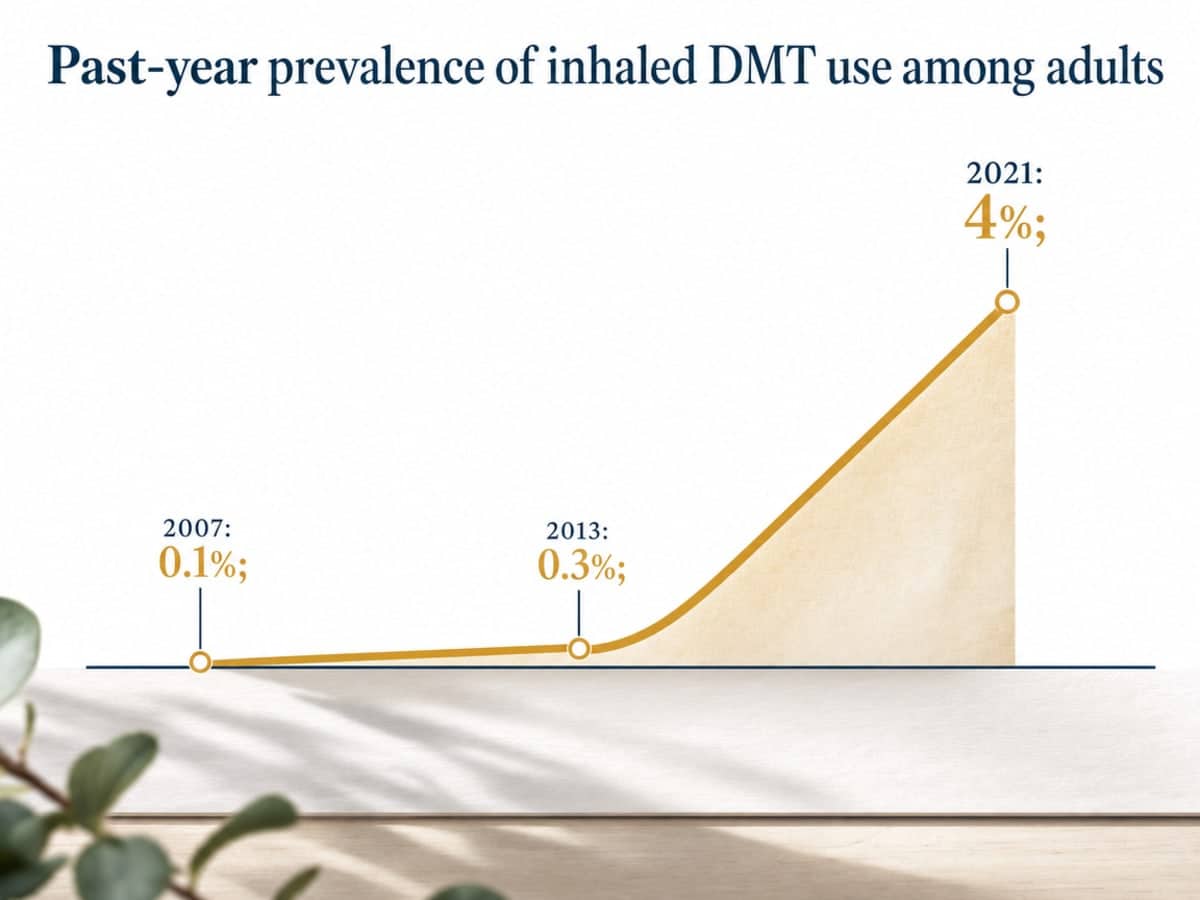
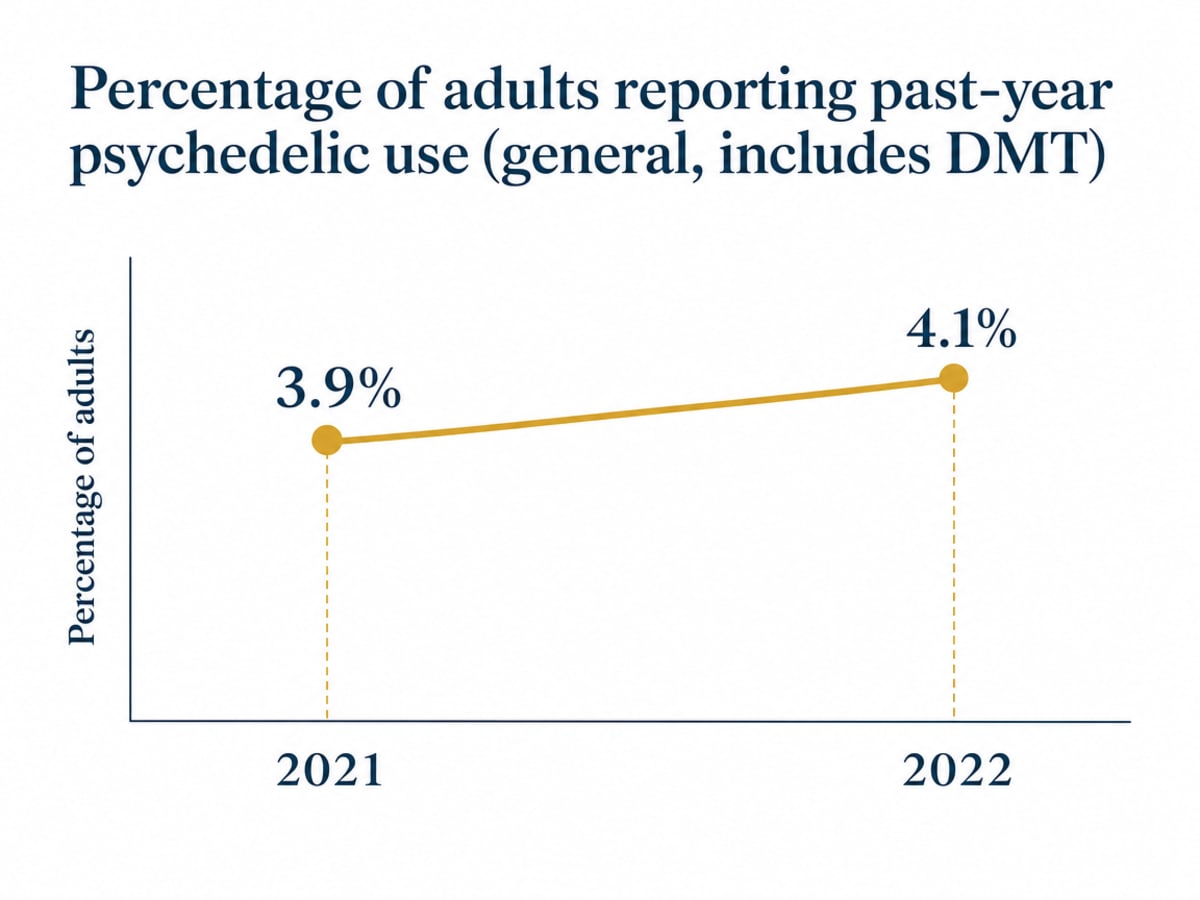
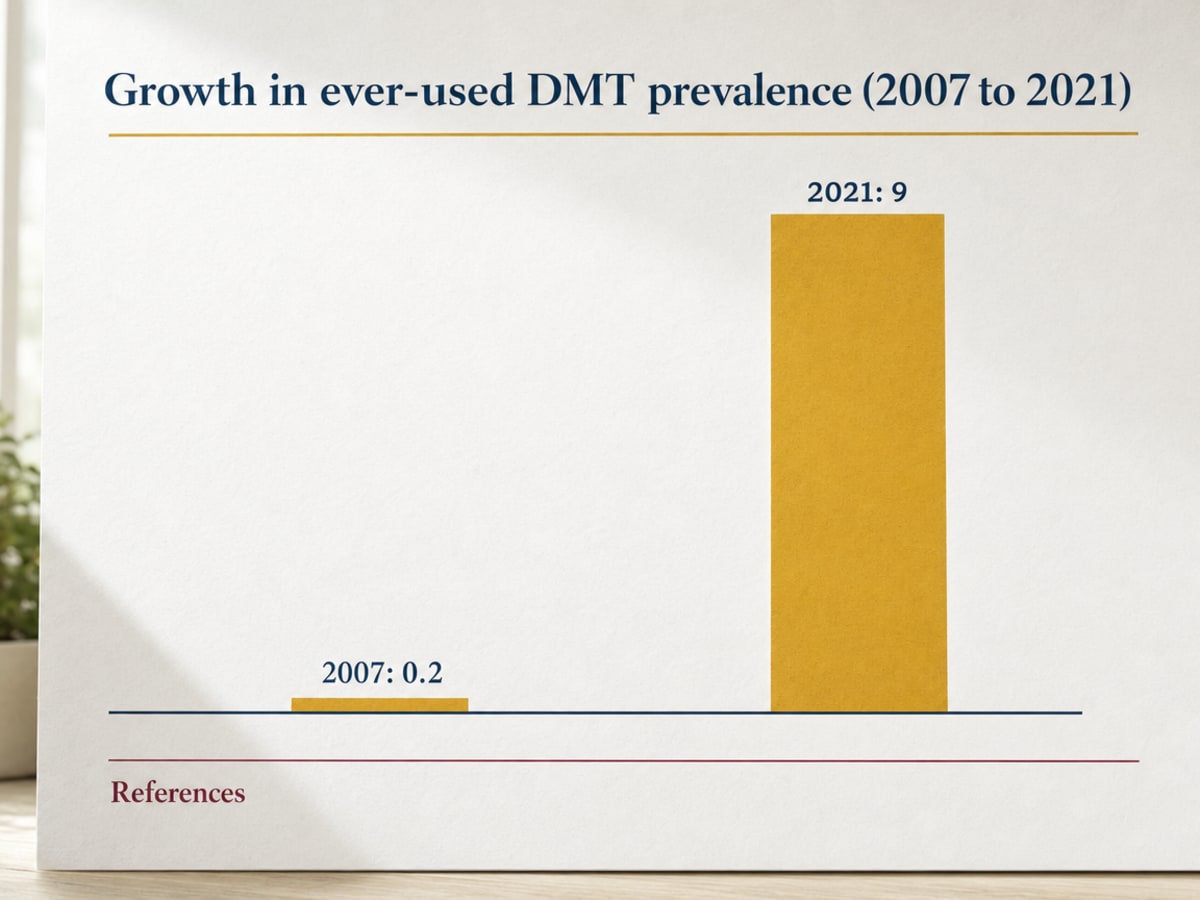
The largest recent study of inhaled DMT use, drawing on a global sample published in 2024, tracked how prevalence has moved over time. Past-year inhaled DMT use among adults surveyed climbed from 0.1% in 2007 to 0.3% in 2013 to 4.0% in 2021 2. That’s the population reporting they smoked or vaporized DMT in the last twelve months — not a niche subculture anymore, but a much wider group that now includes people who found it through friends, festivals, and social media rather than through decades of psychedelic reading.
Here’s the piece that changes the risk picture. The people showing up in that 4% are rarely using DMT in isolation. Many are already using other substances — cannabis, alcohol, stimulants, opioids, benzos — sometimes in the same night, sometimes across the same week. If you’re reading this and that describes you, you’re not an outlier. You’re closer to the norm of who’s actually smoking DMT right now.
That matters for two reasons. First, the acute cardiovascular load DMT puts on you in the first two minutes doesn’t get canceled out because you’ve been drinking or because your tolerance to other drugs is high. If anything, a body already managing another substance has less margin. Second, and this is the harder part to hear: when DMT gets folded into an existing pattern of use, it usually stops being the “occasional spiritual thing” the story sold you on. It becomes another tool in the rotation. That shift often happens without a decision, without a moment you can point to. One day you notice you’ve been reaching for the pipe on Tuesdays for reasons that have nothing to do with insight.
None of that makes you bad at using drugs, or bad at anything. It makes you human, and it makes the risk math different than the version most articles about DMT are willing to write down.
The Tolerance Trap: Why DMT Slips Into an Existing Pattern
Most drugs make you wait. Use them too close together and the effect fades — your body has adjusted, and you need more, or a break, or both. That built-in speed bump is one of the small mercies of pharmacology. DMT doesn’t have it.
Think about how that plays out on a Friday night. You take a hit, come back to the room, and the window is still open. Nothing in your body is saying wait. If you’re already someone whose relationship with substances runs on the logic of “a little more won’t hurt,” DMT hands you permission that other drugs refuse. The cardiovascular strain from the first hit hasn’t fully resolved 13, but the subjective reset makes it feel like it has.
Here’s the part NIDA is honest about: long-term effects and addiction liability for DMT are not well characterized 1. That’s not the same as saying it’s non-addictive. It means the research hasn’t caught up to the people already living the answer. If you’re smoking it weekly, or reaching for the pipe on days that have nothing to do with curiosity anymore, you already have data the studies don’t.
“But Isn’t DMT Being Studied for Depression?”
Supervised Research Is Not a Bathroom or a Friend’s Couch
This is the counter-argument that keeps the pipe in the drawer instead of the trash. You’ve seen the headlines. Researchers are studying DMT for depression. Trials are running. If a hospital thinks it’s promising, how bad can a couple of hits at home really be?
Here’s the honest gap. The FDA published its first draft guidance on clinical trials with psychedelic drugs in 2023, laying out how these studies are supposed to be designed 6. That guidance exists precisely because psychedelics are not being handed out casually — they’re being tested under strict protocols, with screening, monitoring, and trained clinicians in the room. Registered trials like NCT04353024 and NCT06671977 evaluate DMT’s safety, tolerability, and effects in healthy subjects and in people with depression under exactly those conditions 16, 17. A recent phase-1 study of vaporized DMT reported that physiological parameters increased transiently within safe limits and adverse events were mild and transient — but the participants were screened, dosed by researchers, and watched the whole time 18.
None of that maps onto smoking DMT in a bathroom. On top of the clinical distance, DMT is a Schedule I substance, meaning federal law classifies it as having no currently accepted medical use and a high potential for abuse 7. The research is not permission. It’s the opposite — it’s the reason you’re not supposed to be self-dosing while it’s still being figured out.
Preexisting Conditions Change the Risk Math
Here’s the part of the research picture that gets left out of most headlines, and it matters most for anyone reading this while in active use.
If you’re smoking DMT while managing depression, anxiety, PTSD, bipolar disorder, a history of psychosis, or an active substance use disorder — and if any of those describe you, you are exactly who this article is for — you are not the person the reassuring headlines were written about. You’re in the group where the risk numbers change.
That doesn’t mean something bad will happen. It means the “it’s being studied, so it must be fine” argument doesn’t cover you. The studies flagging the higher risk are the same ones being pointed to as evidence of promise. Both things are true. The honest read is that co-occurring conditions shift the math, and pretending otherwise is how people get hurt.
Is Smoking DMT Addictive? An Honest Answer
The internet is full of people insisting DMT can’t be addictive. The pharmacology is unusual, they’ll say. It doesn’t build tolerance the way opioids do. It doesn’t wire the brain toward compulsive use the way stimulants do. Some of that is true. Some of it is the reassurance people repeat when they’re not ready to look at their own week.
Here’s what the science actually says, straight. NIDA states plainly that the long-term effects of DMT and its addiction liability are not well characterized 1. Not “proven non-addictive.” Not well characterized. That’s a research gap, not a clean bill of health. Anyone telling you DMT is definitely non-addictive is filling in a blank the studies haven’t filled in yet.
The pharmacology adds a wrinkle. DMT does not induce tolerance to its psychological effects, even with closely spaced repeated use 11. That’s often quoted as proof it’s safe to keep using. Read it the other way. If nothing in your body pushes back against a second, third, or fourth hit, the only brakes are the ones you bring to the room. If you’re already in active addiction, those brakes have been worn down by something else.
Addiction isn’t only about a molecule hijacking receptors. It’s about a pattern that keeps repeating even when you’ve decided it shouldn’t. If DMT has become that pattern for you — reached for on schedule, used to feel less of something, used more often than you meant to — the label matters less than what’s already happening.
Signs Use Has Become a Problem
Here’s the honest test, and it has nothing to do with how often you smoke or how much. It’s about whether the pattern is running you, or you’re running it.
Some things worth noticing, without judgment:
- You reach for the pipe on days that have nothing to do with curiosity or connection — bored Tuesdays, hard afternoons, the moment a hard feeling shows up.
- You’re smoking DMT alongside other substances more often than not, and the mix has crept up quietly 2.
- Sessions have ended in ways that scared you — a chest that wouldn’t stop pounding, a person you love pulling back, an hour you can’t fully account for 12, 15.
- You’ve told yourself you’d stop or slow down and then didn’t.
- You’ve felt anxiety, low mood, or intrusive thoughts stick around longer between sessions than they used to 1.
- The people closest to you have said something, even carefully, even once.
If more than one of those is nodding at you, that’s not a character flaw. That’s information. And information is where change actually starts.
What Real Support Looks Like
Talking to Someone Before It Gets Worse
The first conversation is almost always the hardest one. It’s also usually the smallest. You don’t have to walk in with a plan or a diagnosis. You just have to say one true sentence to one person who won’t flinch.
That person doesn’t have to be family. It can be a primary care doctor, a therapist you’ve seen once, a friend who has been through their own version of this, or the nurse on a confidential helpline. What matters is picking someone who can hear “I’ve been smoking DMT and I’m not sure I want to keep doing it” without turning it into a lecture.
A few things worth knowing before you make the call. Bring what you actually use, how often, and what else is in the mix. Mention any chest pain, fainting, or lingering anxiety, since those matter clinically 12. If you have depression, PTSD, or anything else you’ve been managing on your own, say so — it changes what safe next steps look like 5. That’s it. You don’t owe anyone a full story on day one.
Inside Residential Care for Hallucinogen-Related Problems
If DMT use is tangled up with other substances, or with a mental health condition that keeps circling back, residential care is often the setting that gives things a real chance to settle. Here’s what that actually looks like from the inside, in plain language.
You move into a facility for a stretch of time — usually a few weeks to a few months — where medical and clinical staff are on-site around the clock. The first days often involve medically supervised detox if other substances are in play, because coming off alcohol, benzos, or opioids without monitoring is where a lot of the acute danger sits. DMT itself doesn’t produce a classic withdrawal syndrome, but the drugs it tends to travel with often do.
From there, days have a shape. Individual therapy to work on what the use has been covering. Group sessions with people whose stories rhyme with yours. Psychiatric care if there’s a co-occurring condition to treat properly rather than around — which matters, because preexisting neuropsychiatric conditions change the risk math of any hallucinogen exposure 5, and treating both at once is the whole point of dual-diagnosis care. Sleep, meals, and a schedule that isn’t built around the next hit.
What residential care buys you isn’t willpower. It’s distance from the pipe, distance from the people and cues that make it easy, and a team that has seen this pattern before. If any of that sounds like the room you actually need, programs like Arrow Passage Recovery exist to be that room.
Talk to Someone Who Gets DMT Recovery
Connect right now for real answers and support on stopping DMT use safely.
Talk With Someone Who Truly Understands DMT Risks
Get honest guidance on safer alternatives to break the DMT cycle and reclaim your life.
Frequently Asked Questions
How long does a DMT trip actually last when smoked?
When smoked or vaporized, effects begin within seconds. The peak hits around two minutes, and most people are largely back to baseline within 20 to 30 minutes 3, 13. That short window is real. What the short window doesn’t tell you is that your blood pressure, heart rate, and body temperature spiked in the same span 13.
Is smoking DMT addictive?
The honest answer is that the long-term effects and addiction liability of DMT are not well characterized in the research 1. It doesn’t build tolerance the way many drugs do 11, which can make repeated use easier, not harder. If you’re already reaching for it on a pattern you didn’t plan, the label matters less than what’s actually happening.
Can smoking DMT cause a heart attack or seizure?
Clinical trials have reported hypertension, chest pain, breathing difficulties, fainting, and seizures among DMT-related adverse events 12. Experimental work also shows DMT directly affects human heart tissue, increasing the force and rate of contraction 19. Serious cardiac events are not the norm, but underlying heart conditions, polydrug use, or larger doses raise the risk in ways a brief high can hide.
If DMT is being studied for depression, why isn’t smoking it safe?
The FDA’s first draft guidance on psychedelic clinical trials makes clear these studies require screening, controlled dosing, and trained monitoring 6. DMT is also Schedule I, meaning federal law classifies it as having no currently accepted medical use 7. A trial with clinicians in the room is not the same setting as your couch, and the research is not permission to self-dose.
Can smoking DMT trigger lasting psychosis or mental health problems?
DMT can induce transient psychotic episodes that usually resolve within hours 14, but a documented case report describes psychosis leading to real injury and property damage 15. NIDA also notes hallucinogens can cause psychotic-like episodes long after use 1. If you already live with depression, anxiety, PTSD, or a history of psychosis, the risk math shifts against you 5.
How do I know if someone I love needs help with DMT use?
Watch the pattern more than the drug. Are they using DMT alongside other substances, hiding sessions, or coming down anxious for longer than they used to 1? Have any sessions ended with chest pain, injury, or a scared bystander 12, 15? You don’t need certainty to say something. One honest, non-shaming conversation, and an offer to help them make a call, is enough to start.
References
- HALLUCINOGENS AND DISSOCIATIVE DRUGS. https://nida.nih.gov/sites/default/files/hallucinogensrrs3_2015.pdf
- Inhaled Dimethyltryptamine (DMT): Use Patterns and Predictors of …. https://pmc.ncbi.nlm.nih.gov/articles/PMC11997157/
- Psychological and physiological effects of extended DMT – PMC – NIH. https://pmc.ncbi.nlm.nih.gov/articles/PMC10851633/
- Exploratory study of the dose-related safety, tolerability, and efficacy …. https://pmc.ncbi.nlm.nih.gov/articles/PMC9372173/
- Adverse Events in Studies of Classic Psychedelics. https://pubmed.ncbi.nlm.nih.gov/39230883/
- FDA Issues First Draft Guidance on Clinical Trials with Psychedelic Drugs. https://www.fda.gov/news-events/press-announcements/fda-issues-first-draft-guidance-clinical-trials-psychedelic-drugs
- Drug Scheduling – DEA.gov. https://www.dea.gov/drug-information/drug-scheduling
- Diversion Control Division | DEA.gov. https://www.dea.gov/operational-division/diversion
- Neuropharmacology of N,N-Dimethyltryptamine – PMC – NIH. https://pmc.ncbi.nlm.nih.gov/articles/PMC5048497/
- N, N-Dimethyltryptamine (DMT), an Endogenous Hallucinogen. https://pmc.ncbi.nlm.nih.gov/articles/PMC6088236/
- Why N,N-dimethyltryptamine matters: unique features and …. https://pmc.ncbi.nlm.nih.gov/articles/PMC11576444/
- Ayahuasca and Dimethyltryptamine Adverse Events and Toxicity …. https://pmc.ncbi.nlm.nih.gov/articles/PMC11088222/
- Dose-response study of N,N-dimethyltryptamine in humans. I …. https://pubmed.ncbi.nlm.nih.gov/8297216/
- Risk assessment of ritual use of oral dimethyltryptamine (DMT) and …. https://pubmed.ncbi.nlm.nih.gov/17207120/
- Acute Intoxication following Dimethyltryptamine Ingestion. https://pmc.ncbi.nlm.nih.gov/articles/PMC5848100/
- NCT04353024 | Effects of Dimethyltryptamine in Healthy Subjects. https://clinicaltrials.gov/study/NCT04353024
- Study of the Safety, Tolerability, Electrophysiological Effects and …. https://clinicaltrials.gov/study/NCT06671977
- Safety, tolerability and subjective effects of vaporized N,N …. https://pubmed.ncbi.nlm.nih.gov/40532423/
- Cardiac effects of two hallucinogenic natural products, N,N-dimethyl …. https://pubmed.ncbi.nlm.nih.gov/40000760/