
What to Look For in Sober Living Homes Near Me
Key Takeaways
- The address you move to after inpatient care shapes the next ninety days more than the treatment plan, because structure, peers, and safety replace the supports that ended at discharge.
- Recovery housing outperforms continuing care as usual on abstinence, employment, and income, with one review estimating a net benefit of about +$29,000 per Oxford House resident over two years 3.
- A credible home hands you a written handbook, itemizes fees, and runs a real grievance process with a named contact outside the house manager and no retaliation 1.
- Ask the operator to name its governance model — peer-run, staffed, or clinically integrated — and describe how it meets SAMHSA’s best practices; vagueness about the model usually means there isn’t one 5.
- Walk the kitchen, bathrooms, and bedrooms to verify smoke detectors, naloxone access, medication storage, and a written screening and testing protocol that treats positives as a clinical event, not automatic eviction 5.
- If you carry a co-occurring diagnosis, elevated psychiatric symptoms predict relapse inside the house, so confirm the home can respond when your symptoms shift, not just point you to a meeting 2.
- A home that refuses prescribed buprenorphine, methadone, naltrexone, or psychiatric meds is out of step with current standards and can run into Fair Housing Act and ADA problems 4.
- Peer culture decides whether you stay sober there — sit in the common room, talk to current residents, and look for voluntary recovery involvement rather than mandated participation 10.
The discharge cliff: why your next address matters more than your last one
The day you walk out of inpatient care, something quiet and dangerous happens. The schedule disappears. The locked med cabinet, the 7 a.m. group, the staff who noticed when you went quiet at lunch — all of it ends at the curb. What replaces it is whatever address is written on your discharge paperwork. That address will shape your next ninety days more than your treatment plan does.
You already know recovery is not a graduation. It is a handoff. And the handoff is where people fall. A safe, structured place to sleep is not a soft amenity at this stage; it is the load-bearing wall under everything else you are trying to do — outpatient appointments, psychiatric meds, rebuilding a workday, staying away from the people and rooms that used to end your sobriety.
That is why “sober living homes near me” is the wrong search if “near me” is the only filter. Proximity matters, but it is the fourth or fifth thing that matters. What matters first is whether the home is run like a recovery environment or just rented like one. The rest of this guide walks you through how to tell the difference before you sign anything or move a single box.
What the evidence actually says about recovery housing
Before you tour a single home, it helps to know what the research has actually shown. Not because evidence makes the decision for you, but because it tells you what to demand from the place you choose.
A 2025 systematic review of recovery housing — covering both traditional sober living homes and Oxford House models — found that residents of recovery housing did better than people who got continuing care as usual on the outcomes that matter after discharge: abstinence, income, employment, and criminal charges. The same review estimated a net benefit of roughly +$29,000 per Oxford House resident over a two-year span when you account for healthcare, criminal activity, incarceration, substance use, and employment 3. That is not a marketing number. That is what shows up when researchers add and subtract the real costs of someone’s next two years.
Two things to hold onto from that finding. First, the comparison is against continuing care as usual, which often means outpatient appointments and a return to a home environment that was part of the problem. A structured, sober place to sleep changes that math. Second, the review notes that benefits are not uniform across every subgroup — formerly incarcerated women, for example, show less consistent gains 3. The model has to fit the person, which is exactly what the rest of this guide is about.
Federal agencies have caught up to what the research is saying. HUD now funds recovery housing through a dedicated program authorized by the SUPPORT Act, aimed at states with high overdose mortality 11. That federal recognition matters for one practical reason: it means there is more recovery housing in your area than there was five years ago, and the quality range is wider. Some homes are tightly run and aligned with national standards. Others rented a four-bedroom and hung a sign. Knowing the average outcome is strong is not the same as knowing which house on which street will hold you. That is the work ahead.
The non-negotiables: what every credible home should clear
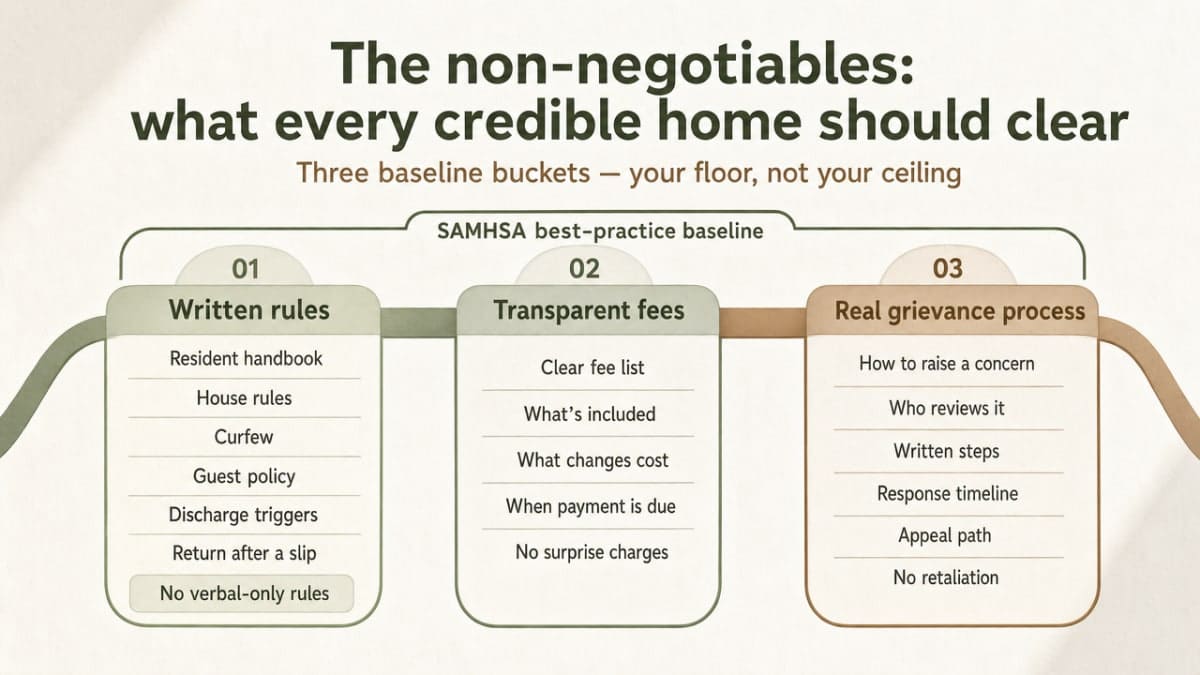
Before you get into clinical fit or peer culture, there are baseline things a credible recovery residence simply has. If a home cannot clear these, you can stop the tour. Everything in this section maps to SAMHSA’s recovery housing best practices, which describe what a competent operator should be doing regardless of size, model, or price 5. Use these three buckets as your floor, not your ceiling.
Written rules, transparent fees, and a real grievance process
Ask for the resident handbook before you sign anything. A credible home hands it to you without hesitation. You want to see written house rules, the curfew, the guest policy, what triggers a discharge, and how someone gets back in after a slip. Verbal-only rules are how favoritism happens and how residents get put out at 9 p.m. with their belongings in a trash bag.
Fees should be itemized. Monthly rent, what it covers (utilities, drug screens, food), the security deposit, and any fee tied to discharge or re-entry. If the manager waves off a question about money, that is your answer.
Finally, ask how complaints are handled. A real grievance process has a named person who is not the house manager, a written timeline, and consequences that do not include retaliation. National quality frameworks treat housing stability and resident voice as measurable outcomes for a reason — homes that take feedback seriously keep people housed 1.
Governance you can name: peer-run, staffed, or clinically integrated
Every recovery residence sits somewhere on a spectrum, and you should be able to name where the home you are touring lands. On one end are peer-run, democratically governed homes — the Oxford House model is the clearest example. Residents vote on admissions, share expenses, and there is no paid staff living in the building. The evidence base for this model is strong: NIH-funded studies have shown higher abstinence rates and better psychosocial outcomes than usual care, including for people with legal histories and co-occurring conditions 7.
In the middle are staffed homes with a house manager (often in recovery themselves), set programming, mandatory meeting attendance, and structured accountability. On the other end are clinically integrated residences, where the home is paired with or operated by a treatment provider and residents are actively engaged in outpatient or PHP-level care from the same organization.
None of these is automatically better. What matters is the match. SAMHSA’s best practices ask any credible operator to define the model clearly, treat substance use disorder as a chronic condition, recognize co-occurring mental disorders, conduct a resident needs assessment, use evidence-based practices, and protect resident rights 5. A peer-run home meets those standards differently than a clinically integrated one, but both should be able to answer the question “how do you do this?” without improvising.
If the home cannot tell you which model it is, that is the signal. Vagueness about governance usually means there is none.
Safety, screening, and substance-free conditions you can verify on a tour
Walk the house. Not the lobby, not the staged living room — the kitchen, the bathrooms, the bedroom you would actually sleep in. Look for working smoke detectors, clean shared spaces, a stocked first-aid kit, and naloxone where staff or residents can reach it. Ask where medications are stored and who has the key.
Ask how the home keeps the environment substance-free. Credible answers include a written screening protocol for new residents, randomized drug and alcohol testing, and a clear policy for what happens after a positive test (which should not always be immediate eviction — a chronic condition deserves a chronic-condition response) 5.
Ask who else lives there. You do not need names, but you should know the house’s intake screening: do they accept anyone with a check, or do they assess whether a candidate is a fit for the current resident mix? Stable, safe living conditions are a prerequisite for recovery, especially if you carry a co-occurring diagnosis 8. A home that cannot describe how it keeps you safe is not one yet.
Clinical fit when you carry a co-occurring diagnosis
If you carry a diagnosis alongside your substance use — PTSD, depression, anxiety, bipolar disorder, or anything else that needs ongoing care — the home you choose is not just a recovery decision. It is a psychiatric one. The next three questions matter more for you than for someone without a co-occurring condition, and a credible home should have answers ready before you ask twice.
Why psychiatric symptoms shape your relapse risk inside the house
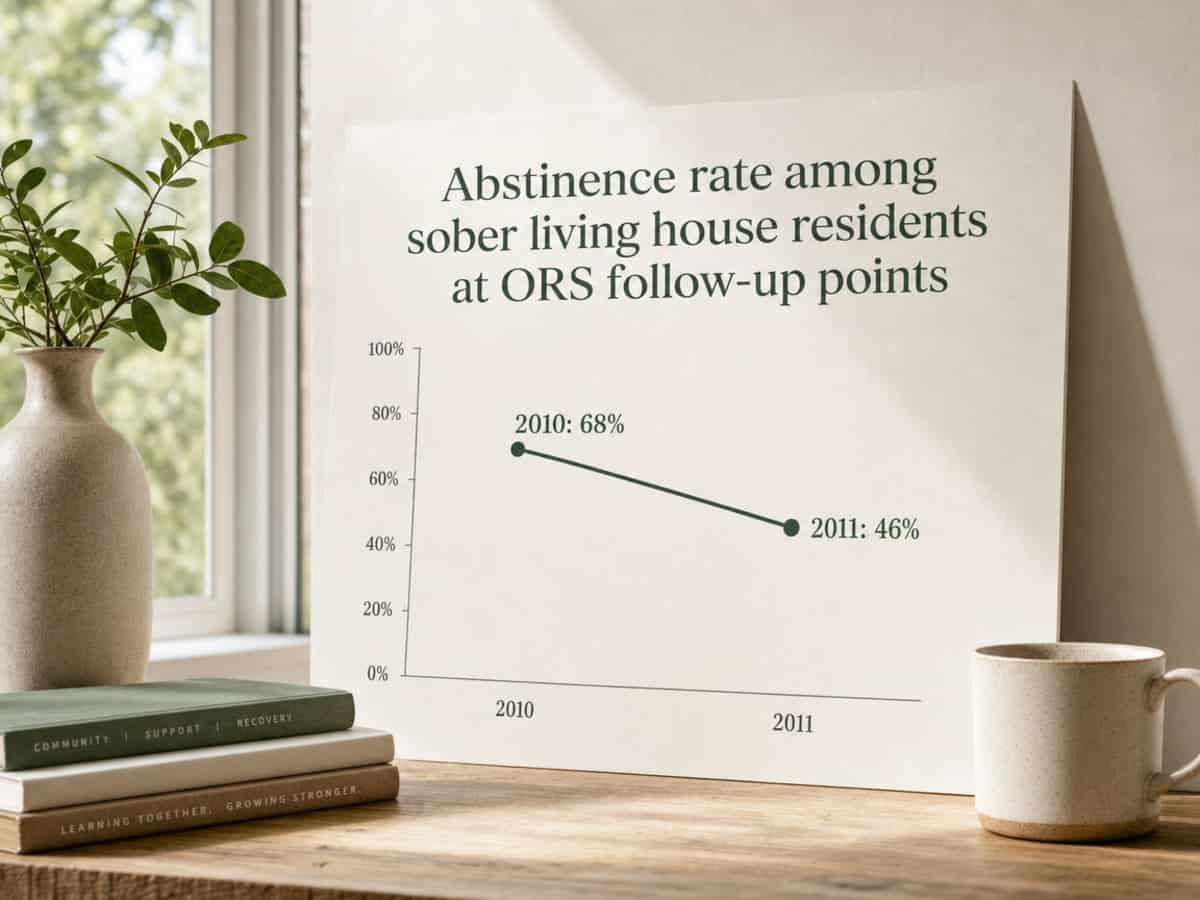
Here is something the brochures will not tell you. In a longitudinal study of residents of sober living houses, researchers tracked psychiatric symptoms over time and found two things that you need to sit with for a minute. Overall psychological distress went down. Depression and phobic anxiety symptoms also dropped over the course of the stay. That is the good news, and it is real — being in a stable, sober environment helps your nervous system catch its breath 2.
The second finding is the one that should shape your tour questions. Residents who carried higher levels of psychiatric symptoms were less likely to stay abstinent. The symptoms themselves predicted relapse risk inside the house 2. Picture it as two lines moving in opposite directions on the same chart: average symptom severity trending down across the population over months, while the residents whose symptoms stayed elevated saw their odds of staying sober drop with each tick.
So when you tour, you are not asking whether the home is nice. You are asking whether it can hold you on the bad days.
Medication policies: prescribed psychiatric meds and MAT
Ask this one early and listen closely: “What is your policy on prescribed medications, including buprenorphine, methadone, and naltrexone?” The answer tells you almost everything you need to know about whether the home understands addiction as a chronic medical condition or as a moral failing dressed up in recovery language.
A credible home accommodates prescribed psychiatric medications — antidepressants, mood stabilizers, antipsychotics, ADHD meds, sleep meds when clinically indicated. It also accommodates medication for opioid or alcohol use disorder. SAMHSA’s recovery housing best practices treat substance use disorder as a chronic condition requiring a range of supports, and they explicitly recognize that co-occurring mental disorders often travel with it 5. A home that refuses MAT is telling you it does not follow current standards.
It is also telling you something about your legal protections. Under federal civil rights law, residents with substance use disorder are people with disabilities, and blanket bans on prescribed medication can run into Fair Housing Act and ADA problems 4. You do not need to wave a statute at the house manager. You just need to hear them describe a workable plan: where meds are stored, who supervises self-administration, and how they coordinate with your prescriber.
Coordination with outpatient and psychiatric care
A sober living home is not a treatment provider. It is the place you sleep while you do the treatment. The question is whether the home actively connects to the care you need or just hands you a bus pass.
Ask how the home coordinates with outpatient programs, IOP, PHP, and psychiatric providers. Concrete answers sound like this: “We have releases of information on file with your outpatient team. We track appointment attendance. If you miss two sessions, the house manager talks to you and loops in your therapist with your permission.” Vague answers sound like: “We encourage residents to stay in treatment.”
Ask whether they conduct a needs assessment at intake and revisit it 5. Ask what happens when someone’s psychiatric symptoms escalate at 11 p.m. on a Tuesday — who gets called, what the protocol is, where you go. Recovery housing works best when it is woven into a continuum of care, not when it sits next to one 3. The seam between your bed and your therapist is where people get lost. A good home closes it.
Peer culture: the part that doesn’t show up on the website
You can read a home’s rules, check its license, and verify its standards, and still miss the thing that will decide whether you stay sober there. Who else lives in the house. What they talk about at the kitchen table. Whether the man two doors down is six months in and steady, or three weeks in and white-knuckling. The culture inside a recovery residence is not on the website, and it is not in the handbook. You have to feel for it.
Research on sober living outcomes keeps landing on the same point: 12-step involvement and the composition of a resident’s social network are strong predictors of how things go 6. That is not a vote for any one program. It is a vote for environment. The people you eat dinner with are doing some of the work your therapist used to do. If they are showing up to meetings, holding each other accountable, and treating early sobriety as a shared project, that pulls you forward. If they are mostly there because a court or a family ultimatum put them there, you will feel that too.
So when you tour, stay past the manager’s pitch. Ask if you can sit in the common room for fifteen minutes. Notice whether residents make eye contact, whether anyone introduces themselves, whether the TV is the loudest thing in the building. Ask a current resident — not the manager — what a typical Wednesday night looks like. Ask how many people in the house are currently working a program, and which ones. A home that bristles at that question is telling you the culture is not something it has paid attention to.
One more thing. Credible operators understand that participation in recovery activities has to be voluntary to actually work 10. A home that mandates a specific fellowship and punishes anyone who attends a different meeting is mistaking control for culture. You want a house where the peer pull is strong because the people there chose it, not because the rules forced it.
Operational signals: what to ask the house manager
The house manager will tell you a lot about a home in the first ten minutes — not by what they pitch, but by how they answer specific questions. You are listening for fluency. A good operator can describe how the house actually runs without reaching for a brochure.
Start with what they measure. Ask: “What outcomes do you track for your residents?” A credible answer includes things like length of stay, housing stability after discharge, employment, return to use, and engagement with outpatient care. National quality frameworks for recovery housing point to exactly these domains — housing stability, abstinence, employment, and recovery capital — as the things competent operators should be able to talk about 1. If the answer is “we don’t really track that,” you have learned something.
Then ask about staffing. Who is awake overnight? What is the manager’s training in recognizing a mental health crisis or an overdose? When was the last time naloxone was used in the house, and what happened next? You are not trying to trap anyone. You are checking whether the people running the building have rehearsed the hard moments.
Ask how new residents are oriented in the first 72 hours — intake assessment, meeting schedule, introduction to housemates, contact with outside providers. Ask how they handle a slip versus a pattern. Ask what they do when a resident loses a job, or a parent dies, or the medication stops working. The answers should sound lived-in, not improvised.
Red flags during a tour
By now you know what good looks like. Here is what bad looks like, so you can spot it inside the first twenty minutes.
- The manager cannot produce a written handbook, or the rules “depend on the situation.”
- Fees are quoted verbally and shift when you ask twice.
- The home refuses prescribed buprenorphine, methadone, or naltrexone outright, or treats your psychiatric medications as something to “wean off.” A blanket ban like that is not just outdated — it can run afoul of fair housing and disability law 4.
- There is no coordination with outpatient or psychiatric care.
- The manager cannot tell you what they would do at 11 p.m. if a resident’s symptoms spiked.
- No one tracks outcomes — not length of stay, not return to use, not employment — even though credible operators are expected to 1.
- The common areas are empty in the middle of the afternoon and no one introduces themselves.
One more. You are pressured to sign today, or a family member is pressured on your behalf. Recovery housing has to be voluntary to work 10. If the home is leaning on you to commit before you have walked the kitchen, that is the loudest red flag in the building. Leave and keep looking.
Your rights as a resident
Here is the short version, because you do not need a law lecture, you need leverage. Federal civil rights law treats people with substance use disorder as people with disabilities under the Fair Housing Act and the ADA. That means a recovery residence cannot blanket-ban prescribed medications like buprenorphine or methadone, cannot refuse you because of your diagnosis, and cannot enforce rules that effectively shut people in recovery out of housing 4.
You also have the right to choose this. Recovery housing is voluntary by design, and credible operators know it. A family member, a referral source, or a court can recommend a home, but the decision to live there is yours 10.
You do not have to memorize statutes. You just have to notice whether the home you are touring acts like it knows the rules. The ones that do will answer questions about medication, discharge, and grievances without getting defensive. That is what a compliant operator sounds like.
Cost, length of stay, and how this fits the household budget
Money is the conversation most families put off until the move-in date, and that is where it bites. Sober living is usually paid out of pocket as a monthly rent, separate from what insurance covers for your outpatient therapy, psychiatric appointments, or IOP. Ask the house for an itemized monthly figure and what it includes: bed, utilities, drug screens, food, transportation to meetings. Then ask what it does not include — co-pays for outpatient care, prescriptions, or program fees that get billed elsewhere.
On length of stay, the honest answer is longer than you think. Peer-run models like Oxford House intentionally set no maximum stay because residents tend to do better when they decide when to leave 7. Six months is a reasonable floor to plan around; a year is not unusual. Build the household budget for the longer number, not the shorter one. If you have to choose between a cheaper home that cannot coordinate with your outpatient team and a slightly costlier one that can, the math from the recovery housing evidence base favors the second 3.
Walking in with the right questions and walking out with a defensible choice
Here is what to bring with you on the next tour. A copy of your discharge plan. The name and contact for your outpatient therapist or prescriber. A short list of your medications. And the questions you have already rehearsed in this guide — about written rules, governance, MAT, psychiatric coordination, what they measure, what they do at 11 p.m. on a hard night.
You are not looking for a perfect home. You are looking for a home that can name what it is, show you how it runs, and connect to the care you are already in. If the manager answers your questions like they have heard them before from someone who knows what to ask, that is a good sign. If they get defensive, vague, or pushy, you have your answer without spending another hour there.
One last thing. The choice in front of you is hard because it matters, not because you are doing it wrong. Take the tours. Trust what you saw in the kitchen. And when you find the home that fits — clinically, culturally, financially — sign the paperwork and start the next part of the work. Long-term aftercare is the project; the right address just makes it possible.
Talk With a Specialist About Sober Living Options
Get immediate guidance on finding the right sober living environment for a successful transition.
Talk Through Your Next Steps in Recovery
Get guidance on finding supportive sober living options that fit your long-term recovery needs.
Frequently Asked Questions
Can a sober living home refuse me if I take medication for addiction or mental health conditions?
A blanket refusal is a problem. Under the Fair Housing Act and ADA, people with substance use disorder are treated as people with disabilities, and policies that ban prescribed buprenorphine, methadone, naltrexone, or psychiatric medications can violate those protections 4. A credible home accommodates prescribed meds, stores them safely, and coordinates with your prescriber 5.
How long should I plan to stay in a sober living home?
Plan for longer than feels comfortable. Six months is a reasonable floor; a year is not unusual. Peer-run models like Oxford House intentionally set no maximum stay because residents tend to do better when they decide when to leave 7. Budget for the longer number so you are not forced to move on someone else’s timeline.
What is the difference between a peer-run home like Oxford House and a staffed or clinically integrated home?
Peer-run homes are democratically governed by residents, self-supporting through shared rent, and have no paid live-in staff. NIH-funded studies show this model produces strong abstinence and psychosocial outcomes, including for people with legal histories and co-occurring conditions 7. Staffed homes add a house manager and structured programming. Clinically integrated homes are paired with a treatment provider for active outpatient care.
What questions should I ask the house manager during a tour?
Ask for the written handbook and itemized fees. Ask about the medication policy, including MAT. Ask how they coordinate with outpatient providers and what happens at 11 p.m. when a resident is in crisis. Ask what outcomes they track — housing stability, return to use, employment, recovery capital are the domains a competent operator should be able to discuss 1.
Will insurance cover the cost of sober living?
Usually not directly. Sober living rent is typically paid out of pocket, while insurance covers the clinical services you receive alongside it — IOP, PHP, psychiatric appointments, medications. Federal funding through HUD’s Recovery Housing Program supports some homes in states hit hardest by overdose 11, but for most residents the monthly fee is a household expense.
What are the clearest red flags that a sober living home is not credible?
No written rules or handbook. Fees that shift when you ask twice. A flat refusal of prescribed medications, which can violate federal civil rights protections 4. No coordination with outpatient or psychiatric care. No outcome tracking, even though credible operators are expected to measure it 1. And pressure to sign today — recovery housing is voluntary by design 10.
References
- Establishing Quality and Outcome Measures for Recovery Housing. https://pmc.ncbi.nlm.nih.gov/articles/PMC11001738/
- Prevalence and Trajectories of Psychiatric Symptoms among Sober Living House Residents. https://pmc.ncbi.nlm.nih.gov/articles/PMC4914417/
- Recovery housing for substance use disorder: a systematic review. https://pmc.ncbi.nlm.nih.gov/articles/PMC11922849/
- Recovery Housing and Civil Rights Laws. https://oneill.law.georgetown.edu/wp-content/uploads/2023/12/ONL_BI20_OPIOD_Recovery_Housing_P5-1.pdf
- EXHIBIT 4.6. Best Practices for Recovery Housing. https://www.ncbi.nlm.nih.gov/books/NBK601481/box/ch4.b20/
- What Did We Learn from Our Study on Sober Living Houses and Where Do We Go from Here?. https://pmc.ncbi.nlm.nih.gov/articles/PMC3057870/
- Oxford House Recovery Homes: Characteristics and Effectiveness. https://pmc.ncbi.nlm.nih.gov/articles/PMC2888149/
- What is known about persons with co-occurring problems of substance use and mental health? A scoping review. https://pmc.ncbi.nlm.nih.gov/articles/PMC11549848/
- The Meaning of Recovery from Co-Occurring Disorder: Views from Consumers and Staff Members Living and Working in Housing First and …. https://pmc.ncbi.nlm.nih.gov/articles/PMC4570491/
- Housing First and Recovery Housing Cal ICH Guidance. https://bcsh.ca.gov/calich/meetings/materials/recovery_housing_guidance.pdf
- HUD launches Recovery Housing Program to aid Americans recovering from substance use disorder. https://archives.hud.gov/news/2020/pr20-198.cfm
- Supporting Needed Research on Recovery. https://nida.nih.gov/about-nida/noras-blog/2022/09/supporting-needed-research-recovery