
Key Takeaways
- Sober living in Cleveland spans peer-run homes to clinically staffed residences, and only those on Ohio’s Department of Behavioral Health registry follow the written protocols required under ORC 340.034 12.
- Neighborhood exposure matters: four Cleveland ZIP codes accounted for 46.3% of Q3 2025 overdose events while holding about 37% of the population, so weigh proximity to triggers against access to treatment and meetings 9.
- Length of stay drives outcomes. The risk of walking out drops sharply after six weeks 6, and staying six months or longer is linked to more abstinent days and fewer legal problems 7.
- Before signing, compare NARR level, organizational and treatment affiliation, MAT policy, and response to a return to use, since affiliated homes show roughly four times the odds of total abstinence 2.
What Cleveland Parents Are Actually Choosing Between
If you’re reading this, you’re probably running on fumes. Your son or daughter finished detox, maybe wrapped up a stretch of residential care or IOP, and now the discharge planner is asking where they’re going to live. That question hits harder than most people outside your house will ever understand.
Here’s the honest frame. Sober living in Cleveland isn’t one thing. It’s a spectrum that runs from a peer-run house on a quiet street in Old Brooklyn to a clinically staffed residence connected to an outpatient program. Some homes are certified through Ohio’s registry and follow written protocols. Some are just landlords with a slogan. The difference shows up in whether your child stays, gets a job, keeps their meds, and builds a life you recognize again.
The stakes are also geographic. In Q3 2025, four Cleveland ZIP codes— 44102, 44105, 44109, and 44111—accounted for 46.3% of the city’s overdose events while holding roughly 37% of the population 9. Your child’s block matters. This guide walks you through what a well-run recovery residence looks like under Ohio’s rules, how long a stay should realistically last, and how to stay steady when the road gets bumpy.
Recovery Housing Under Ohio’s Rules, Not the Marketing Version
How Ohio Defines a Recovery Residence in 2025
Ohio actually writes down what a recovery residence is supposed to be, which helps you cut through the glossy websites. Under Ohio Revised Code Section 340.034, a recovery housing residence has to follow written protocols, submit to monitoring by the Ohio Department of Behavioral Health, and maintain quality standards through the local board 12. That’s not a marketing badge. That’s a legal frame you can hold an operator to.
Two pieces of that law matter most to you right now. First, a certified home cannot cap your child’s stay at some arbitrary number of days. If a place tells you “everyone leaves at 90 days, no exceptions,” they’re out of step with the statute 12. Second, the law explicitly permits residents to continue medication-assisted treatment and certified addiction services while living there 12. If your son is on buprenorphine or your daughter is stable on naltrexone, a house that quietly discourages MAT is not the right home, and it’s not the Ohio standard.
NARR Levels 1-4 and What Each One Looks Like Day to Day
Ohio’s Department of Behavioral Health publishes a statewide registry that classifies every certified recovery residence using the four NARR levels, paired with ASAM types P, M, S, and C 13. That sounds like alphabet soup. In your kitchen, it translates to how much structure your young adult is walking into.
- Level 1, Type P (Peer-run).
- A democratically run home with no paid staff on site. Residents run house meetings, hold each other accountable, and share chores. Best for someone stable, working or in school, and ready for a lot of personal responsibility 13.
- Level 2, Type M (Managed).
- A house manager lives on site or is closely involved. There are clear rules, curfews, drug testing, and required meeting attendance, but no clinical services in the home 13. This is where many young adults land after residential treatment.
- Level 3, Type S (Supervised).
- Paid staff, supervised activities, and life-skills programming built into the daily schedule. Think budgeting classes, job coaching, and structured evenings 13. A good fit for a young adult who hasn’t lived independently or who is rebuilding basic routines.
- Level 4, Type C (Clinical).
- Clinical services are included on site. This looks more like a residential program with housing attached 13. It’s the highest level of structure and usually a shorter stop before stepping down.
Your child doesn’t need the most intense level to succeed. They need the level that matches what they can actually handle this month.
Recovery Housing vs. Supportive Housing vs. Treatment
These terms get thrown around interchangeably, and that confusion costs families real money and time. SAMHSA draws a clear line: recovery houses are safe, family-like, substance-free environments centered on peer support and connections to outside services 15. They are not treatment. They are where your child lives while they get treatment somewhere else, holds a job, and rebuilds a schedule that doesn’t revolve around using.
Supportive housing is different again. It’s designed around choice and equitable access for people with behavioral health conditions and doesn’t require abstinence in the same way 15. And treatment, meaning IOP, PHP, or residential care, is the clinical work: therapy, medication management, group counseling.
For most Cleveland families, the pattern that works is a recovery residence at Level 2 or 3 layered with outpatient treatment during the day. Two different providers. One coordinated plan.
How to Tell a Well-Run Home From a Risky One
The Questions to Ask the House Manager Before You Sign
Tour the house. Sit at the kitchen table. Then ask these questions and watch how comfortable the house manager is answering them.
Can I see your written protocols and house rules? Ohio law requires a certified residence to have them in writing 12. A manager who fumbles for a copy or promises to email it “later” is telling you something.
Are you listed on the Ohio Department of Behavioral Health statewide registry, and what NARR level are you? Certified homes appear on the registry with a specific Level 1 through 4 designation 13. If the answer is vague, that’s your answer.
How do you handle medication-assisted treatment? Ohio explicitly permits residents to continue MAT while in a recovery residence 12. A house that discourages buprenorphine or naltrexone is out of step with state rules and current clinical practice.
What happens if my child returns to use? A thoughtful manager will describe a graduated response, not an automatic discharge. Immediate eviction on a first slip is a red flag.
How do you connect residents to outside treatment, meetings, and work? Look for named partners, not “we tell them to find something.”
Who owns the house, and who supervises the manager? You want an accountability chain, not a single charismatic person running everything solo.
If the answers feel rehearsed or defensive, keep looking. A well-run home welcomes these questions because they get asked all the time.
Why Organizational and Treatment Affiliation Matters
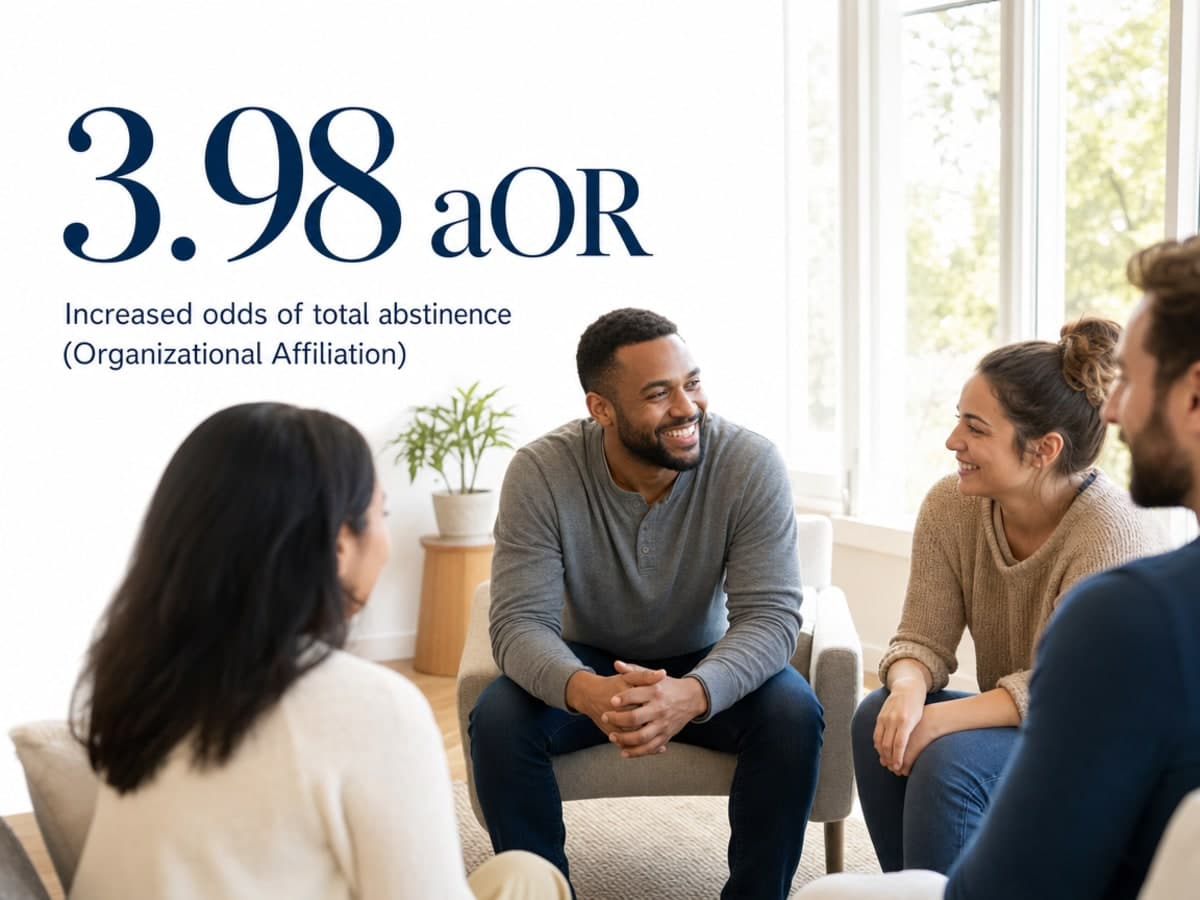
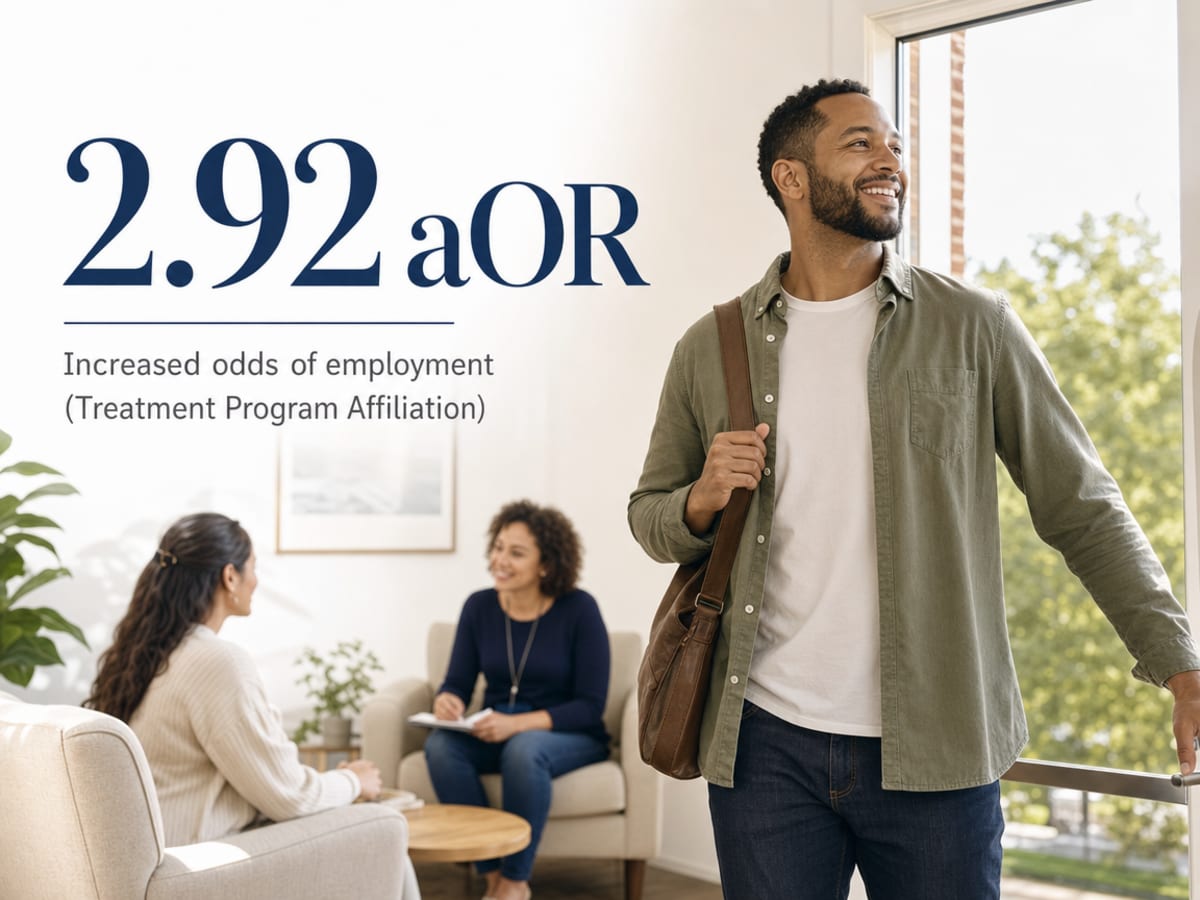
A standalone house run by one owner can be lovely on the tour and still be a coin flip for your child. The research on this is unusually clear. In a multilevel analysis of 330 residents across 49 sober living houses, being in a home affiliated with a larger organization was linked to roughly four times the odds of total abstinence (adjusted odds ratio 3.98) and about three times the odds of drug abstinence (aOR 3.19) compared to unaffiliated homes. Homes with formal treatment-program partnerships showed nearly three times the odds of employment (aOR 2.92) 2.
Read those numbers the way a clinician would. They don’t guarantee your daughter stays sober because the house has a logo on the door. They describe a pattern: homes tied to organizations and treatment providers tend to have better protocols, more consistent staff, clearer referral pathways, and someone above the house manager who answers when things go sideways.
What does affiliation look like in practice? A house that has a memorandum of understanding with a local IOP. A manager who can text your son’s counselor the same afternoon. A parent organization that trains staff and runs quality reviews. In Cuyahoga County, ask directly which outpatient programs, hospital systems, or recovery organizations the house works with. If the honest answer is “none,” weigh that against the odds ratios above.
SAMHSA’s Quality Benchmarks in Plain English
SAMHSA’s 2023 guidance lays out 11 best practices for recovery housing, and you don’t need to memorize them. A handful translate directly into things you can look for on a tour 14.
Recovery-centered and person-centered. The house exists to support your child’s recovery goals, not to fill beds. Ask how they individualize expectations.
Social-model oriented. Peer support and shared responsibility are the engine. You should see house meetings on the schedule and residents involved in running the place.
Trauma-informed. Staff understand that many young adults in recovery carry trauma. Rules are firm but not punitive. Discipline doesn’t look like humiliation.
Equity-promoting. The home welcomes LGBTQ+ residents, people on MAT, and residents with co-occurring mental health conditions without asterisks.
Committed to certification and evaluation. They can name their certifying body and show you outcomes they track.
Bring the list. Ask which of the 11 the house explicitly follows and how they’d prove it. Operators who take the standards seriously will be relieved you asked.
Choosing the Right Neighborhood in Cuyahoga County
Location is not a detail. It’s part of the treatment plan. A recovery residence three blocks from your child’s old dealer is going to work differently than one across town, even if the house itself is identical.
Cleveland’s overdose data makes the geography plain. In Q3 2025, four west- and south-side ZIP codes—44102 (Detroit-Shoreway), 44105 (Slavic Village), 44109 (Old Brooklyn/Brooklyn Centre), and 44111 (West Park)—accounted for 46.3% of all overdose events in the city while holding about 37% of the population 9. That doesn’t mean recovery is impossible in those neighborhoods. Plenty of strong homes operate there, closer to the outpatient providers, peer supports, and hospital systems that serve people most affected. Community context research is clear that a house’s relationships with its block matter as much as what happens inside 4.
What you’re actually weighing is exposure versus access. Ask the house manager how residents get to IOP appointments, 12-step or SMART meetings, and work. Is there an RTA line nearby? Are there recovery meetings within walking distance? For a young adult without a car, a house in a quieter part of Lakewood, Parma, or the east-side suburbs may add a commute but reduce daily triggers. A west-side home closer to services may be the right call if it’s tied to a strong outpatient partner. Walk the block with your son or daughter before signing. Their gut read matters here.
Length of Stay: Why Six Weeks and Six Months Are the Numbers That Matter
The First Six Weeks Are the Fragile Ones
The early stretch of a sober living stay is where most parents get scared and most residents wobble. New house, new roommates, new rules, and a body still resettling after treatment. Your son might call you on day nine and say the place is terrible and he wants to come home. Your daughter might go quiet for a week and then say she’s ready to try it on her own. That pull is normal. It’s also the exact moment to hold steady.
Here’s what the research shows. In a recent analysis of recovery home stays, the hazard of a resident leaving dropped to about 25% of its early level once they had lived there for six weeks 6. Translated to the kitchen: the risk of walking out is highest in the first month and a half, and it falls off sharply after that. Those six weeks are the crossing. If your child can get through them, they’ve done something meaningful, and the odds of staying long enough to see real progress climb significantly.
Why Six Months Is the Outcome Threshold
Six weeks gets your child rooted. Six months is where the outcomes actually change.
A 2023 study of sober living residents found that staying six months or longer, what researchers called stable residence, was linked to more percent days abstinent and lower odds of ongoing substance use disorder and legal problems compared to residents who left earlier 7. The people who stayed didn’t just avoid using longer. They came out with measurably better mental health and fewer entanglements with the court system.
That’s a hard sell in the middle of a Cleveland winter when your daughter is texting you that she’s ready to move in with a friend and “be fine.” But six months is roughly what it takes for new routines to feel like her own instead of borrowed rules. Meetings become people she knows. A job becomes a paycheck she counts on. A sponsor becomes a phone call she actually makes.
Set the expectation with your young adult before move-in day: the plan is six months, not thirty days. If life shifts and they need longer, that’s a good sign, not a setback.
What Realistic Progress Looks Like in Year One
Progress in year one is quieter than most parents expect. It rarely looks like a movie montage. It looks like your daughter making it to her Tuesday IOP three weeks in a row, or your son texting you a photo of a paycheck stub from a warehouse job in Brooklyn Heights.
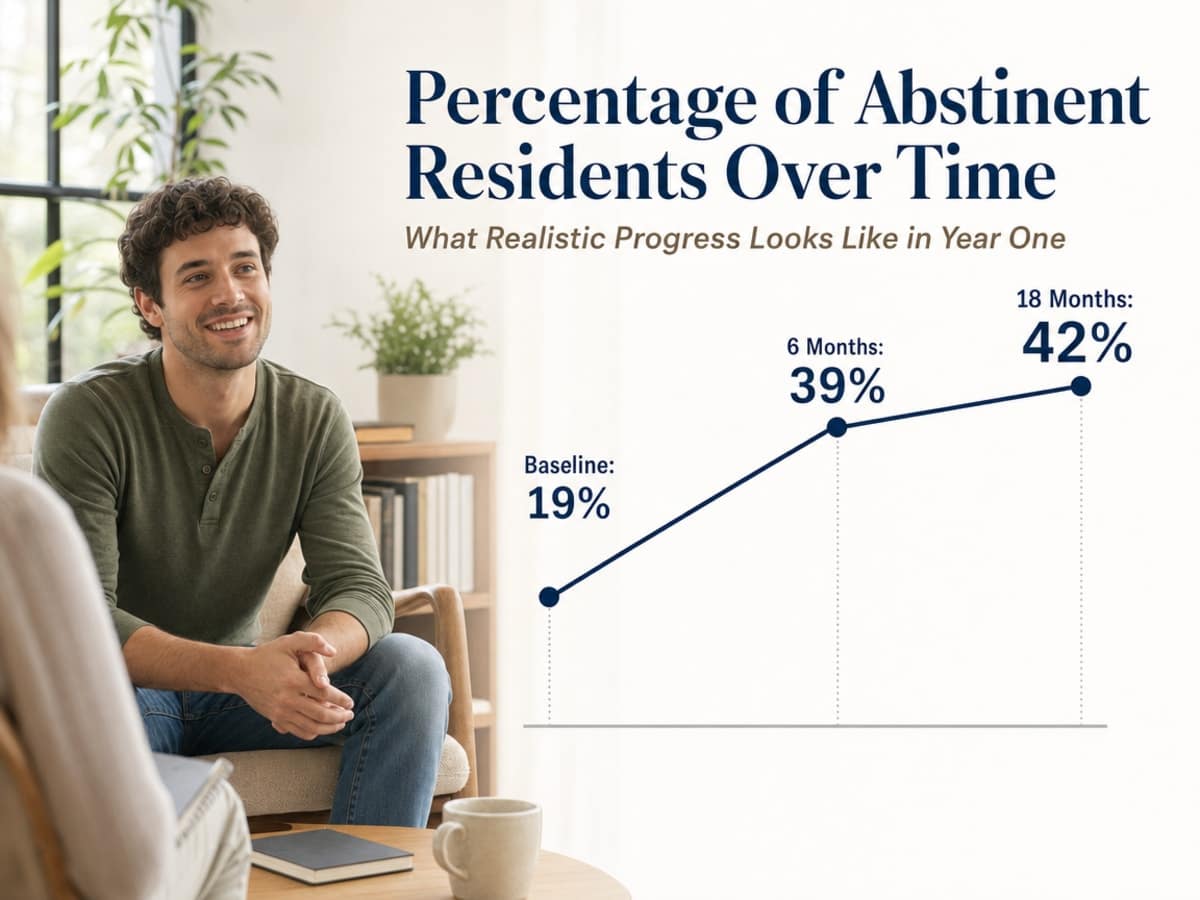
The research gives you a realistic yardstick. In a long-running study of sober living residents, the share of people abstinent in the prior six months climbed from 19% at baseline to 39% at six months and 42% at eighteen months. Peak days of substance use per month dropped from 18.8 to 10.4 by the six-month mark 1. Read that carefully. A lot of young adults are not fully abstinent at six months, and they are still improving in real, measurable ways. Fewer using days. Fewer crisis calls. More steady mornings.
Ohio-specific data echoes the pattern. Residents in Ohio Recovery Housing–affiliated homes show rising recovery capital scores and fewer returns to the justice system over time 11. Celebrate the small wins out loud. A week of meetings, a repaired conversation at Sunday dinner, a first bus pass paid for with their own money. Those are the year-one milestones that actually predict year two.
When a Return to Use Happens: Reading It as Data, Not Failure
Here’s the part no one wants to talk about at family night. Slightly over half of sober living residents, about 55%, report some substance use within the first six months of entry 17. Read that number and take a breath. It doesn’t mean the house failed. It doesn’t mean your child failed. It means a return to use is a common event on the recovery road, not the end of it.
What actually matters is what happens next. The same research on relapse and recovery capital shows that residents who stay engaged in the house and keep building resources like peer support, employment, and stable routines can still improve their long-term functioning, even after a slip 17. The people who lose ground are usually the ones who disappear from the house, the meetings, and the outpatient program at the exact moment they need those things most.
So if you get the phone call, try not to lead with punishment or panic. Ask your son or daughter if they’ve told the house manager and their counselor. Ask what the graduated response looks like under the house’s protocols. Then let the plan work.
Your Role as a Parent Through the First Six Months
You are not the counselor. You are not the house manager. Your job for the next six months is quieter and, honestly, harder: stay steady, stay in touch, and stay out of the middle of things that aren’t yours to fix.
A few practical moves that actually help. Show up for family sessions when the outpatient program offers them. Keep your Sunday call or Wednesday coffee predictable so your daughter knows when to expect you. Ask about her sponsor, her meetings, her work schedule, not just whether she used. Learn the names of two or three people in the house. When your son calls at week three saying the place is unfair, listen first, then point him back to the house manager and his counselor instead of solving it for him.
Take care of yourself, too. Al-Anon and Nar-Anon meetings run all over Cuyahoga County, and a therapist of your own is not a luxury this year. Ohio Recovery Housing–affiliated residents build recovery capital over time when the people around them stay engaged rather than hover 11. Steady presence beats intensity. Every week you both make it through counts.
What Comes After Sober Living
Sober living isn’t the finish line. It’s the bridge. Somewhere around month five or six, the conversation shifts from “how do we get through this week” to “what does the next year look like.” That’s a good problem to have, and it deserves a real plan, not a shrug.
Aftercare for a young adult usually means a few things working together. Continued outpatient therapy, ideally at a lower intensity than what they’ve been doing. Ongoing medication management if they’re on MAT, which Ohio law protects as part of recovery housing and beyond 12. A peer community that outlasts the house, whether that’s a home group, a SMART meeting, or an alumni network. And a housing step that keeps some structure, maybe a roommate from the house, maybe a supervised apartment, before a fully independent lease.
Talk with your daughter’s counselor and house manager about the step-down eight weeks before her stay ends, not two. The Cleveland winter is long, the first apartment is quiet, and the recovery capital she’s built inside the house is what will carry her out of it.
Talk About Sober Living Support in Cleveland
Get answers and guidance for your family’s next step toward lasting recovery.
Frequently Asked Questions
How do I verify a sober living house in Cleveland is actually certified in Ohio?
Check the Ohio Department of Behavioral Health statewide registry, which lists every certified recovery residence and its NARR level from 1 through 4 13. Then ask the house for its written protocols, which Ohio Revised Code 340.034 requires certified homes to keep on file 12. If a home isn’t on the registry or can’t show you protocols, that’s your answer.
Can my child stay on medication-assisted treatment while living in a recovery residence?
Yes. Ohio law explicitly permits residents of certified recovery housing to continue medication-assisted treatment and other certified addiction services while they live there 12. If a house discourages buprenorphine, naltrexone, or methadone, or asks your son or daughter to taper as a condition of admission, they’re out of step with state rules. Keep looking for a home that supports the full treatment plan.
How long should my son or daughter plan to stay in a sober living house?
Plan for at least six months. Research shows stable residence of six months or longer is linked to more days abstinent and lower odds of ongoing substance use disorder and legal problems compared to earlier exits 7. Shorter stays can still help, but six months is where routines, peer connections, and recovery capital have time to actually take root.
What should I do if my child returns to use while living in a recovery home?
Take a breath first. About 55% of sober living residents report some substance use within six months of entry, and staying engaged in the home while building recovery capital is linked to better long-term outcomes even after a slip 17. Ask if they’ve told the house manager and their counselor, then let the home’s graduated response protocols work. Don’t lead with pulling them out.
What is the difference between NARR Level 3 and Level 4 recovery housing?
Level 3 (Type S, Supervised) has paid staff, supervised activities, and life-skills programming built into the daily schedule, but clinical services happen elsewhere. Level 4 (Type C, Clinical) includes clinical services on site and looks closer to residential treatment with housing attached 13. Level 4 is usually a shorter, higher-structure step before stepping down to Level 3 or 2.
Does it matter which Cleveland neighborhood the sober living house is in?
It matters, but not the way you might think. Some west- and south-side ZIP codes carry heavier overdose burden, and community relationships shape the daily recovery experience 4. That doesn’t rule those neighborhoods out. Strong homes operate near the outpatient providers and peer supports serving those areas. Weigh exposure against access to meetings, work, and treatment, and walk the block together.
References
- What Did We Learn from Our Study on Sober Living Houses?. https://pmc.ncbi.nlm.nih.gov/articles/PMC3057870/
- Sober living house characteristics: A multilevel analyses of factors associated with improved outcomes. https://pmc.ncbi.nlm.nih.gov/articles/PMC6605057/
- Sober living house characteristics: A multilevel analyses of factors associated with improved outcomes. https://pubmed.ncbi.nlm.nih.gov/30665601/
- Community Context of Sober Living Houses. https://pmc.ncbi.nlm.nih.gov/articles/PMC3902663/
- Housing Status, Psychiatric Symptoms, and Substance Use Among Individuals in Recovery from Substance Use Disorders. https://pmc.ncbi.nlm.nih.gov/articles/PMC5646694/
- Understanding Length of Stay in Recovery Homes. https://pmc.ncbi.nlm.nih.gov/articles/PMC11658391/
- Six-month length of stay associated with better recovery outcomes among residents of sober living houses. https://pmc.ncbi.nlm.nih.gov/articles/PMC12841932/
- Expansion and evaluation of level II and III recovery residences for justice-involved individuals in Pennsylvania. https://pmc.ncbi.nlm.nih.gov/articles/PMC11535685/
- Q3 2025 Overdose Report – City of Cleveland. https://www.clevelandohio.gov/sites/clevelandohio/files/health/health/health_statistics/Q3%202025%20Overdose%20Report.pdf
- Drug Overdose Quarterly Report Q1 2025 – City of Cleveland. https://www.clevelandohio.gov/sites/clevelandohio/files/health/health/health_statistics/drug_overdose_quarterly_report_Q1_2025.pdf
- Ohio Recovery Housing: Resident Risk and Outcomes Analysis Using Data Science. https://scholar.smu.edu/datasciencereview/vol7/iss3/9/
- Section 340.034 | Recovery housing. – Ohio Laws. https://codes.ohio.gov/ohio-revised-code/section-340.034
- Statewide Registry – Ohio Department of Behavioral Health and Mental Health Services. https://dbh.ohio.gov/supporting-providers/housing-providers/recovery-housing-residences/statewide-registry
- Best Practices for Recovery Housing. https://library.samhsa.gov/product/best-practices-recovery-housing/pep23-10-00-002
- Housing Supports Recovery and Well-Being: Definitions and Shared Values. https://library.samhsa.gov/sites/default/files/housing-supports-pep24-08-007.pdf
- Ohio Unintentional Drug Overdose Deaths – Quarterly Report (Preliminary Data Q3 2024). https://odh.ohio.gov/wps/wcm/connect/gov/a7816795-869f-4113-808c-dc83d695d188/Ohio+Quarterly+Overdose+Report_Preliminary+Data_For+Release+Q3+2024.pdf?MOD=AJPERES&CONVERT_TO=url&CACHEID=ROOTWORKSPACE.Z18_K9I401S01H7F40QBNJU3SO1F56-a7816795-869f-4113-808c-dc83d695d188-p5.BHiD
- Outcomes among Sober Living House Residents Who Relapse: Role of Recovery Capital. https://pmc.ncbi.nlm.nih.gov/articles/PMC10724373/
- Drug and Alcohol Outcomes of Sober Living Houses. https://pmc.ncbi.nlm.nih.gov/articles/PMC2677754/