
The Stages of Addictions: What Stage Are You In?
Key Takeaways
- Addiction maps onto three frameworks at once: the brain’s binge-withdrawal-craving cycle, the DSM-5 severity count, and the stages of change tracking your readiness 6, 4, 1.
- Where you sit on one map rarely matches the others — someone with severe SUD can be in contemplation, and someone with mild SUD can already be in action.
- Care intensity should match severity: brief intervention for at-risk use, outpatient for mild, IOP or PHP for moderate, and medically supervised detox plus residential for severe 2, 5.
- When anxiety, depression, or trauma is part of the picture, integrated treatment that addresses both at once is what holds — sequential care rarely does 2.
Why One Stage Model Isn’t Enough
If you’re reading this trying to figure out where you are, you’ve already done something most people avoid. That counts.
Here’s the thing nobody tells you up front: addiction doesn’t have one neat set of stages. It has three different maps, and they each answer a different question. One map describes what’s happening inside your brain as use repeats itself 6. Another counts symptoms to sort severity into mild, moderate, or severe 4. A third tracks what your mind is doing about the problem — whether you’re not thinking about change, thinking about it, or actively working on it 1.
You can sit in a different spot on each one. Someone can have a moderate substance use disorder on paper, a deeply grooved brain cycle, and still be in the earliest stage of thinking about change. That’s normal. It’s also why a single funnel from “casual” to “rock bottom” gets so much wrong.
The rest of this article walks you through all three maps, helps you locate yourself honestly on each, and shows what kind of care actually fits where you are right now — especially if anxiety, depression, or trauma is part of the picture.
Three Maps That Describe Where You Are
The Brain Cycle: What’s Happening Underneath
The first map doesn’t ask how often you drink or whether you’ve tried to quit. It asks what your brain is doing on repeat.
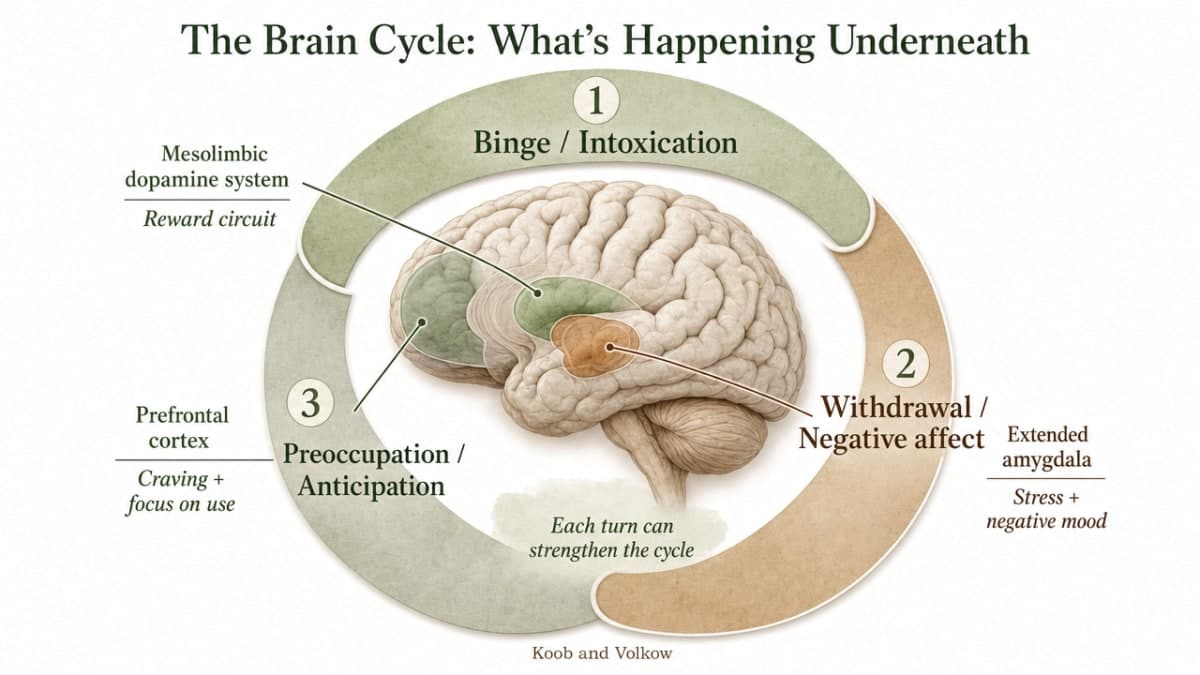
Researchers George Koob and Nora Volkow describe addiction as a three-stage cycle that grows deeper with each turn: binge/intoxication, withdrawal/negative affect, and preoccupation/anticipation 6. Each stage lives in a different part of the brain, and each one gets stronger the more times you run the loop.
Stage one is the part most people picture when they hear the word “addiction” — the using itself. The substance hits the mesolimbic dopamine system, the brain’s reward circuit, and you feel relief, energy, calm, whatever it is you came for 6. Early on, this stage runs the show.
Stage two is the one nobody warns you about. When the substance leaves your system, the extended amygdala — the brain’s stress and threat center — turns up the volume 6. You feel anxious, irritable, flat, achy, off. Sunday mornings get heavier. The 3 p.m. crash gets sharper. You’re not just chasing the high anymore; you’re trying to stop feeling bad.
Stage three lives in the prefrontal cortex, the part of you that plans, weighs, and says no 6. As the cycle deepens, this circuit gets quieter. Craving and anticipation get louder. You find yourself thinking about your next drink while you’re still at work. You promise yourself Friday and break the promise on Wednesday.
Here’s the part worth sitting with: this isn’t a moral failure or weak willpower. It’s neuroadaptation — the brain literally rewiring itself so the substance feels necessary and the off-switch feels broken 5. NIDA calls addiction a chronic, relapsing brain disorder for exactly this reason 7.
Which means if you’ve noticed yourself looping — use, crash, crave, repeat — you’re not imagining it. You’re describing a circuit.
The DSM-5 Severity Ladder: How Clinicians Count
The second map is the one a clinician would use if you walked into an assessment tomorrow. It doesn’t care about your brain circuits or your readiness to change. It counts symptoms.
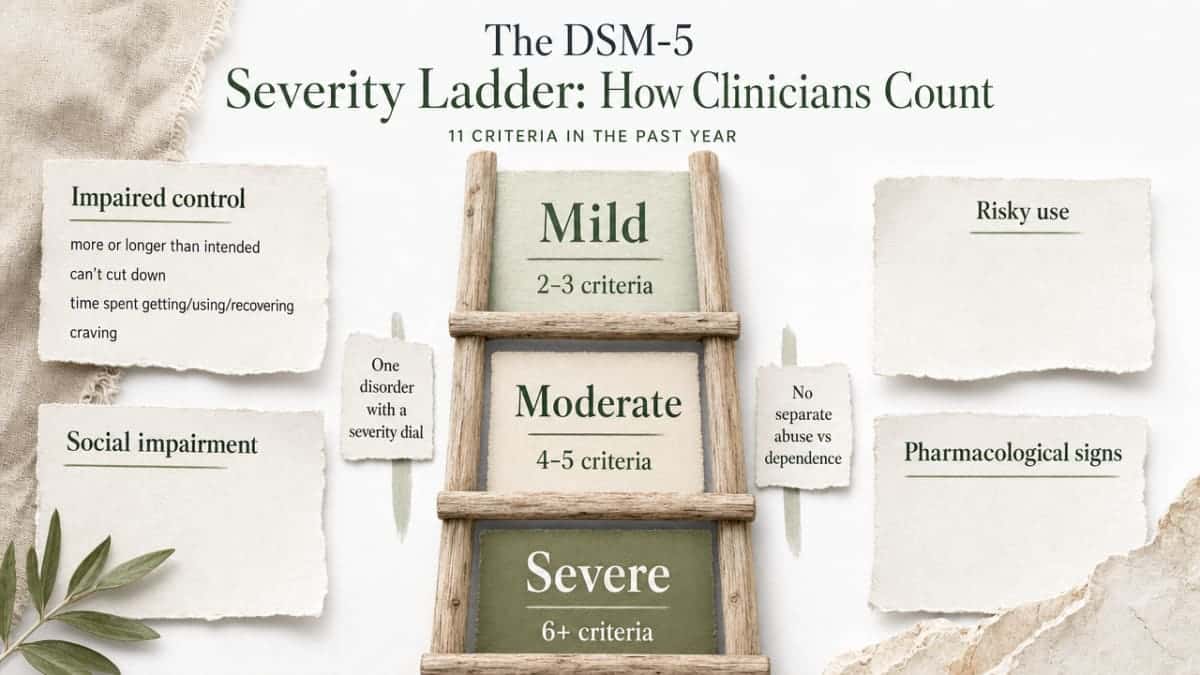
The DSM-5 lists 11 criteria for a substance use disorder, and the number you meet in the past year tells the story. Meet 2 or 3, and it’s considered mild. Meet 4 or 5, moderate. Meet 6 or more, severe 8. There’s no separate diagnosis for “abuse” versus “dependence” anymore — the DSM-5 folded those into one disorder with a severity dial 4.
The 11 criteria sort into four buckets, and reading them slowly is its own kind of self-assessment.
- Impaired control covers using more or longer than you meant to, wanting to cut down but not being able to, spending a lot of time getting/using/recovering, and cravings 4.
- Social impairment covers failing at work, school, or home; using even when it causes problems with people you love; and giving up activities you used to care about 4.
- Risky use covers using in situations that could hurt you — driving, mixing substances, using while caring for kids — and continuing even when you know it’s making a physical or mental health problem worse 4.
- Pharmacological signs are tolerance (needing more for the same effect) and withdrawal (feeling sick when you stop or using to head off feeling sick) 4.
A few honest notes about this ladder. One, it counts the past 12 months — not your worst year ever. Two, severity can shift. Someone who met six criteria last year and four this year has moved, even if they haven’t quit. Three, the count is a starting point, not a verdict. People with mild SUD can still need real help, and people with severe SUD can still recover.
If you’ve been doing math in your head while reading this, that’s not a bad thing. That’s the map working.
The Stages of Change: What Your Mind Is Doing About It
The third map has nothing to do with how much you use or what your brain scan would show. It asks a different question: where is your mind on the idea of changing?
James Prochaska and Carlo DiClemente built this model after watching people quit smoking. They noticed something simple and important — people don’t go from “using” to “quit” in one move. They go through stages, and most of the work happens in your head before anything visible changes.
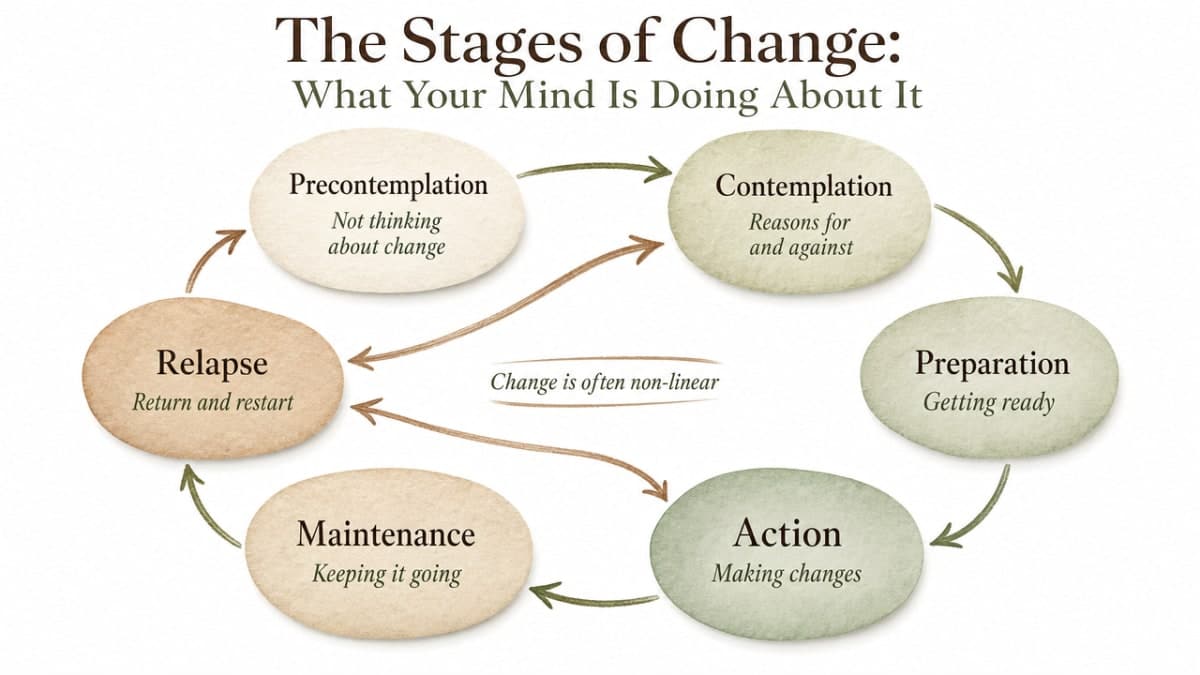
The five official stages look like this 1:
- Precontemplation — you’re not thinking about changing. Maybe the people around you are worried, but you’re not. The problem, if there is one, belongs to someone else.
- Contemplation — part of you knows. You can list reasons to cut back and reasons to keep going, and the list is roughly tied. You think about quitting on bad mornings and forget about it by lunch.
- Preparation — something has shifted. You’re making small moves: looking things up at 2 a.m., telling one person, picking a date, pouring out a bottle.
- Action — you’re doing the thing. Cutting back, abstaining, going to a meeting, starting treatment. This is the visible stage everyone else finally notices.
- Maintenance — you’ve been at it long enough that the new pattern is becoming the default, though it still takes attention.
Prochaska and DiClemente recognized an unofficial sixth stage too: relapse 11. Not as a failure, but as a normal part of how change actually happens.
The thing to know about this map is that movement is rarely a clean line. People loop back, sit in contemplation for years, jump from preparation to action and back to contemplation, and recycle through the whole sequence more than once 1. If you’re reading this article at all, you’ve probably left precontemplation. That itself is movement.
Locating Yourself Honestly on Each Map
Signals That Use Has Moved Past Casual
Casual use has a quiet quality. You can take it or leave it, you don’t think about it between times, and stopping doesn’t cost you anything.
Use that’s moved past casual sounds different from the inside. It starts asking for attention.
Some signals to read honestly:
- You drink or use more than you planned to, more nights than you planned to, or for longer than you meant.
- You’ve quietly upped the amount because the old amount doesn’t quite land anymore.
- You’ve started timing things around it — leaving events early, planning around the next one, making sure there’s enough in the house.
- You’ve used in situations where it could hurt you or someone else: driving, watching kids, mixing with medication, going to work the next morning underslept.
- You feel rough the morning after in a way that’s becoming familiar — shaky, foggy, anxious, low.
- Someone close to you has said something. Maybe gently. Maybe more than once.
This zone — what clinicians often call risky or at-risk use — is exactly where a brief, structured conversation has the most leverage 10. You may not meet a full diagnosis yet, and that doesn’t make the pattern fake. It makes it early. Early is good news, because early is where the smallest moves matter the most.
Signals of Moderate Substance Use Disorder
Moderate is the stage most people sit in longer than they admit. On the DSM-5 ladder, it means meeting four or five of the eleven criteria in the past year 8. In real life, it looks like this:
You’ve tried to cut back and it didn’t hold. Maybe more than once. You meant to stop at two and didn’t. You picked a quit date and watched it pass.
Use is starting to cost you something real. A missed shift. A fight you can’t quite remember. A project you keep pushing. You’re still functional — that’s part of why this stage hides — but the edges are fraying.
You’ve kept using even when you can see it making something worse: your sleep, your anxiety, your stomach, your marriage, your money.
Cravings show up between uses, not just when you’re around it. You think about it on your commute. You notice every bar sign.
You’ve started hiding amounts — pouring a little extra when no one’s looking, buying at a second store, deleting texts.
If several of these are true at once, you’re not exaggerating. You’re describing a moderate substance use disorder, and it’s the stage where outpatient counseling, intensive outpatient, or a structured program tends to do the most work 2.
Signals of Severe Substance Use Disorder
Severe doesn’t mean you’re a bad person or that you’ve reached some mythical bottom. It means six or more DSM-5 criteria are stacking up in the same year 8. The body and the brain are both in it now.
Some of what severe looks like:
Withdrawal is a daily fact. You feel sick — shaky, sweaty, nauseous, anxious, can’t sleep — when you go too long without, and using makes it stop. That morning drink, that first pill, that hit before work isn’t recreational. It’s medicine for a problem the substance itself created 5.
Tolerance has climbed somewhere you didn’t expect. The amount that used to feel like a lot is now the amount that gets you steady.
Big parts of your life have narrowed. Friends you used to see, things you used to care about, work you used to take pride in — they’ve quietly stepped aside to make room for use, recovery from use, and planning the next use.
You’ve kept going even when it’s caused serious damage you can name out loud — health scares, lost jobs, relationships ending, legal trouble, near-misses.
Where Your Readiness Sits Right Now
Now the third map. Forget how much you use for a minute and answer a different question: what is your mind actually doing about it?
Read these out loud to yourself and notice which one lands closest 1:
“I don’t really see a problem. Other people are making this into something it isn’t.” That’s precontemplation.
“I can see both sides. Part of me knows. Part of me isn’t ready to do anything about it.” That’s contemplation, and it’s where a lot of honest readers live.
“I’m starting to make small moves. I’m telling someone. I’m looking things up. I’ve picked a date in my head.” That’s preparation.
“I’m doing it. I’ve cut back, I’ve stopped, I’ve walked into a meeting, I’ve called.” That’s action.
“I’ve been at this for a while and I’m protecting what I’ve built.” That’s maintenance.
Here’s what matters: where you sit on this map is not where you sit on the other two. You can have severe SUD and be in contemplation. You can have mild SUD and be in action. The readiness map tells you what kind of next step will actually stick — not whether you need help, but what shape that help should take first 2.
When Anxiety, Depression, or Trauma Is in the Mix
For a lot of people reading this, the substance didn’t show up first. The anxiety did. Or the depression. Or something that happened years ago that you still don’t talk about.
If that’s your story, the stages above don’t quite tell the whole truth on their own. Substance use and mental health conditions tangle together — each one feeding the other, each one making the other harder to see clearly. The drink quiets the panic, and the panic gets worse without the drink. The pills smooth out the trauma flashbacks, and the flashbacks sharpen the moment the pills wear off. The withdrawal stage of the brain cycle and a depressive episode can feel almost identical from the inside 5.
This matters for locating yourself. You might look at the DSM-5 ladder and undercount, because what feels like “my anxiety acting up” is actually withdrawal. You might sit longer in contemplation because quitting feels like losing the only thing that’s been working. Neither of those is weakness. They’re predictable.
Matching Care to the Stage You’re Actually In
Here’s where the three maps stop being theory and start telling you what to do tonight.
If you’re in the at-risk zone — using more than you meant to, noticing it costs you, but not stacking up a full diagnosis yet — the most leveraged thing is a brief, structured conversation with someone trained to have it. Brief intervention is a short, time-limited approach built for exactly this stage, often summarized by the FRAMES framework: Feedback on your actual use, Responsibility (the choice stays yours), Advice that’s clear and specific, a Menu of options, Empathy, and building Self-efficacy that you can actually do this 10. A primary care visit or a single session with a counselor often does the work here.
If you’re sitting in mild SUD territory — two or three criteria, real but contained — outpatient counseling once a week is usually enough scaffolding. You keep your job, your routine, your bed at home, and you add a structured space to work on the pattern before it deepens.
Moderate SUD is where intensity steps up. Intensive outpatient (IOP) — typically three to five sessions a week — or partial hospitalization (PHP), which is most of the day but you sleep at home, is where the math starts to work. You need more hours of support than once-a-week counseling can give, but you don’t necessarily need to leave your life.
Severe SUD usually calls for residential treatment with medical detox up front. The withdrawal stage of the brain cycle is doing real physical work at this point, and from alcohol or benzodiazepines, stopping cold can be dangerous 5. A medically supervised detox followed by 24/7 residential care gives the brain and body a chance to settle before outpatient work picks up.
One layer that crosses every row: if anxiety, depression, PTSD, or bipolar symptoms are part of what you’re carrying, the level of care you pick needs to treat both at the same time, not one and then the other 2. That isn’t an upgrade. It’s what makes the match actually hold.
Where your readiness sits — contemplation, preparation, action — shapes the first conversation, not the level of care. You can walk into residential in contemplation. People do.
Relapse Is Not Failure, It’s Data
Prochaska and DiClemente called relapse the unofficial sixth stage for a reason 11. It’s not a glitch in the model. It’s part of how change actually moves.
NIDA describes addiction itself as a chronic, relapsing brain disorder — meaning the relapsing part is in the definition, not the exception to it 7. People recycle through the stages. Someone who reaches action, slips at month four, and lands back in contemplation hasn’t undone anything. They’ve gathered information they didn’t have before: which trigger, which hour, which feeling, which person, which thought right before the first drink.
That’s data. It tells you what your next plan needs to account for that your last one didn’t.
If you’ve relapsed — once, or more times than you want to count — you are not back at zero. You’re further along than someone who hasn’t yet tried. The work now is reading what happened honestly, not punishing yourself for it.
What This Means for What You Do Next
You came here to figure out where you are. By now you probably have a rougher answer than you did an hour ago, and that’s the work this article was for.
So here’s what to do with it.
Write down, just for yourself, three things: roughly where you sit on the brain cycle, roughly how many DSM-5 criteria you’d count honestly in the last twelve months, and which readiness stage your mind is actually in. Not your worst day. Not your best week. The average.
Then pick one move that fits the stage you’re in tonight, not the stage you wish you were in. A call. A conversation with one person. A screening appointment. A question asked out loud.
If mental health is tangled into this, find care that treats both at once 2. Arrow Passage Recovery is one place that does. The next step doesn’t have to be the whole staircase. It just has to be the next one.
Ready to move forward from your current stage?
Connect with someone who truly understands what you’re facing and talk through your next step right now.
Find Your Next Step Toward Stable Recovery
Get clarity on your current stage and supportive guidance for what comes next.
Frequently Asked Questions
How do I know if I’m in an early stage or already have a substance use disorder?
Count honestly. If you can name two or three patterns from the past year — using more than you meant to, cravings, problems at home or work because of it — that’s already mild SUD territory on the DSM-5 criteria. Below that, with use that’s still risky but not stacking criteria, you’re in the at-risk zone where a brief, structured conversation tends to do real work.
Can you skip stages or move backward through them?
Yes, and most people do. Movement between stages of change is rarely a straight line — people loop, sit in one stage for years, jump ahead, then circle back. The brain cycle also doesn’t unwind in reverse order. None of that means you’re broken. It means you’re working with a real model of how change actually happens, not a tidy staircase someone drew on a whiteboard.
Does being in denial mean I’m not ready for help?
No. What looks like denial is often precontemplation — the stage where you genuinely don’t see the problem the way others do. People enter treatment from every stage, including this one. A non-confrontational conversation that explores what you actually want from your life, rather than arguing whether you have a problem, is the approach that moves people forward from here.
What if my drinking or drug use is tied to anxiety, depression, or trauma?
Then you need care that treats both at once, not one and then the other. Withdrawal can look exactly like a depressive or anxiety episode from the inside, and untreated mental health conditions make every stage of use harder to move through. Integrated dual-diagnosis treatment — addressing the substance use and the underlying condition together — is what tends to hold over time.
If I’ve relapsed before, does that mean I’m back at stage one?
No. Relapse is recognized as an unofficial sixth stage of change, not a reset. You don’t lose what you learned. You usually land somewhere between contemplation and preparation, with new information about what triggered the slip — which hour, which feeling, which person, which thought came first. Your next plan gets to account for what your last one didn’t.
How do I figure out what level of care actually fits my stage?
Match intensity to severity. At-risk use responds well to a brief intervention from a primary care provider or counselor. Mild SUD usually fits weekly outpatient counseling. Moderate calls for intensive outpatient or partial hospitalization. Severe typically needs medical detox followed by residential care, especially with alcohol or benzodiazepines. A screening call with a treatment center can sort this in one conversation.
References
- Stages of Change Theory. https://www.ncbi.nlm.nih.gov/books/NBK556005/
- Enhancing Motivation for Change in Substance Use Disorder Treatment (TIP 35, 2019 update). https://www.ncbi.nlm.nih.gov/books/NBK571071/
- Screening, Brief Intervention, and Referral to Treatment (University of Pittsburgh Nursing, 2023). https://www.nursing.pitt.edu/sites/default/files/brief_interventions_-_2023_06_28.pdf
- DSM-5 Criteria for Substance Use Disorders. https://pmc.ncbi.nlm.nih.gov/articles/PMC3767415/
- 1.5 Neurobiology of Substance Use Disorders. https://pressbooks.txst.edu/nursingcph/chapter/1-5-neurobiology-of-substance-use-disorders/
- Neurocircuitry of addiction. https://pubmed.ncbi.nlm.nih.gov/19710631/
- Drug Misuse and Addiction. https://nida.nih.gov/publications/drugs-brains-behavior-science-addiction/drug-misuse-addiction
- Substance Use Disorder defined by NIDA and SAMHSA (handout). https://wyoleg.gov/InterimCommittee/2020/10-20201105Handoutfor6JtMHSACraig11.4.20.pdf
- Neurobiologic Advances from the Brain Disease Model of Addiction. https://pmc.ncbi.nlm.nih.gov/articles/PMC6135257/
- Brief intervention in substance use disorders. https://pmc.ncbi.nlm.nih.gov/articles/PMC5844156/
- Prochaska and DiClemente’s Stages of Change Model for Social Workers. https://online.yu.edu/wurzweiler/blog/prochaska-and-diclementes-stages-of-change-model-for-social-workers