
Practical Sugar Addiction Help for Cravings & Mood
Key Takeaways
- Sugar cravings in early recovery reflect a sensitized reward system, not weak willpower, because dopamine and opioid pathways respond to intermittent high-sugar intake much like they do to substances 5.
- The sugar-mood link is bidirectional but inconsistent across studies, so reducing intake can quiet part of the loop but should not replace antidepressants, trauma work, or relapse-prevention plans 6.
- Layering implementation intentions, self-monitoring, feedback, and environmental restructuring gives the most reliable signal for cutting sugar, with structured planning showing meaningful effects on cravings and distress 10, 11.
- Framing reduction as elimination tends to backfire, since intermittent deprivation is exactly the pattern that sensitizes reward responses and drives binge rebounds in vulnerable patients 5.
Why sugar cravings show up loudest in dual-diagnosis recovery
You’ve probably noticed the pattern in your own caseload, or in yourself: the patient who just stabilized off alcohol is now keeping a sleeve of cookies in the car. The veteran two months into PTSD work who suddenly drinks four sodas a day. The cravings aren’t random, and they’re not a side quest. They’re the reward system doing exactly what it learned to do.
When the brain’s dopamine and opioid pathways have been sensitized by years of substance use, anything that reliably produces a fast hedonic signal becomes a candidate replacement. High-sugar foods qualify. Animal work and human reviews both describe sugar’s capacity to engage these same circuits, which is why intake patterns in early recovery can start to look uncomfortably familiar 4, 5. Add a mood disorder on top, and the loop gets tighter: a depressive afternoon, a quick sweet, a brief lift, a stronger association the next day.
This isn’t a character problem, and it’s worth saying that plainly to the patient sitting across from you. It’s a predictable feature of a nervous system that learned to seek relief. The clinical question is what you do with it.
That’s where this piece is going. Not a sugar-cleanse pep talk, and not another list of swaps. The same toolkit you already use for substance use and mood, including CBT skills, mindfulness, implementation intentions, and structured outpatient follow-up, has direct, cited applications to sugar cravings. The neurobiology gives you the why. The behavior change literature gives you the how. And the dual-diagnosis context is exactly where these tools have to hold up.
The reward-system case: what sugar actually does to a sensitized brain
Dopamine, opioids, and the intermittent-intake pattern
Here’s the part of the conversation your patients usually find clarifying: the brain doesn’t really care whether the reinforcer is ethanol, an opioid, or a frosted donut at 9 p.m. It cares about the speed and reliability of the signal. Sugar, particularly when it shows up intermittently and in concentrated form, hits that signal cleanly.
The animal literature is where this gets sharpest. In the Avena line of work, rats given intermittent access to sugar solutions developed binge-like intake, signs that looked like withdrawal when sugar was removed, and shifts in both dopamine and opioid signaling that paralleled what’s seen with drugs of abuse 5. The authors put it plainly:
sugar “releases opioids and dopamine and thus might be expected to have addictive potential” 5.
That’s not a casual analogy. It’s a specific neurochemical claim about a specific intake pattern.
The intermittent piece matters more than the total dose. A rat with steady, predictable access to sugar doesn’t develop the same profile as one that gets it in bursts after deprivation. Translate that to your caseload and the pattern is familiar: the patient who white-knuckles through the morning, skips lunch, then collapses into a sweet at 4 p.m. is essentially running the experimental protocol on themselves. The dopamine response gets larger, not smaller, with that kind of scheduling.
Newer reviews echo the mechanism. High-sugar food triggers dopamine release in reward pathways, and repeated activation appears to sensitize those pathways in vulnerable individuals 4. For someone whose mesolimbic system has already been reshaped by substance use, this is not a neutral input. It’s a familiar key fitting a familiar lock.
That framing changes the clinical conversation. You’re not asking a patient to resist a cookie. You’re asking a sensitized circuit to tolerate a smaller, less predictable reward while it recalibrates. Worth saying out loud in session.
Where the ‘sugar addiction’ label still breaks down in humans
Now the caveat your patients deserve to hear, especially the clinically literate ones who will ask.
Most of the strongest neurochemical evidence comes from rodents on engineered schedules, not from humans eating birthday cake. The reviews that frame sugar as addiction-like are careful about this. The NIH-hosted synthesis notes that while reward pathway sensitization, tolerance, and withdrawal-like signs have all been described, formal diagnostic criteria for sugar addiction in humans remain debated 4. There is no DSM entry. There is no validated screening instrument with the kind of consensus you’d see for alcohol or opioid use disorder.
What you can say honestly: the biological plausibility is real, the behavioral overlap in some patients is real, and the reinforcer is powerful enough to deserve clinical attention, particularly in dual-diagnosis contexts. What you should not say: that a patient “has” sugar addiction in the same diagnostic sense they have opioid use disorder. The category isn’t settled, and overclaiming it can erode trust the first time a patient reads the same caveats you skipped.
The useful middle ground is to treat sugar as a high-potency reinforcer operating on an already-sensitized system, with addiction-adjacent features in a subset of patients. That framing lets you apply the behavioral toolkit you already trust without picking a fight with the literature. It also keeps the door open for the patient who responds well to structure but bristles at another label.
Hold the nuance. The rest of this piece assumes you can.
The mood link, honestly stated
Here’s where you have to be careful, because the popular framing has run ahead of the data.
You’ve probably read the headlines: sugar causes depression, sugar drives anxiety, cutting sugar lifts mood within weeks. The actual literature is messier. A 2024 NHANES-based analysis looking at different types of dietary sugar and depression in US adults found inconsistent patterns across sugar subtypes and demographic subgroups, with the authors noting plainly that studies on whether dietary sugar intake increases depression risk have “produced inconsistent results” 6. That’s not a null finding. It’s a signal that the relationship is real in some directions, for some sugars, in some people, and not a clean causal arrow you can draw on a whiteboard.
What you can say to a patient with confidence: there is a plausible bidirectional loop. Low mood lowers the threshold for fast-reward seeking, sugar delivers a fast reward, the post-spike crash and the self-criticism that follows can deepen the mood state, and the cycle reinforces itself by evening. That clinical pattern is recognizable even when the population-level statistics refuse to behave.
The honest framing in session sounds something like this. Sugar intake is one input the patient can actually modify. Mood is influenced by many inputs, and this is one of the few that responds quickly to a behavioral skill. Working on it is reasonable. Expecting it to do the heavy lifting of mood treatment is not.
That framing protects the patient from two predictable disappointments: the one where they cut sugar for three weeks and feel betrayed that their PTSD didn’t lift, and the one where they decide the whole conversation was overblown and go back to using sweets as their primary affect regulator. Neither outcome serves them. A calibrated expectation does.
What actually moves cravings: evidence-based behavior change techniques
Implementation intentions and if-then planning
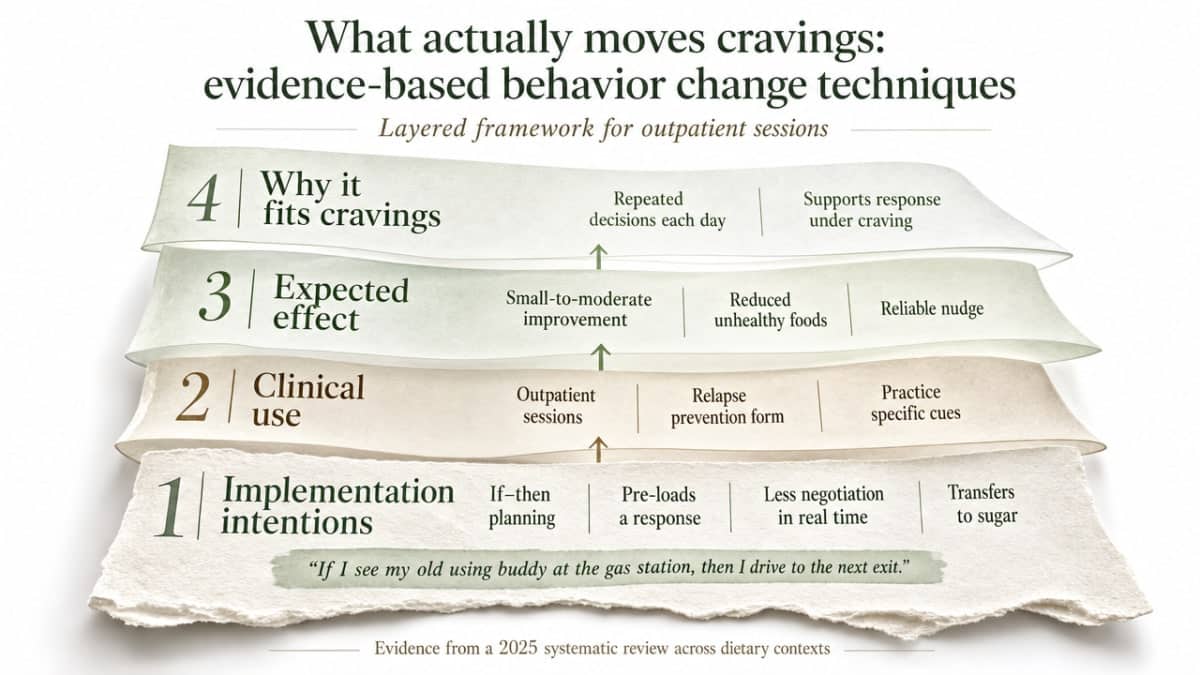
If you’ve used implementation intentions in relapse prevention, you already know the form. “If I see my old using buddy at the gas station, then I drive to the next exit.” The structure pre-loads a response so the patient doesn’t have to negotiate with their cravings in real time. The same technique transfers cleanly to sugar.
A systematic review of implementation-intention interventions across dietary contexts concluded that if-then planning can produce small-to-moderate improvements in eating behaviors, including reduced intake of unhealthy foods 3. Small-to-moderate is honest framing. It’s not a miracle. It’s a reliable nudge in the right direction, which is exactly what you want for a behavior the patient has to perform several times a day.
The adolescent SSB trial is worth knowing about because the pattern shows up in a higher-risk population. Adolescents with overweight or obesity who received implementation-intention training combined with inhibitory-control practice cut their sugar-sweetened beverage consumption more than controls 2. Two skills, layered: a plan for what to do at the cue, and a rehearsed pause before the automatic reach.
In session, the plans that hold up are specific to the patient’s actual day. Not “if I want something sweet, then I’ll have water.” That’s a wish. Something closer to: “If I finish my last patient note at 4:30 and I’m reaching for the vending machine, then I walk to the lobby coffee station and refill my water bottle first.” The cue is named. The behavior is named. The location is named. The patient can rehearse it before leaving your office.
For a dual-diagnosis caseload, the relapse-prevention parallel is your selling point. Patients who have already built if-then plans for substance use cues don’t need to learn a new framework. They need permission to apply the one they have.
Mindfulness-based eating as a craving-tolerance skill
Mindfulness work in this space isn’t about savoring a raisin for ten minutes. It’s about teaching the patient to sit with a craving long enough to watch it crest and fall, without staging an intervention against themselves.
A mindfulness-based intervention study tracking participants over the course of the program found that increases in mindful eating were associated with decreased eating of sweets and lower fasting glucose levels in the mindfulness group 9. Association, not causation, and a modest sample, but the direction matters. The patients getting better at noticing were also, on average, eating fewer sweets and showing better glycemic markers.
For someone already using mindfulness for PTSD flashbacks or anxiety spikes, this is a small skill extension rather than a new modality. The instruction set is familiar: notice the urge, name the body sensation, observe without acting, let the wave pass. You’re just applying it to a different stimulus.
What this skill does well is decouple the craving from the automatic behavior. What it does not do well is shrink the craving in the moment. Patients should know that distinction before they try it. A craving they can observe is still a craving. The win is that they’re no longer being driven by it without consent. Over weeks, the frequency and intensity tend to soften, which is what the intervention data suggests 9.
Pair this with the if-then plan from the previous skill and you have something close to a complete in-the-moment response: notice, pause, execute the pre-loaded behavior.
The behavior change techniques with the clearest signal
If you want a short list of techniques to actually bring into a session, the 2025 systematic review on behavior change techniques (BCTs) for sugar reduction is the most useful single source in the supplied literature. The authors identified four techniques with the clearest signal across the included trials: goal setting, self-monitoring, feedback, and environmental restructuring 11. They note that the results “will enable clinicians to provide more effective dietary advice when supporting dietary behavior change” 11.
Worth walking through what each looks like in practice for a dual-diagnosis patient.
- Goal setting
- works when it’s specific and the patient helped write it. “Reduce sugar” is not a goal. “No sweetened drinks before 6 p.m. on weekdays” is. The narrower the target, the easier it is to either succeed or learn from a miss.
- Self-monitoring
- is the technique most patients underestimate and most clinicians can deploy in five minutes. A note app, a photo log, a tally on the back of an appointment card. The mechanism is awareness, not punishment. Patients who track honestly for two weeks almost always describe a pattern they didn’t know they had.
- Feedback
- is where outpatient counseling adds value the patient can’t replicate alone. You see the log. You reflect what you see. You name the cue you noticed that they didn’t. This is the BCT that turns self-monitoring from a journaling exercise into a clinical signal.
- Environmental restructuring
- is the highest-leverage one for early recovery. If the sweet isn’t in the house, the 9 p.m. craving has nowhere to go. If the coworker’s candy bowl is on a different floor, the workday cue weakens. You’re not asking the patient to outmuscle their reward system. You’re rearranging what the reward system gets to vote on.
The four techniques compound. A goal without monitoring is a wish. Monitoring without feedback is a diary. Feedback without environmental change asks the patient to win every cue in real time, which they won’t. Used together, they’re the structural backbone of the planning interventions covered next.
Effect sizes from a structured planning intervention
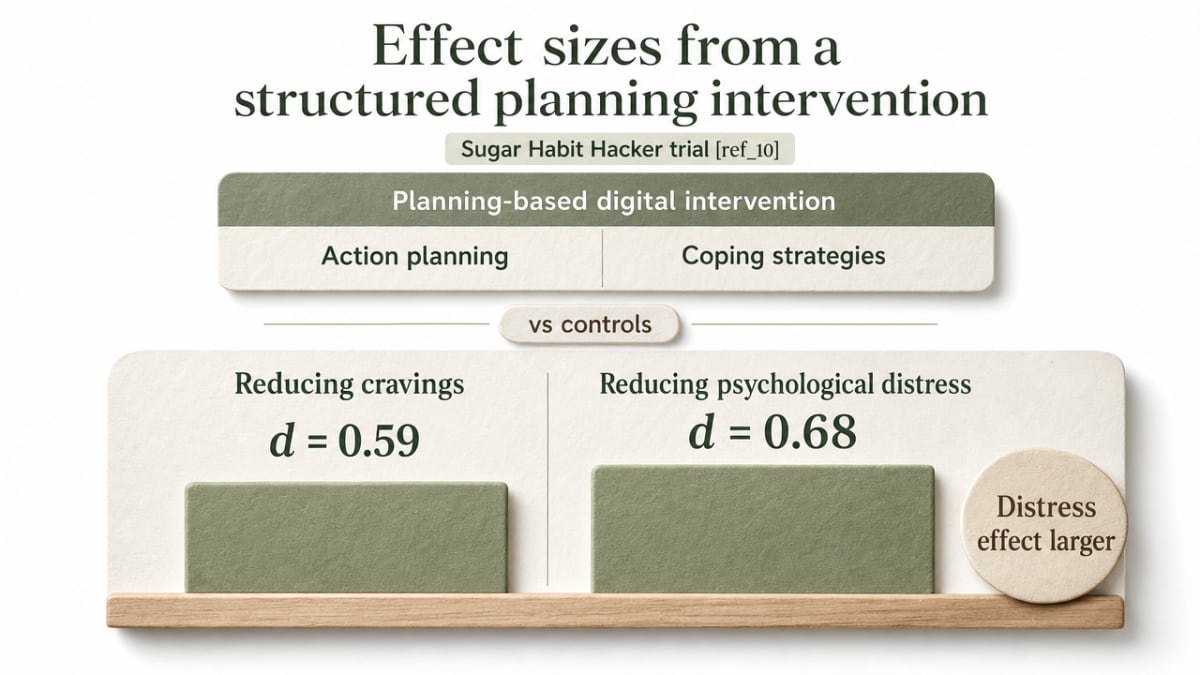
When patients ask whether any of this actually works in a study setting, the Sugar Habit Hacker trial is the cleanest answer in the supplied evidence. It’s a randomized test of a planning-based digital intervention built around action planning and coping strategies, the same BCT family covered above 10.
The headline numbers: the intervention produced large effects on reducing cravings (d = 0.59) and on reducing psychological distress (d = 0.68) compared with controls 10. Two things worth pulling out of that pair.
First, the distress effect was larger than the craving effect. That’s the part that should interest a dual-diagnosis clinician. A structured sugar-reduction plan didn’t just lower the urges. It lowered the psychological distress markers the participants reported alongside them. The mechanism is plausible: if cravings have been an ambient source of self-criticism and perceived loss of control, getting a working response to them removes a chronic stressor.
Second, d = 0.59 for cravings is a respectable signal for a brief, structured, mostly self-directed intervention. It tells you that the same planning techniques you can teach in an outpatient session, formatted into a coherent protocol, move the dial on the symptom most patients are most worried about.
Caveats the patient should hear once and not have to relitigate: the trial was time-limited, and long-term maintenance plus applicability to patients with severe mental illness or active substance use disorders are open questions 10. The effect sizes are an argument for trying the protocol, not a guarantee it will hold for a year. Use them to motivate engagement, not to set expectations the next relapse will undercut.
Integrating sugar work into outpatient dual-diagnosis care
None of the techniques above stand alone. They live inside the same outpatient structure already holding the patient’s medication management, trauma processing, and relapse-prevention plan. The integration question is where sugar work fits without crowding out the higher-priority work.
In practice, sugar typically enters the case formulation through the back door. A patient mentions weight gain in early sobriety. A diabetic patient’s A1C drifts up during a depressive episode. Someone in PTSD treatment describes nighttime eating that’s started to feel out of control. These are the openings. You don’t need a separate intake for sugar; you need to recognize when the existing intake has already surfaced it.
The lowest-friction integration is to fold sugar into the relapse-prevention framework the patient already speaks. Cues, urges, plans, and follow-through are the same language. A patient who has mapped their using triggers can usually map their sugar triggers in one session. The if-then planning supported by the implementation-intention literature transfers without retraining, and the BCT cluster of goal setting, self-monitoring, feedback, and environmental restructuring slots cleanly into weekly outpatient check-ins 3, 11.
For patients already doing mindfulness work as part of trauma or anxiety care, extending the practice to eating cues is a small ask. The mindful-eating intervention data suggests the same skill carries useful weight in this context 9. You’re not adding a modality. You’re adding a target.
Group therapy is an underused setting for this. Sugar cravings are something most patients in a dual-diagnosis group can speak to without the shame that sometimes attaches to the primary substance. It can become a low-stakes practice ground for skills the group will need for higher-stakes cues later in the week.
The goal isn’t a sugar-free patient. It’s a patient whose reward system has one fewer hijack point and whose mood regulation has one more working tool. That’s an outpatient-sized win, which is the right size for this work.
Honest limits of the evidence
One consolidated caveat paragraph, because your patients deserve it in one place rather than scattered across every section.
- Most of the strongest neurochemical work on sugar as an addiction-like reinforcer comes from rodents on intermittent access schedules, not from humans navigating a real food environment 5.
- Formal diagnostic criteria for sugar addiction in humans remain debated, and there is no consensus screening tool comparable to what exists for alcohol or opioid use disorder 4.
- The sugar-mood literature is genuinely inconsistent across subtypes and subgroups, which is why a clean causal claim isn’t available 6.
- Behavior change technique reviews acknowledge heterogeneity across trials, making it hard to isolate any single component as the active ingredient 11.
- The Sugar Habit Hacker effect sizes are encouraging but time-limited, with open questions about maintenance and applicability to patients with severe mental illness or active substance use disorders 10.
- And the FGF21 work on hypothalamic neurons is interesting frontier science in mice, not a basis for any pharmacologic recommendation in your clinic this week 8.
None of this should stop you from using the toolkit. It should keep you honest about what you’re promising the patient when you do.
Reach Out Now for Real Sugar Craving Support
Connect directly with a caring specialist for guidance on managing sugar cravings and mood challenges, anytime.
Ready to Break Free From Sugar Cravings?
Start your personalized plan to manage cravings and support your mood—one step at a time.
Frequently Asked Questions
Is sugar actually addictive, or is that an overstatement in clinical settings?
The honest answer is that it’s somewhere in between. There is real neurobiological evidence that high-sugar foods engage dopamine and opioid pathways in ways that overlap with substance reinforcement, particularly under intermittent intake schedules in animal models 5. But formal diagnostic criteria for sugar addiction in humans remain debated, and no consensus screening tool exists 4. Treat sugar as a powerful reinforcer worth clinical attention, not as a fully recognized diagnostic category.
How do I distinguish a sugar craving from a mood episode or substance-use trigger in a dual-diagnosis patient?
Look at the cue, the timing, and what the patient is reaching for. A sugar craving usually has a predictable temporal pattern, often afternoon or evening, and softens once the patient eats. A mood episode persists across cues and isn’t resolved by a snack. A substance-use trigger tends to be tied to people, places, or affect states the patient already mapped in relapse-prevention work. Self-monitoring for two weeks usually separates them faster than a single session can.
Which behavior change techniques should I introduce first in a brief outpatient session?
Start with self-monitoring and one specific if-then plan. Self-monitoring builds the awareness the rest of the work depends on, and an implementation intention gives the patient something concrete to execute before the next visit 3. Add goal setting and environmental restructuring at the second session once you’ve seen their log. The 2025 BCT review identifies these four as the techniques with the clearest signal for sugar reduction 11. Layer them; don’t try to deploy all four cold.
Can mindfulness-based eating help patients who already use mindfulness for PTSD or anxiety?
Yes, and the transfer is usually smoother than starting from scratch. Patients with an existing practice can extend the same noticing-and-allowing skill to food cues without learning new instructions. A mindfulness-based intervention study found that increases in mindful eating were associated with decreased sweet consumption and lower fasting glucose in the mindfulness group 9. The skill won’t shrink a craving in the moment, but it decouples the urge from the automatic behavior, which is the more useful win.
What should I tell patients about cutting sugar without triggering restriction-rebound cycles?
Avoid frame the work as elimination. The intermittent-deprivation pattern is exactly what sensitizes the reward response in the first place, which is part of why bingeing follows skipped meals and rigid rules 5. Steady, predictable intake with specific reductions in the highest-leverage spots beats heroic abstinence weeks. Use the WHO threshold of under 10% of energy from free sugars as a reasonable upper-bound reference, not a moral line 1. Aim for fewer cue-driven spikes, not zero sweetness.
How does reducing sugar fit alongside medications, CBT, and relapse-prevention work?
It fits as an additional target inside the same framework, not as a competing modality. The cues, urges, plans, and follow-through language patients already use for substance work transfers directly. Effect sizes from a structured planning intervention showed reductions in cravings and psychological distress, suggesting the work supports rather than distracts from mood treatment 10. If the patient has diabetes, metabolic syndrome, or significant weight changes on psychiatric medication, coordinate with their prescriber before launching a structured reduction plan.
References
- Current WHO recommendation to reduce free sugar intake from all sources is justified. https://pmc.ncbi.nlm.nih.gov/articles/PMC9307988/
- Self-regulation Interventions for the Reduction of Sugar-Sweetened Beverages in Overweight and Obese Adolescents. https://pmc.ncbi.nlm.nih.gov/articles/PMC5443114/
- Do implementation intentions help to eat a healthy diet? A systematic review. https://www.ncbi.nlm.nih.gov/books/NBK81362/
- About Sugar Addiction. https://pmc.ncbi.nlm.nih.gov/articles/PMC12257121/
- Evidence for sugar addiction: Behavioral and neurochemical effects of intermittent, excessive sugar intake. https://pmc.ncbi.nlm.nih.gov/articles/PMC2235907/
- Association between dietary sugar intake and depression in US adults. https://pmc.ncbi.nlm.nih.gov/articles/PMC10851576/
- The Impact of Free Sugar on Human Health—A Narrative Review. https://pmc.ncbi.nlm.nih.gov/articles/PMC9966020/
- Study pinpoints brain cells that trigger sugar cravings and consumption. https://medicine.uiowa.edu/news/2020/07/study-pinpoints-brain-cells-trigger-sugar-cravings-and-consumption
- Effects of a mindfulness-based intervention on mindful eating, sweets consumption, and fasting glucose levels. https://pmc.ncbi.nlm.nih.gov/articles/PMC4801689/
- Sugar Habit Hacker: Initial evidence that a planning intervention can help reduce sugar consumption. https://pmc.ncbi.nlm.nih.gov/articles/PMC8997217/
- Behavior Change Techniques to Reduce Sugars Intake: A Systematic Review. https://pubmed.ncbi.nlm.nih.gov/39394740/