
Key Takeaways
- Match programs to the person rather than sorting by labels, since effective care addresses medical, psychological, social, vocational, and legal needs together 11.
- Evaluate four fit factors that decide outcomes: clinical intensity, dual-diagnosis capability, planned length of stay, and how family is built into the treatment plan.
- Residential isn’t automatically better than intensive outpatient — a randomized trial showed residential only added benefit on social and psychiatric outcomes, so pick the lowest level that can safely hold your loved one 3.
- Learn what each residential format actually does — detox, 30-day, long-term or therapeutic communities, and specialized tracks — so you can match the type to severity and motivation rather than marketing.
- Verify Ohio licensure directly with OhioMHAS, ask about Class 1 status when mental illness is involved, and confirm accreditations and Medicaid coordination before committing 6.
- Use a structured intake script that probes assessment, prescribing, length-of-stay decisions, family involvement, and licensing, and listen for specifics rather than amenities or testimonials.
- Treat guaranteed success rates, same-day admission pressure, and vague psychiatric answers as red flags, while weekly plan reviews, on-site prescribers, and early family sessions signal a serious program.
Start With the Person, Not the Program Label
Take a breath. If you’re reading this, you’ve probably already spent hours scrolling through facility websites that all start to sound the same — “luxury,” “holistic,” “evidence-based,” “individualized.” That blur is exhausting, and you’re not failing for feeling stuck in it.
Here’s the shift that will save you time: stop sorting programs by their labels and start sorting them by your loved one. The research is unusually clear on this point. NIDA’s principles of effective treatment put it plainly — care must address the person’s medical, psychological, social, vocational, and legal situation, not just their substance use 11. The setting matters less than whether the services inside it actually match what your person needs 2.
That reframe changes everything. Instead of asking “Is this a good program?” you’ll be asking “Is this a good program for him, for her, for them?” Those are very different questions, and only one of them has a useful answer.
The rest of this guide walks you through four match points that decide fit, an honest comparison between residential and intensive outpatient, the types of residential treatment programs you’ll actually encounter, and the Ohio-specific checks worth making before you commit to anything.
The Four Match Points That Actually Matter
Clinical Intensity: What 24/7 Care Should Include
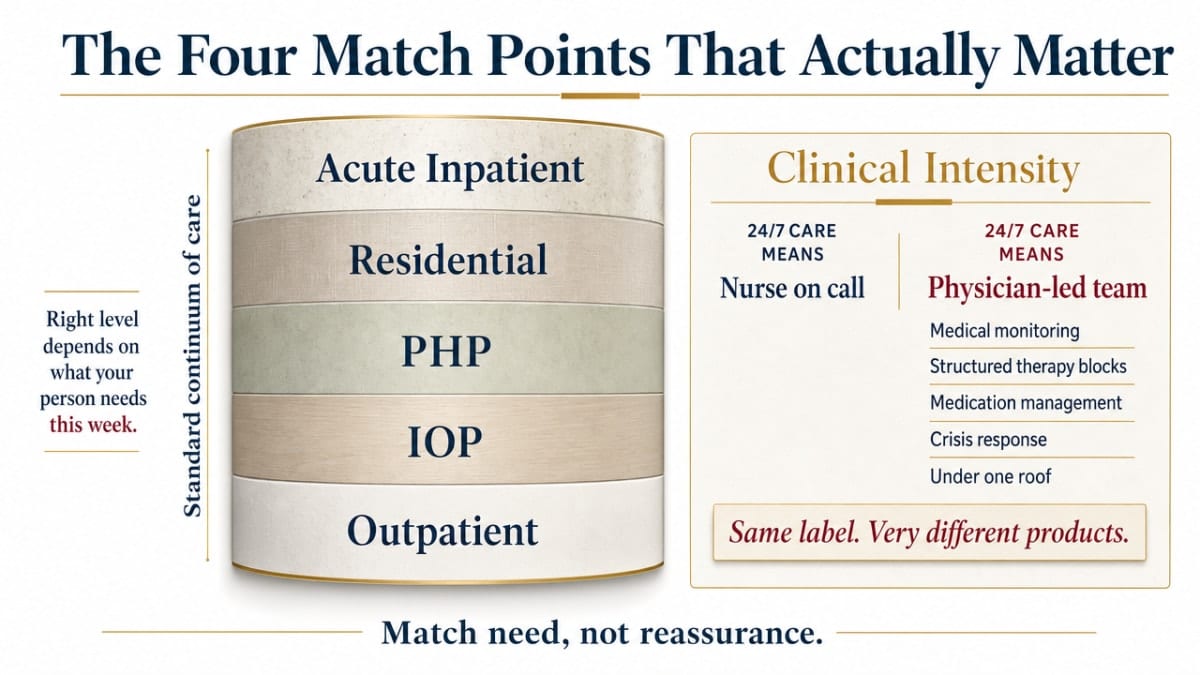
Clinical intensity is the first thing to match, and it’s the easiest to misread from a website. “24/7 care” can mean a nurse on call, or it can mean a physician-led team running medical monitoring, structured therapy blocks, medication management, and crisis response under one roof. Those are very different products wearing the same label.
Residential sits near the top of the standard continuum of care. Below it you’ll find partial hospitalization (PHP), intensive outpatient (IOP), and standard outpatient counseling. Above it sits acute inpatient hospitalization for medical or psychiatric emergencies. SAMHSA frames these as a layered system where the right level depends on what your person actually needs in a given week, not on what sounds most reassuring to you as a family member 7. The TIP literature draws the same line: inpatient and residential settings differ from outpatient mainly in cost, intensity, and duration, while sharing core therapeutic components 9.
When you’re asking about intensity, push past the brochure. A genuinely intensive residential program should offer daily individual or group therapy, medical oversight that includes medication management, integrated assessment of mental health alongside substance use, and a written weekly schedule you can actually see before admission. If the answer to “What does a typical Tuesday look like?” is vague, the intensity probably is too. You’re not being picky by asking — you’re doing the assessment work the program should already be doing for you.
Dual-Diagnosis Capability: What to Verify Before Admission
If your loved one has any history of depression, anxiety, trauma, bipolar disorder, ADHD, or psychosis alongside substance use, this match point is non-negotiable. Co-occurring conditions are common, symptoms overlap in ways that confuse even experienced clinicians, and treating only the addiction while ignoring the mental health side is a setup for relapse 1.
The phrase “dual-diagnosis capable” gets thrown around loosely. Here’s what it should actually mean inside a residential program: a psychiatric prescriber on staff or under contract, clinicians trained in both substance use and mental health disorders, integrated treatment plans that address both conditions at the same time rather than in sequence, and medications prescribed and adjusted on-site when clinically appropriate. SAMHSA is direct about this — integrated care, where one team treats both conditions together, consistently produces better outcomes than parallel or sequential treatment 10.
When you call intake, ask three specific things. First: “Who on your team can diagnose and treat mental health conditions, and how often do they see residents?” Second: “If my loved one needs a medication change for depression or anxiety during their stay, who handles that and on what timeline?” Third: “How do you build the treatment plan when someone has both a substance use disorder and a mental health diagnosis — do the same clinicians address both?”
If the answers feel scripted, ask follow-ups. A program that genuinely handles dual diagnosis will talk about it with detail and confidence because it’s how they work, not a service line they bolted on. Asking these questions already puts you ahead of most families who call.
Planned Length of Stay: The 80-Day Threshold Most Families Aren’t Told About
Length of stay is where families get the least honest information and the most marketing. Programs sell 30-day, 60-day, and 90-day packages as if the numbers were clinically meaningful by themselves. They’re not. What matters is how long your loved one actually stays and what happens in those days.
What does that mean for you, sitting at a kitchen table trying to pick between a 30-day and a 90-day option? A few things. Thirty days is often too short for the deeper therapeutic work to take hold, especially when the first week or two is spent stabilizing. Around 80 to 90 days appears to be where most of the measurable benefit lands. And committing your loved one to a six- or twelve-month program when their motivation is shaky may set up a worse outcome than choosing a shorter program they’re more likely to complete.
Ask programs how they decide length of stay clinically, how often plans are reviewed, and what the step-down process looks like when someone is ready to leave residential and move into PHP or IOP. The honest programs will talk about length as a clinical question, not a billing one. NIDA’s principles back this up — adequate duration matters, but “adequate” is individualized, not a sticker on a package 2.
Family Involvement: A Selection Criterion, Not an Afterthought
Most family-facing articles treat family involvement as a nice extra — a weekend visit, maybe a phone call. The research treats it as a treatment lever. A review of youth and transition-age SUD outcomes concluded that families are powerful resources for improving engagement, retention, and long-term recovery, and that many programs underuse family-based approaches even though the evidence supports them 4. NIMH echoes this for co-occurring conditions: family-based interventions are among the supports that help people stay in care 1.
That reframes a question you should be asking out loud on the intake call. Not “Can we visit?” but “How is the family built into the clinical plan?”
A program that takes family involvement seriously will offer:
- scheduled family therapy sessions (not just visiting hours),
- structured education about substance use and co-occurring disorders,
- a clear communication plan with the treatment team within HIPAA limits, and
- a discharge plan that includes you by design — not as a courtesy.
If the program treats family contact as a privilege the resident has to earn, ask why, and listen carefully to the answer. There are clinical reasons that exist, but they should be specific to your loved one, not blanket policy.
Your involvement isn’t intrusion. Done well, it’s part of what makes the treatment hold after discharge.
Residential vs. Intensive Outpatient: An Honest Comparison
Here’s something most facility websites won’t tell you: residential isn’t automatically better than intensive outpatient. The research has been saying so for decades, and pretending otherwise would waste your time and possibly your loved one’s best chance at recovery.
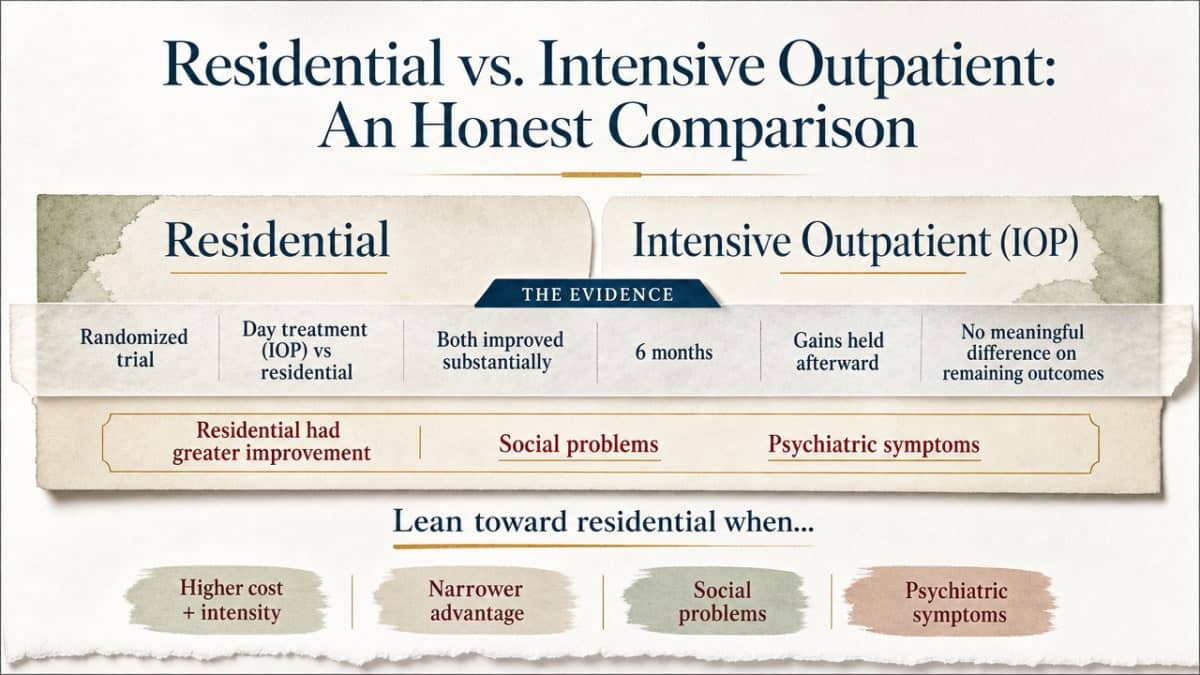
A randomized trial that directly compared day treatment (essentially IOP) to residential drug abuse treatment found that both groups improved substantially over six months and held those gains afterward. Residential clients did show greater improvement on two specific outcomes — social problems and psychiatric symptoms — but on the remaining outcomes, the two settings produced no meaningful difference 3. That is a narrower advantage than the way residential is often marketed.
So when does residential actually earn its higher cost and intensity? Lean toward residential when your loved one’s home environment is itself a trigger — active using partners, easy access to substances, chronic instability. Lean toward it when psychiatric symptoms are severe enough that daily clinical eyes matter, or when previous outpatient attempts have ended in early relapse. The social and psychiatric domains where residential added benefit map closely to those situations.
Lean toward intensive outpatient when your person has a stable, sober-supportive living situation, work or school they can keep, milder co-occurring symptoms, and the motivation to show up several days a week. IOP isn’t a consolation prize. For the right person, it produces comparable results at a fraction of the disruption.
A fair caution: comparing outcomes across programs is harder than it sounds. A 2025 review found that SUD studies don’t even define success the same way — some measure abstinence, others measure functioning, others measure retention 12. Treat any program’s outcome statistic with healthy skepticism and ask what was measured and how.
The honest framing: pick the lowest level of care that can safely hold your loved one. If that’s residential, commit. If it’s IOP, that’s a real choice, not a compromise.
Types of Residential Programs You’ll Actually Encounter
Medical Detox and Stabilization
Detox is the front door for many people, not the treatment itself. If your loved one has been using alcohol, benzodiazepines, or opioids regularly, the first 3 to 10 days carry real medical risk — seizures, dangerous blood pressure swings, severe withdrawal symptoms — and need round-the-clock medical monitoring with a physician available for medication management.
A good detox program does two things at once: keeps the body safe and starts the bridge to whatever comes next. That bridge matters more than families realize. Detox alone, without a planned step into residential, PHP, or IOP, leaves people in a fragile window where relapse rates climb. NIDA’s principles are explicit that detox is a beginning, not a treatment course on its own 2.
When you call, ask who supervises withdrawal, whether MAT is available, and what the warm handoff into ongoing care actually looks like. “We’ll give you a list” is not a handoff.
Short-Term Residential (Roughly 28-30 Days)
The 28- to 30-day program is the format most families picture when they hear “rehab.” It typically includes the back end of detox if needed, daily group and individual therapy, psychoeducation, introduction to mutual-help frameworks, and discharge planning into outpatient care.
Be clear-eyed about what 30 days can and can’t do. It can stabilize someone, interrupt the cycle, build early skills, and surface co-occurring conditions that need ongoing treatment. It usually can’t, by itself, resolve trauma, rebuild employment, or replace a using social network. Pair short-term residential with a real step-down plan into PHP or IOP and you have a credible recovery arc. Treat 30 days as a complete fix and you’ve set up a hard landing.
The TIP literature describes short-term residential as one node in a continuum, not a finish line 9. Ask the program what their typical discharge plan looks like — not in theory, but for a person like yours.
Long-Term Residential and Therapeutic Communities
Long-term residential — generally 90 days to 12 months — and therapeutic communities (TCs) are designed for people whose addiction has tangled into nearly everything: housing, work, legal problems, relationships, identity. The TC model uses the community itself as the treatment, with structured roles, peer accountability, and a focus on rebuilding social functioning alongside abstinence.
This level of care can be the right call when shorter stays have repeatedly ended in relapse, when there’s no stable housing to return to, or when criminal-justice involvement is part of the picture. The TIP framework places these programs at the most intensive end of the residential spectrum, with corresponding cost and duration 9.
A caution worth holding: matching the program to motivation matters as much as matching it to severity. As covered earlier in the length-of-stay discussion, committing a wavering person to a year-long program can backfire. Talk honestly with the clinical team about how the program handles ambivalence in the first 30 days.
Specialized Tracks: Co-Occurring, Youth, and Population-Specific
Specialized tracks exist because one-size programs miss people who don’t fit the default mold. The ones you’re most likely to encounter:
Co-occurring or dual-diagnosis tracks build psychiatric care into the residential structure rather than offering it as a side service. SAMHSA’s guidance is that integrated treatment — one team, one plan, both conditions — outperforms parallel or sequential approaches 10. If your loved one carries a mental health diagnosis, this isn’t optional.
Youth and transition-age programs (roughly 16 to 25) are built around developmental realities — identity formation, family dynamics, education, peer influence. Family involvement is especially powerful here; the evidence on transition-age SUD outcomes treats family as a core treatment lever, not a visitor policy 4.
Gender-specific, veterans, LGBTQ+, and faith-based tracks address shared experiences that shape both the addiction and the recovery work. A veterans track that genuinely understands PTSD, MST, and reintegration looks materially different from a generic program with a flag in the lobby. Ask what training the clinicians have for the population, not just whether the track exists.
Ohio Licensure and Policy: What to Confirm Before You Commit
Before you sign anything, spend ten minutes verifying that the facility you’re considering is actually licensed by the state to do what it claims. This is the one place where a quick check pays off out of proportion to the effort.
In Ohio, the Department of Mental Health and Addiction Services (OhioMHAS) licenses residential facilities, with Class 1 facilities specifically authorized to provide housing, care, and mental health services for individuals with severe or persistent mental illness 6. If your loved one carries a serious mental health diagnosis alongside substance use, that Class 1 designation matters — it tells you the facility has been reviewed against state standards for that level of care, with incident-reporting rules and oversight attached.
Four things worth confirming directly with the program, not just from their website:
- Ask for their current OhioMHAS license number and category, and verify it on the state’s licensure page.
- Ask which national accreditations they hold (Joint Commission or CARF are the common ones).
- Ask how they coordinate with Medicaid and commercial insurance for residential SUD services, because coverage rules differ.
- Ask whether they align placement decisions with ASAM Criteria — the standard framework clinicians use to match level of care to need.
Ohio’s broader policy context matters too. RecoveryOhio coordinates the state’s mental health and addiction response and works to expand access to treatment and recovery supports across the continuum 13. That doesn’t certify any individual facility, but it shapes the funding, referral pathways, and step-down options your loved one will encounter after discharge. A program well-connected to those state systems will talk fluently about Medicaid, county ADAMHS boards, and local recovery housing. A program that gets vague on those questions may leave you scrambling at discharge.
Asking for the license number on the first call already puts you ahead of most families. It also signals to the program that you’re paying attention — which tends to sharpen the quality of every answer that follows.
Your Intake Call Script: Questions That Cut Through Marketing
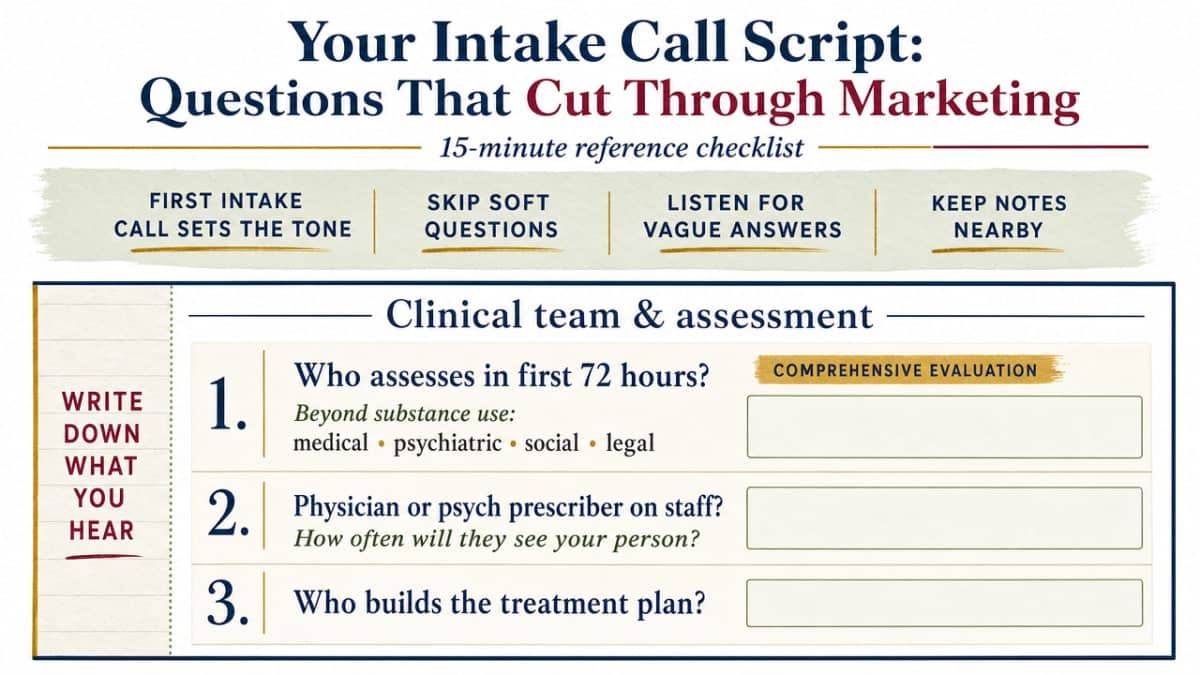
The first intake call sets the tone for everything that follows. Most programs are ready for the soft questions — “What’s your philosophy?” “Do you have a pool?” — and have polished answers waiting. The questions below are different. They surface whether a program actually does what it advertises, and they take maybe fifteen minutes to run through.
Keep a pen near you. Write down what you hear, especially the things that get vague.
On the clinical team and assessment
- “Who will assess my loved one in the first 72 hours, and what does that assessment cover beyond substance use — medical, psychiatric, social, legal?” The right answer references comprehensive evaluation, which is the foundation of effective treatment 11.
- “Is a physician or psychiatric prescriber on staff, and how often will they see my person?”
- “Who builds the treatment plan, and when is it reviewed?”
On dual diagnosis
- “If my loved one needs a medication adjustment for anxiety or depression mid-stay, who handles that, and how fast?”
- “Do the same clinicians treat both the substance use and the mental health diagnosis, or are those handled by separate teams?” Integrated care should be the answer 10.
On length of stay and step-down
- “How do you decide when someone is ready to step down to PHP or IOP?”
- “What does your discharge plan typically include for a person like mine?”
On family
- “How is the family built into the clinical plan — not visiting hours, but actual sessions and education?”
On the basics
- “What is your current OhioMHAS license number and category?”
- “Which national accreditations do you hold?”
- “How does insurance work for the full length of stay you’re recommending?”
Listen for specifics, names, and timeframes. Watch for answers that drift back to amenities or testimonials when you asked about clinical process. You’re not being difficult — you’re doing exactly the work this decision deserves.
Red Flags and Quiet Green Flags
By now you’ve made dozens of calls or you’re about to. Some impressions are loud — a slick website, a confident voice on the phone. The signals that actually predict whether a program will serve your loved one well are quieter.
Red flags to take seriously: guaranteed success rates (no honest program offers them — outcome measures aren’t even standardized across the field 12), pressure to admit today without a thorough assessment, vague answers about psychiatric prescribing, a discharge plan that’s really just a phone list, family contact framed as a reward, or a facility that can’t tell you its current license number and category on the spot.
Quiet green flags are easier to miss because they don’t sparkle. A clinician who asks you more questions than you ask them. An intake coordinator who mentions ASAM Criteria without prompting. A program that recommends a lower level of care than you called about — that honesty is rare and worth noting. A treatment plan reviewed weekly, not monthly. Medication decisions made on-site by a prescriber who knows the resident. Family sessions scheduled into week one, not week three.
Trust your read on tone, too. A program that sounds like a friend who happens to be a clinician usually behaves like one. A program that sounds like a sales pitch usually behaves like that, too.
Connect With a Specialist About Program Options
Speak with an expert to find the best-fit residential treatment approach for your loved one’s unique needs.
Talk With a Specialist About Your Options Today
Get personalized guidance to clarify the best residential care for your loved one’s unique needs.
Frequently Asked Questions
How do I know if my loved one needs residential treatment instead of intensive outpatient?
Lean toward residential when the home environment is itself a trigger, when psychiatric symptoms need daily clinical eyes, or when prior outpatient attempts ended in early relapse. A randomized trial found residential added benefit specifically on social problems and psychiatric symptoms, with no overall superiority on other outcomes 3. If your person has stable, sober-supportive housing and milder symptoms, IOP can be a real choice, not a compromise.
How long should someone stay in a residential program?
Long enough for the work to take hold, which research suggests is at least around 80 days of actual time in treatment, with benefit accumulating up to roughly six months 5. Beyond that, additional planned duration shows limited extra benefit, and committing a wavering person to a year-long program can backfire if they exit early. Ask programs how length is decided clinically and how step-down is handled.
What does a truly dual-diagnosis capable program look like in practice?
One team treats both conditions on one plan — not parallel tracks or sequential care. SAMHSA’s guidance is that integrated treatment outperforms siloed approaches 10. In practice that means a psychiatric prescriber on staff who can adjust medications mid-stay, clinicians trained in both substance use and mental health, and a single treatment plan that addresses depression, anxiety, trauma, or bipolar disorder alongside the addiction from day one.
How do I verify a residential facility is properly licensed in Ohio?
Ask the program directly for its current OhioMHAS license number and category, then verify it on the state’s licensure page. Class 1 facilities are specifically authorized to house and treat individuals with severe or persistent mental illness, which matters if dual diagnosis is part of the picture 6. Also ask about national accreditations like Joint Commission or CARF, and how they coordinate with Medicaid for residential SUD coverage.
How involved can families be during a residential stay?
More involved than most programs initially suggest, and the research says you should be. A review of transition-age SUD outcomes found families are powerful resources for engagement, retention, and long-term recovery, yet many programs underuse family-based approaches 4. Push past visiting hours. Ask about scheduled family therapy sessions, structured education, regular communication with the treatment team within HIPAA limits, and your role in the discharge plan.
What questions should I ask on an intake call to cut through marketing language?
Ask who conducts the first 72-hour assessment and whether it covers medical, psychiatric, social, and legal needs, since comprehensive evaluation anchors effective treatment 11. Ask who prescribes psychiatric medications and how fast adjustments happen. Ask how length of stay is decided clinically, how families are built into the plan, and for the current OhioMHAS license number. Listen for specifics — names, timeframes, processes — not amenities or testimonials.
References
- Finding Help for Co-Occurring Substance Use and Mental Disorders. https://www.nimh.nih.gov/health/topics/substance-use-and-mental-health
- Principles of Drug Addiction Treatment: A Research-Based Guide (Third Edition). https://nida.nih.gov/sites/default/files/podat-3rdEd-508.pdf
- A randomized trial comparing day and residential drug abuse treatment. https://pubmed.ncbi.nlm.nih.gov/10369064/
- Family Involvement in Treatment and Recovery for Substance Use Disorders among Transition-age Youth: Research Findings and Clinical Implications. https://pmc.ncbi.nlm.nih.gov/articles/PMC8380649/
- Planned duration of residential drug abuse treatment. https://pubmed.ncbi.nlm.nih.gov/9519490/
- Residential Facilities. https://dbh.ohio.gov/supporting-providers/licensure-and-certification/residential-facilities
- Treatment Types for Mental Health, Drugs and Alcohol. https://www.samhsa.gov/find-support/learn-about-treatment/types-of-treatment
- 2023 National Directory of Drug and Alcohol Use Treatment Facilities. https://www.samhsa.gov/data/report/2023-national-directory-of-drug-and-alcohol-use-treatment-facilities
- Chapter 5—Specialized Substance Abuse Treatment Programs. https://www.ncbi.nlm.nih.gov/books/NBK64815/
- Managing Life with Co-Occurring Disorders. https://www.samhsa.gov/mental-health/serious-mental-illness/co-occurring-disorders
- NIDA Treatment Guidelines (Module 1 Treatment). https://webcampus.med.drexel.edu/nida/module_1/content/5_0_Treatment.htm
- Substance Use Disorder Treatment Outcomes. https://pmc.ncbi.nlm.nih.gov/articles/PMC12180564/
- RecoveryOhio Initiative. https://ohio.gov/initiatives/recoveryohio