
Key Takeaways
- UMR administers self-funded employer plans with employer-specific rules, while UnitedHealthcare Student Resources issues standardized school-sponsored policies, so coverage details differ even within the same corporate family.
- Federal parity law (MHPAEA) requires these plans to cover substance use treatment on terms comparable to medical care, and 2024 final rules demand documented comparative analyses 1, 3.
- Cost-sharing varies widely by campus plan, and in-network versus out-of-network status can shift coverage by 20 percentage points or more, dramatically changing out-of-pocket costs 10.
- Families should review the SPD, SBC, and Student Health Insurance Certificate, and can request medical necessity criteria in writing with a 30-day response requirement 2.
Navigating UMR and UnitedHealthcare Student Plans for Addiction Treatment in Ohio
Navigating insurance paperwork for addiction treatment can be overwhelming, especially when dealing with a loved one’s health. Whether it’s a UMR benefits binder from a spouse’s employer in Massillon or a UnitedHealthcare Student Resources brochure from Ohio University, understanding coverage for substance use disorder treatment is crucial.
Federal law mandates that most UMR-administered plans and UnitedHealthcare student plans cover substance use disorder treatment comparably to medical care 1. This guide will help Ohio families understand typical coverage, potential challenges, and how to get clear answers regarding their specific plan.
UMR vs. UnitedHealthcare Student Resources: Understanding the Differences
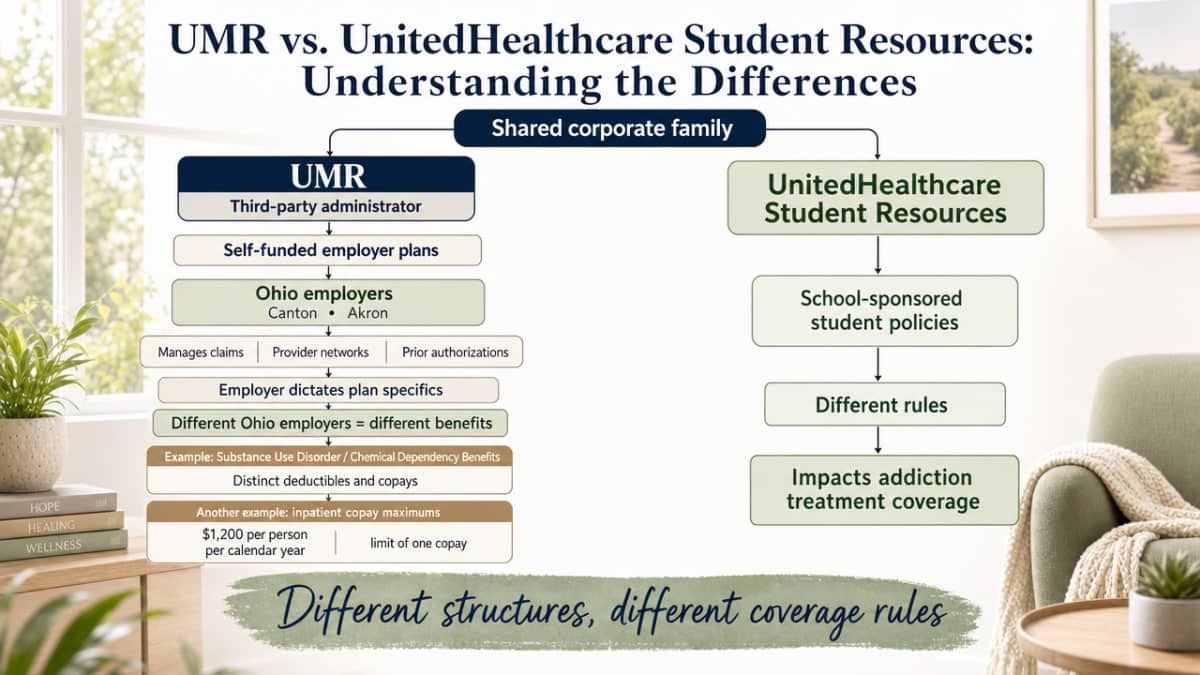
It’s important to distinguish between UMR and UnitedHealthcare Student Resources, even though they are part of the same corporate family. Each operates under different rules, which significantly impacts coverage for addiction treatment.
UMR is a third-party administrator. For employers in Ohio, such as those in Canton or Akron, who self-fund their health plans, UMR often manages claims, provider networks, and prior authorizations. The employer dictates the plan’s specifics, meaning two UMR plans from different Ohio employers can have varied benefits. For instance, one plan might detail specific Substance Use Disorder and Chemical Dependency Benefits with distinct deductibles and copays 15, while another might combine inpatient copay maximums, such as $1,200 per person per calendar year with a limit of one copay per 30 days 16.
UnitedHealthcare Student Resources (UHC SR) is a school-sponsored student plan. If a student receives their insurance card at an Ohio University orientation, it’s likely UHC SR. These policies are issued to the educational institution, and benefits are outlined in a Student Health Insurance Certificate, which applies uniformly to all enrolled students on that campus 11. UHC SR plans are generally more standardized than UMR employer plans and often provide substantial outpatient behavioral health coverage.
Understanding which plan applies is the first step in verifying benefits. A student might have both—a parent’s UMR plan as primary and a UHC SR plan as secondary, or vice versa. Coordinating benefits between the two can reduce out-of-pocket expenses, but this requires checking both plans. When preparing to verify benefits, gather both insurance cards, noting the group number, member ID, and the phone number on the back of each.
Federal Parity and Addiction Equity Act (MHPAEA)
The Mental Health Parity and Addiction Equity Act (MHPAEA) ensures that if a health plan covers substance use disorder treatment, it must do so on terms comparable to medical or surgical care. This applies to both UMR-administered employer plans and UHC Student Resources policies 1.
This means that financial requirements, such as copays and deductibles, for outpatient counseling sessions for substance use disorder cannot be more restrictive than those for a standard office visit. Similarly, treatment limitations, like visit caps or prior authorization requirements, cannot be more stringent for addiction treatment than for other medical procedures 6, 13. The law specifies that financial requirements and treatment limitations on mental health and substance use benefits cannot be more restrictive than the predominant requirements that apply to substantially all medical and surgical benefits 8.
Recent 2024 final rules further strengthen MHPAEA, requiring plans to document their comparative analyses when applying tools like prior authorization or medical necessity reviews to behavioral health benefits 3. This provides families with concrete information to request if a claim is denied, ensuring transparency and accountability.
Covered Rehab Services and Levels of Care
Understanding Levels of Care: Detox, Residential, PHP, IOP, and Outpatient
Addiction treatment involves various levels of care, each designed to meet specific needs. Most insurance plans, including UMR and UHC Student Resources, cover a spectrum of these services, which are typically outlined in plan documents.
Medical detox is the initial stage, providing 24/7 supervision for 3 to 7 days to safely manage withdrawal from substances like alcohol, opioids, or benzodiazepines. Following detox, residential treatment offers an immersive therapeutic environment where individuals live on-site for several weeks to engage in deeper recovery work. For example, the Cornell student certificate explicitly states coverage for inpatient substance use services, including detoxification and rehabilitation 7. This comprehensive coverage is common across UHC Student Resources plans, including those for Ohio students.
Stepping down from residential care, partial hospitalization programs (PHP) involve day-long treatment sessions, typically 5-6 hours daily, allowing individuals to return home or to sober living environments at night. Intensive outpatient programs (IOP) offer more flexibility, with treatment usually spanning 9-12 hours per week across three evenings, making it suitable for students attending classes at institutions like Ohio University or Kent State. The lowest rung of care is standard outpatient counseling, which includes weekly therapy, group sessions, and medication management. The SUNY Oswego UHC SR certificate details coverage for this full range of outpatient services, including PHP, IOP, opioid treatment programs, counseling, and medication-assisted treatment 14.
For UMR employer plans, coverage for these services is typically found under a dedicated “Substance Use Disorder and Chemical Dependency Benefits” section. This section outlines medically necessary treatment subject to deductibles, copays, and plan participation percentages 15. It’s important to note that while most substance use treatments are covered, nicotine-related services are often excluded from UMR employer plans 15.
Medication-Assisted Treatment (MAT) Coverage
Medication-assisted treatment (MAT), which includes medications like buprenorphine, naltrexone, and methadone, is a critical component of modern recovery care, particularly for opioid and alcohol use disorders. MAT significantly reduces overdose risk and supports long-term stability.
Student plans have increasingly become more supportive of MAT. The SUNY Oswego UHC SR certificate, for instance, lists opioid treatment programs, peer support services, counseling, and MAT as covered outpatient services. Notably, it specifies that preauthorization is not required for medications to treat substance use disorder, including opioid overdose reversal medications 14. This can expedite access to vital stabilizing medications.
When verifying benefits, it is crucial to ask whether MAT is covered under the medical benefit, the pharmacy benefit, or both, and if any prior authorization is required for either. Documenting these details will provide clarity on access and speed of treatment.
Understanding Cost-Sharing on Student Plans
Cost-sharing, including deductibles, copays, and coinsurance, varies significantly among student plans, even within the same insurance provider. This variation directly impacts out-of-pocket expenses for Ohio families.
For example, the Ohio University student plan for 2025–2026 covers outpatient mental illness and substance use disorder office visits at 80% of the allowed amount, and these visits are not subject to the deductible 11. This means the plan begins contributing to costs from the first visit, offering immediate financial relief.
In contrast, the University of Rhode Island UHC SR plan features a flat $20 copay per visit for outpatient mental illness and substance use disorder office visits 9. This provides a predictable cost for ongoing therapy.
The University of Chicago USHIP plan, also administered through UHC Student Resources, has a different structure. Outpatient office visits for mental illness and substance use disorder treatment with a preferred provider outside the campus Student Wellness list incur a $20 copay per visit, plus coinsurance, and are subject to the deductible 10. Here, the deductible and coinsurance can significantly increase the total cost.
These examples highlight why a general statement like “UHC covers rehab” is insufficient. Families must consult the Summary of Benefits and Coverage (SBC) for their student’s specific plan, focusing on the “Mental Illness/Substance Use Disorder Treatment” section to understand the exact financial obligations. The Ohio University plan’s waiver of the deductible for outpatient benefits 11can make early intervention and step-down care more accessible during the critical initial stages of recovery.
In-Network vs. Out-of-Network Coverage: Impact on Costs
The network status of a treatment facility is a primary factor determining the financial burden on families. Whether a rehab facility is in-network with UnitedHealthcare Choice Plus (for UHC SR plans) or the specific network used by a UMR-administered employer plan can result in cost differences of tens of thousands of dollars for the same length of stay.
Consider the University of Chicago USHIP plan: inpatient hospitalization for mental illness and substance use disorder treatment with a preferred provider is covered at 90% of the allowed amount after the deductible. However, the same inpatient stay at an out-of-network provider drops to 70% of the allowed amount after the deductible 10. This 20-percentage-point difference in coverage, coupled with potential balance billing from out-of-network facilities, can dramatically inflate costs for a residential stay that might exceed $30,000.
Arrow Passage Recovery works with UnitedHealthcare, and their intake team can confirm the in-network status for specific plans, whether for their Massillon or Cleveland programs. Obtaining this network confirmation in writing before admission is crucial to avoid unexpected expenses.
Addressing Prior Authorization and Medical Necessity
Two common hurdles in accessing addiction treatment coverage are “prior authorization” and “medical necessity.” These processes can cause delays and denials, even when coverage is technically available.
Prior authorization requires plan approval before a patient can enter detox or residential care. Medical necessity involves a reviewer, typically a nurse or physician employed by UMR or UHC, determining if the requested level of care aligns with the patient’s clinical needs. While these processes are not inherently unfair, they can create administrative burdens for families already under stress.
The 2024 final rules under MHPAEA have strengthened requirements for plans regarding these limitations. Plans imposing nonquantitative treatment limitations on mental health and substance use benefits must now perform and document a comparative analysis. This analysis must demonstrate that prior authorization and medical necessity reviews for addiction treatment are no more restrictive than those for medical or surgical care 3, 12. This provides families with leverage: if a plan requires extensive hoops for residential treatment, it must show similar requirements for other medical conditions.
Before admission, it is advisable to have the admissions team at the treatment facility handle prior authorization requests, as they are experienced in this process. If a denial occurs, families should not accept it as final. Requesting the criteria in writing, asking for a peer-to-peer review between the facility’s clinician and the plan’s reviewer, and filing an appeal are all viable steps. Denials are frequently overturned, especially when the clinical case is well-documented.
A 2024 report to Congress indicated that while progress has been made on parity, plans still have shortcomings 4. This underscores the importance of informed advocacy and working with a treatment team that can effectively navigate insurance challenges.
Verifying Benefits: Key Documents and Questions
Verifying a student’s insurance benefits for addiction treatment requires reviewing specific documents and asking targeted questions during a phone call to the insurance provider.
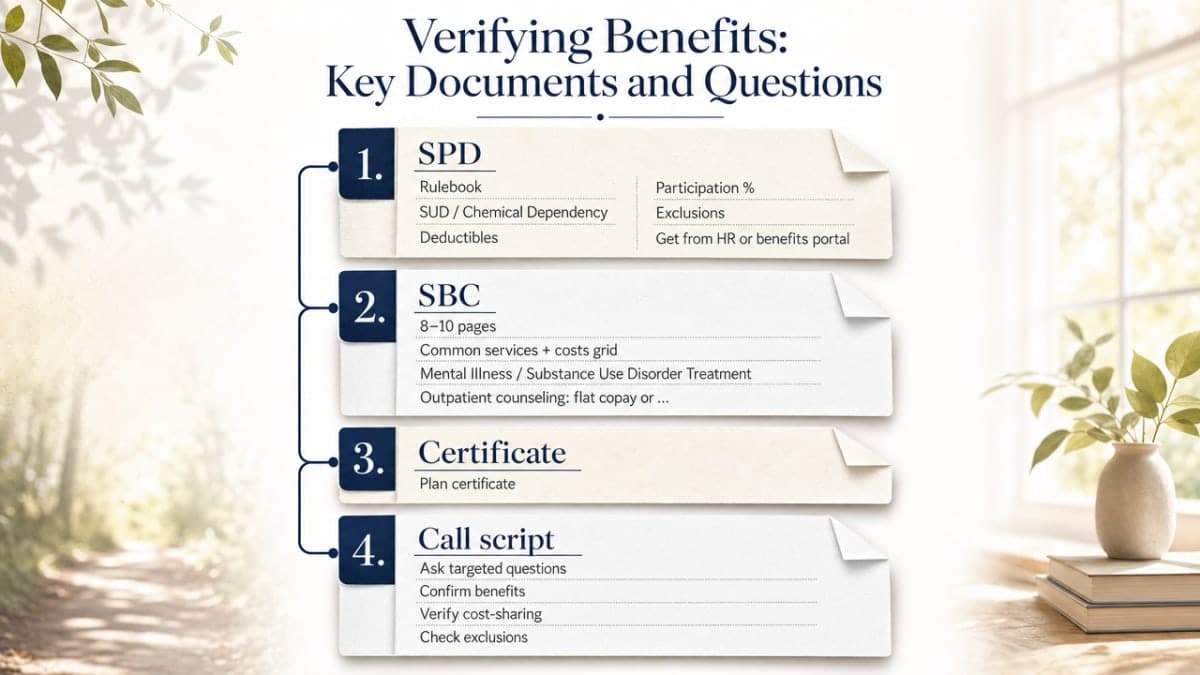
- 1. Summary Plan Description (SPD): For UMR-administered employer plans, the SPD is the comprehensive rulebook. It details the Substance Use Disorder and Chemical Dependency Benefits section, deductibles, plan participation percentages, and any exclusions 15. This document can be obtained from HR or through the employer’s benefits portal.
- 2. Summary of Benefits and Coverage (SBC): This is a concise, 8-10 page document provided by every plan. It features a grid outlining common services and associated costs. For UHC Student Resources plans, the “Mental Illness/Substance Use Disorder Treatment” row indicates whether outpatient counseling involves a flat copay or coinsurance after a deductible.
- 3. Student Health Insurance Certificate: If the student is enrolled in a school-sponsored UHC SR plan, this certificate outlines inpatient detox and rehab coverage, various outpatient levels (PHP, IOP, MAT), and whether preauthorization applies to substance use disorder medications 14. Ohio University students, for example, can access theirs via the student insurance page.
When contacting the insurance provider, families have the right to request specific information regarding copayments, medical necessity, and prior authorization criteria, which the plan must provide within 30 days 2. It’s crucial to make this request in writing.
Key questions to ask during the benefits verification call include:
- Is the student’s substance use disorder benefit covered, and at what levels of care (detox, residential, PHP, IOP, outpatient)?
- Is Arrow Passage Recovery in Massillon or Cleveland in-network for this specific plan (provide group number and member ID)?
- What is the deductible, and how much has been met this year?
- What are the copays, coinsurance, and out-of-pocket maximums for in-network inpatient and outpatient SUD care?
- Is prior authorization required for detox, residential, or PHP? Who submits it, and what is the typical timeframe?
- Is MAT covered under the medical benefit, pharmacy benefit, or both, and does preauthorization apply?
- Are there any visit caps or day limits for residential or IOP?
Document all answers, including the representative’s name and a reference number. If any information seems inconsistent with parity laws, request the medical necessity criteria in writing, citing the 30-day right to receive this information 2.
Arrow Passage Recovery offers a free benefits verification service. Families can provide their insurance cards, and the admissions team will contact UMR or UHC on their behalf, providing a same-day summary of coverage, network status, and estimated out-of-pocket costs.
Support for Student-Veterans
Student-veterans often face unique challenges, including co-occurring PTSD and substance use disorders. These individuals may have multiple insurance coverages, such as TRICARE alongside a UHC Student Resources card, or a parent’s UMR plan in addition to VA benefits. This layered coverage can be an advantage for coordinating benefits and reducing costs, as federal parity rules still apply to commercial plans 1.
Arrow Passage Recovery provides veteran-specific programming, including trauma-focused therapy and MAT. Their intake team is equipped to navigate multiple insurance plans to maximize coverage for student-veterans.
A Clear Path Forward for Ohio Families
Understanding insurance coverage for substance use disorder treatment is a critical step in supporting a loved one’s recovery. Federal parity laws ensure that UMR and UHC Student Resources plans must cover addiction treatment comparably to medical care 1. Key information can be found in the Summary Plan Description (SPD), Summary of Benefits and Coverage (SBC), and the Student Health Insurance Certificate. Families also have the right to request medical necessity criteria in writing, with a 30-day response window 2.
Arrow Passage Recovery’s admissions team in Massillon and Cleveland offers a free, confidential benefits check to help Ohio families navigate these complexities. By providing insurance card details, families can receive a clear summary of coverage and estimated out-of-pocket expenses.
Start Your Path to Covered Student Rehab Care
Get clear answers about your UMR or UHC student rehab coverage in Ohio with a caring, confidential conversation.
Frequently Asked Questions
Does my UMR or UHC Student Resources plan actually cover rehab?
Most UMR and UHC Student Resources plans cover substance use disorder treatment at various levels of care. Federal parity law mandates comparable coverage to medical care 1. Student certificates often specify coverage for inpatient detox, rehabilitation, and outpatient options like PHP, IOP, counseling, and MAT 7, 14. A benefits check can clarify the extent of coverage and specific conditions.
What’s the difference between UMR and UnitedHealthcare Student Resources?
UMR acts as a third-party administrator for self-funded employer plans, where the employer dictates the rules for claims and prior authorizations 15. UnitedHealthcare Student Resources (UHC SR) is a school-sponsored plan with benefits outlined in a Student Health Insurance Certificate, applicable to all enrolled students 11. While both are part of the same corporate entity, their operational rules differ, and a student may have coverage from one or both.
Will I need prior authorization before my student goes to detox or residential rehab?
Prior authorization is typically required for detox and residential care to ensure the requested level of care aligns with clinical needs. The 2024 final rules require plans to demonstrate that prior authorization for rehab is no more restrictive than for medical care 3, 12. Treatment facilities like Arrow Passage can assist with submitting authorization requests. If a denial occurs, families can request medical necessity criteria in writing and pursue a peer-to-peer review.
What documents should I pull before I call about benefits?
Gather three key documents: the Summary Plan Description (SPD) for UMR employer plans 15, the Summary of Benefits and Coverage (SBC) for any plan, and the Student Health Insurance Certificate if your student has a UHC SR plan 14. Additionally, you can request medical necessity criteria and prior authorization details in writing, which the plan must provide within 30 days 2.
How much will out-of-network rehab cost compared to in-network?
Out-of-network rehab can be significantly more expensive. For instance, the University of Chicago USHIP plan covers in-network inpatient substance use disorder treatment at 90% after deductible, but only 70% out-of-network 10. Out-of-network facilities can also balance-bill above the allowed amount, unlike in-network providers. Confirming network status before admission is crucial to avoid substantial unexpected costs.
Is medication-assisted treatment (MAT) covered under student plans?
Yes, MAT is increasingly covered by student plans. The SUNY Oswego UHC SR certificate, for example, includes opioid treatment programs, peer support, counseling, and MAT as covered outpatient services, with no preauthorization required for certain medications 14. When verifying benefits, inquire whether MAT is covered under medical or pharmacy benefits, and if any preauthorization is necessary.
References
- Mental Health and Substance Use Disorder Parity. https://www.dol.gov/agencies/ebsa/laws-and-regulations/laws/mental-health-and-substance-use-disorder-parity
- Understanding Your Mental Health and Substance Use Disorder Benefits. https://www.dol.gov/agencies/ebsa/about-ebsa/our-activities/resource-center/publications/understanding-your-mental-health-and-substance-use-disorder-benefits
- Fact Sheet: Final Rules under the Mental Health Parity and Addiction Equity Act (MHPAEA). https://www.dol.gov/agencies/ebsa/about-ebsa/our-activities/resource-center/fact-sheets/final-rules-under-the-mental-health-parity-and-addiction-equity-act-mhpaea
- 2024 MHPAEA Report to Congress – U.S. Department of Labor. https://www.dol.gov/sites/dolgov/files/ebsa/laws-and-regulations/laws/mental-health-parity/report-to-congress-2024.pdf
- US Departments of Labor, Health and Human Services … 2024 Report to Congress on MHPAEA. https://www.dol.gov/newsroom/releases/ebsa/ebsa20250117
- US Departments of Labor, Health and Human Services … parity guidance news release. https://www.dol.gov/newsroom/releases/ebsa/ebsa20220125
- Student Health Plan (SHP). https://studenthealthbenefits.cornell.edu/sites/default/files/2025-06/CUSHPCert2526.pdf
- Mental health parity: History and overview. https://www.tdi.texas.gov/InsurED/documents/mental-health-parity.pdf
- 2024–2025 Student Health Insurance Plan for The University of Rhode Island. https://web.uri.edu/healthservices/wp-content/uploads/sites/1769/2024-1149-1-Summary-Brochure-ISmaller.pdf
- Learn More… And There’s More 2024–2025 – University of Chicago Student Health Insurance (USHIP) User Guide. https://college.uchicago.edu/sites/default/files/documents/USHIP%202024%20User%20Guide_Final.pdf
- 2025–2026 Student Health Insurance Plan for Ohio University – Policy Summary. https://www.ohio.edu/sites/default/files/sites/student-insurance/files/PolicySummary_2025_26.pdf
- New Mental Health and Substance Use Disorder Parity Rules: What They Mean for Plans and Issuers. https://www.dol.gov/agencies/ebsa/laws-and-regulations/laws/mental-health-parity/new-mhpaea-rules-what-they-mean-for-plans-and-issuers
- 42 U.S. Code § 300gg-26 – Parity in mental health and substance use disorder benefits. https://www.law.cornell.edu/uscode/text/42/300gg-26
- Student Health Insurance Certificate – SUNY Oswego 2024. https://ww1.oswego.edu/auxiliary-services/sites/auxiliary-services/files/2024-StudentHealthInsurance_certificate.pdf
- 2025 UMR Plan Document – Noblesville, IN. https://www.noblesville.in.gov/DocumentCenter/View/220/2025-UMR-Plan-Document-PDF
- Active and Retiree Health Benefit Summary Plan Description – UMR. https://sites.uams.edu/uasys/wp-content/uploads/sites/16/2013/08/Medical-Plan-SPD-UMR-01-01-2013-00-03.pdf