
Is It Suboxone Addiction or Physical Dependence?
Key Takeaways
- Physical dependence on buprenorphine is an expected pharmacological adjustment, while addiction is compulsive use that harms your life despite consequences 1, 6.
- Buprenorphine’s partial agonism and ceiling effect occupy opioid receptors enough to quiet withdrawal and craving without producing the escalating reward loop that drives compulsive use 2, 6.
- Outcomes data shows people on buprenorphine/naloxone stay in treatment longer, relapse less, and die less often from overdose, and stopping carries high relapse risk 4, 9.
- Indefinite maintenance is a legitimate endpoint, not a failure, and decisions about tapering, surgery, or pushback from family belong in shared conversation with your prescriber 2, 11, 13.
The question that means you’re paying attention
You take your dose every morning. Maybe you’ve been doing it for six months, maybe six years. Then one night you can’t sleep, and the thought won’t leave you alone: If I need this every day, am I just addicted to my treatment?
Here’s the first thing worth saying: the fact that you’re asking this question is itself a sign of recovery work. People in active addiction rarely sit up at night auditing their own use. They don’t compare their behavior to a clinical definition. You are, and that matters.
The worry usually comes from somewhere specific. A family member made a comment at dinner. A post in a recovery forum called Suboxone a crutch. Maybe a clinician outside addiction medicine raised an eyebrow at your prescription. The message lands the same way every time: needing the medication must mean something is wrong with you.
It doesn’t. Buprenorphine is one of three FDA-approved medications for opioid use disorder, alongside methadone and naltrexone 3, 12. Current national guidelines name buprenorphine and methadone as first-line treatment, not last-resort options 13. You are using standard medical care.
The rest of this article is going to give you the language to tell the difference between physical dependence, which is expected, and addiction, which is something else entirely. You’ll see what withdrawal actually looks like, why the pharmacology matters, and how to think about staying on the medication or eventually tapering off. No lecture. No shame. Just the clinical picture you’re already asking for.
Dependence and addiction are not the same word
English uses one word, “addicted,” for two very different things. That’s most of the problem. When a relative says you’re “addicted to Suboxone,” they usually mean you need it to feel normal and would get sick without it. That’s true. It’s also not addiction. It’s physical dependence, and the FDA prescribing information for Suboxone says so plainly: buprenorphine is a partial agonist at the mu-opioid receptor, and chronic administration produces physical dependence of the opioid type 1. Expected. Predictable. Not a character flaw.
Physical dependence is what your body does when a medication is on board long enough to adjust to it. Stop the medication and your body reacts. This happens with antidepressants, beta blockers, and seizure medications too. Nobody calls a heart patient addicted to their metoprolol.
Addiction is a behavior pattern. It’s compulsive use that continues even when it’s hurting you, your relationships, your work, your health. It includes loss of control, cravings that override your decisions, and harm you keep choosing anyway. Buprenorphine, used as prescribed, does something close to the opposite. It prevents withdrawal and craving and stabilizes opioid receptors so you can function 6.
Look at it side by side and the difference gets concrete:
| Observable factor | Physical dependence on Suboxone | Addiction |
|---|---|---|
| Control over use | You take it as prescribed, on schedule | You use more than intended, can’t cut back |
| Harm despite consequences | Use supports work, family, health | Use continues even as life falls apart |
| Cravings | Reduced or absent on a stable dose | Intrusive, drive behavior |
| Withdrawal if stopped | Yes, expected, typically milder than full agonists 1 | Yes, plus return to compulsive seeking |
| Daily functioning | Stable or improving | Deteriorating |
Read down the addiction column and ask yourself honestly: does that describe how you take your morning dose? For most people on stable maintenance, it doesn’t. You’re not hiding film strips in your car. You’re not lying to your prescriber to get more. You’re taking a medication that lets you go to work, sleep through the night, and stop organizing your life around the next high. That’s treatment working, not addiction wearing a new outfit.

What buprenorphine actually does at the receptor
The pharmacology is worth understanding because it’s the answer to most of the worry. Buprenorphine is what’s called a partial agonist at the mu-opioid receptor 1. A full agonist, like heroin, oxycodone, or fentanyl, walks up to that receptor and turns it on all the way. Breathing slows. Reward signals fire. The dose-response curve climbs and climbs, which is why overdose is so easy with full agonists.
Buprenorphine binds to the same receptor, but it only turns it on partway. And here’s the key: past a certain dose, more buprenorphine doesn’t produce more effect. That’s the ceiling effect. The receptor is occupied, the withdrawal signal is quiet, the craving is quiet, but the runaway high that defines a full opioid isn’t there.
Two things follow from that. First, your receptors stop sending the constant alarm that drove your use. Buprenorphine prevents withdrawal and craving and stabilizes opioid receptors so the nervous system can settle down 6. Second, because the ceiling caps the effect, you don’t get the escalating reward loop that trains the brain toward compulsive use.
SAMHSA puts it in plainer language: buprenorphine’s unique pharmacological properties diminish the effects of physical dependency to opioids, including withdrawal symptoms and cravings 2. That word “diminish” is doing real work. The medication is reducing the very thing your relative is accusing you of having.
So when someone says you’re “on opioids,” they’re technically right and clinically misleading. You’re on a partial agonist that occupies the receptor without producing the high, stops the withdrawal, and quiets the craving. The molecule is doing the opposite job of the drug that brought you here.
Answering the ‘you just swapped one drug for another’ criticism
This is the line that stings the most, isn’t it? Usually it comes from someone who loves you, which makes it worse. You traded heroin for Suboxone, or pills for Suboxone, and to them that looks like a lateral move. Same dependence, different prescription pad.
The criticism collapses two things that pharmacology keeps separate. Yes, buprenorphine is an opioid. Yes, your body has adjusted to it. No, that is not the same as the disorder you were treating. The medication occupies the receptor with a ceiling on its effect, quiets withdrawal, and quiets craving, which is the opposite of what your previous use was doing to you 6. The molecule’s job is to keep you from chasing the next dose, not to send you chasing it.
The outcomes data is where this argument actually ends. Compared to placebo, buprenorphine-naloxone is associated with greater retention in treatment, a lower frequency of relapse, and less opioid-related overdose 9. Those are three different measures, and they all move in the same direction.
| Outcome measure | Buprenorphine/naloxone vs. placebo |
|---|---|
| Staying in treatment | Greater retention |
| Relapse to opioid use | Lower frequency |
| Opioid-related overdose | Less frequent |
Read that chart honestly. People on the medication stay in care longer, use less, and die less. If Suboxone were just heroin in a strip, those numbers wouldn’t exist. They’d look like placebo, or worse.
So when someone tells you that you’ve swapped one drug for another, you have a real answer. You swapped a drug that was narrowing your life for a medication that is keeping you in it. That isn’t semantics. It’s what the evidence shows the medication does.
What withdrawal from Suboxone actually looks like
Most of the fear around stopping Suboxone comes from memory. You remember what coming off heroin or oxy felt like at hour 18. Your body curled around itself, sweat soaking the sheets, every nerve lit up. So when you imagine stopping buprenorphine, you imagine that, only longer because the medication has been with you longer.
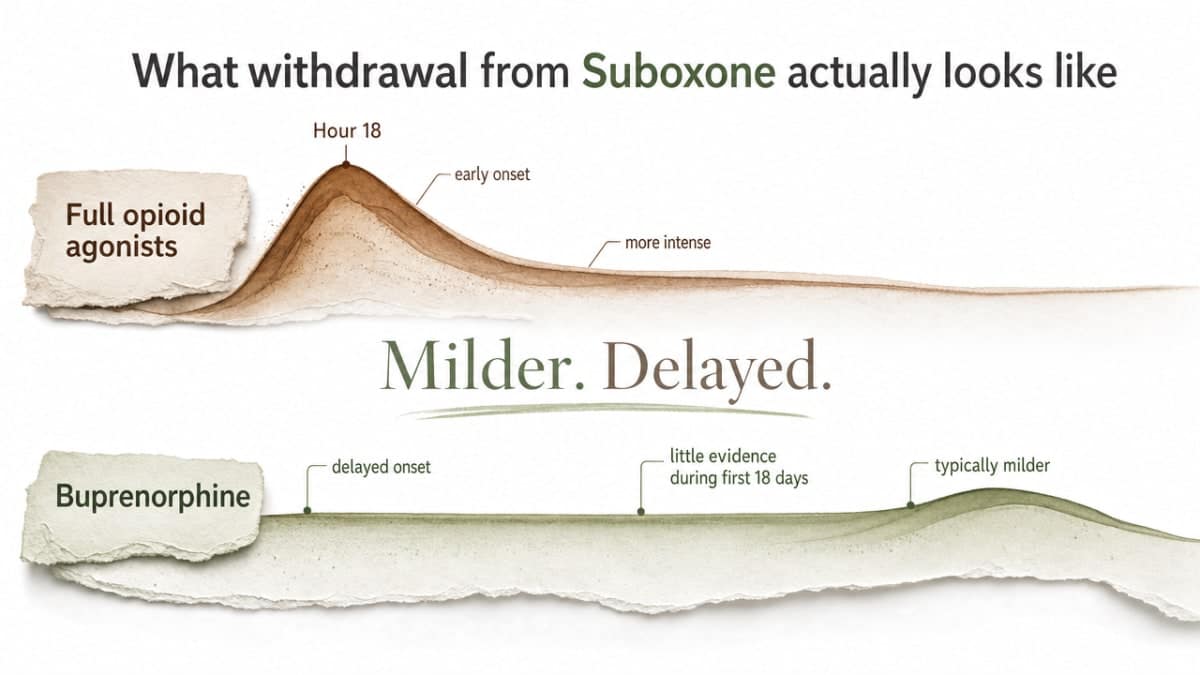
That isn’t what the evidence shows. The FDA prescribing information for Suboxone is unusually direct on this point: the withdrawal syndrome is typically milder than seen with full agonists and may be delayed in onset 1. Milder. Delayed. Two words worth holding onto when your relative tells you that quitting will be hell.
The delay piece surprises people. A controlled comparison of spontaneous withdrawal from buprenorphine versus morphine found little evidence of withdrawal during the eighteen days after buprenorphine cessation in the participants studied 8. That doesn’t mean nothing happens to anyone. It means the timeline you’re bracing for, the one that starts twelve hours after your last dose and peaks in three days, doesn’t apply to this medication the way it applied to your last one. Buprenorphine sits on the receptor longer and lets go more slowly, which spreads the adjustment out.
| Window after last dose | Full opioid agonist (e.g., morphine, short-acting opioids) | Buprenorphine |
|---|---|---|
| First 24 hours | Early symptoms begin: anxiety, yawning, watery eyes | Often quiet; receptor still substantially occupied |
| Days 2 to 4 | Peak symptoms: chills, cramps, nausea, intense restlessness | Symptoms may start to appear, generally milder than full agonist peak 1 |
| Days 5 to 14 | Acute symptoms easing; sleep and appetite returning | Spread-out, lower-intensity symptoms; one controlled study saw little evidence of withdrawal across 18 days 8 |
| Severity overall | Sharp and concentrated | Typically milder and may be delayed in onset 1 |
Honest picture, though: milder is not the same as nothing. A small case series of people who stopped buprenorphine/naloxone abruptly described minimal morbidity, with mild withdrawal that lasted roughly one to two days in the patients followed 7. You may notice trouble sleeping, low-grade body aches, a stretch of low mood, or a flat feeling that takes a few weeks to lift. Some people barely register it. Others feel it more.
What this changes for you: the version of withdrawal in your head, the one shaped by your worst day in active use, is probably not the version your body will actually go through. That doesn’t mean stop your medication tomorrow. It means if you and your prescriber decide a taper is right at some point, you are not signing up to repeat the worst week of your life. You’re planning a slow handoff your nervous system has time to absorb.
Staying on the medication versus tapering off
Somewhere along the way, you probably absorbed the idea that the real finish line is being off Suboxone. Off everything. White-knuckle clean. That framing is so common that even some clinicians repeat it. It’s also not what the evidence supports for most people with opioid use disorder.
The reason this matters is what happens when people stop. A peer-reviewed overview of buprenorphine treatment found that the medication improves retention compared with placebo and that stopping it carries a high risk of relapse 5. CDC clinical guidance goes further and says detoxification alone, without ongoing MOUD, is not recommended because of increased risk of resumed drug use, overdose, and overdose death 4. Read that twice. The federal agency that tracks overdose deaths is telling clinicians not to push patients off the medication into nothing.
So how do you think about the choice without guilt loading the scale?
Staying on the medication makes sense if your life is working. You’re holding a job or stable housing. Cravings are quiet. You haven’t had a near-miss in months or years. The dose isn’t escalating. Surgeries, dental work, and stressful seasons haven’t pushed you back toward use. There’s nothing in that picture that needs fixing by removing the thing that built it.
Tapering becomes a real conversation, not a moral one, when you and your prescriber agree the timing fits your life. That usually means a long stretch of stability, a support system you trust, a plan for relapse warning signs, and a slow, prescriber-led reduction rather than a calendar deadline. It does not mean stopping because a family member is uncomfortable, because insurance changed, or because you hit some imagined ethical milestone.
Here’s the part worth keeping: choosing to stay on Suboxone long-term is not the absence of a decision. It is a decision. You weighed the relapse data, the overdose data, and how you actually feel on the medication, and you chose continued treatment. That’s recovery work, not a detour from it.
Surgery, hospital stays, and acute pain on buprenorphine
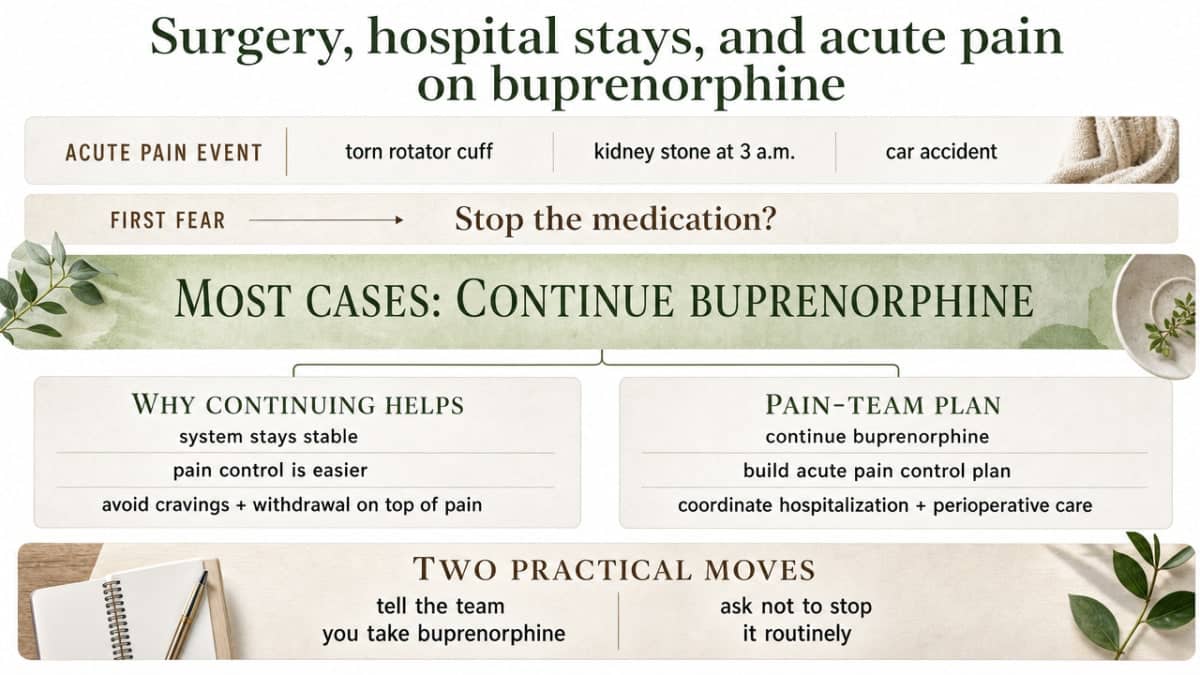
Sooner or later, something is going to require an operating room or an emergency department. A torn rotator cuff. A kidney stone at 3 a.m. A car accident you didn’t see coming. And the first thought, before the pain even fully lands, is the one that’s been sitting in the back of your head for years: they’re going to make me stop the medication.
For most situations, they shouldn’t. A 2024 clinical review on managing acute pain in patients prescribed buprenorphine reached a direct conclusion: the medication should be continued during hospitalization and perioperative care in most cases 11. Stopping it tends to make pain control harder, not easier, because you lose the receptor occupancy that’s been keeping your system stable, and you open the door to cravings and withdrawal on top of whatever surgical pain you’re already dealing with.
What actually changes during an acute pain episode is the plan around your usual dose. Anesthesiologists and pain teams have several options:
- They can keep your buprenorphine going and add non-opioid pain control like ketorolac, acetaminophen, regional blocks, or nerve catheters.
- They can split your daily dose into smaller portions across the day to free up some receptor activity.
- They can add a short course of a full opioid agonist on top of your buprenorphine when the surgery is significant enough to need it.
The review notes there isn’t full consensus on dose-splitting or exact adjustments 11, so expect a conversation, not a script.
Two practical moves help you walk into that conversation prepared:
- Tell the surgical and anesthesia teams about your buprenorphine before the procedure, not the morning of. A pre-op call to the prescriber’s office and a note to the anesthesiologist a week ahead gives everyone time to coordinate.
- Ask one direct question: What is the plan to keep me on my buprenorphine through this, and what’s the backup if my pain isn’t controlled? That single sentence signals you’re an informed patient, not a problem to be managed.
If a clinician outside addiction medicine tells you that you simply have to stop the medication for the surgery, you are allowed to ask for a second opinion or a consult with someone familiar with current perioperative guidance. Your prescriber is your ally here. The medication that’s been holding your recovery together does not have to be sacrificed to the appendix coming out.
How to talk about your treatment with people who don’t get it
You don’t owe anyone a pharmacology lecture. You also don’t have to absorb their discomfort as evidence that you’re doing something wrong. Most of the people who question your medication are not addiction specialists. They’re worried, or they were raised on the idea that real recovery means being on nothing, or they read something online. Their confusion is not your verdict.
A short, plain answer usually works better than a long defense. Something like: Suboxone is an FDA-approved medication for opioid use disorder, and my doctor and I decided it’s the right treatment for me. That sentence does three things. It names the medical category, it names the condition, and it places the decision where it belongs, with you and your prescriber. You can stop there. You don’t have to explain partial agonism to your aunt at Thanksgiving.
If the person keeps pushing, you have one more honest line: people on this medication stay in treatment longer, relapse less often, and die less often from overdose 9. That’s not opinion. That’s what the outcome data shows. Most people soften when they realize you’ve actually read about your own care.
Some conversations aren’t worth having. A coworker who treats your prescription as gossip, a relative who keeps relitigating the decision every holiday, a forum that exists to shame people on maintenance, none of these are owed your time. Protecting your recovery includes protecting it from people who don’t understand it yet.
It helps to have one person in your corner who does get it. A prescriber who answers questions without flinching. A sponsor or peer who is also on medication. A friend who’s read enough to be useful. You don’t need a crowd. You need someone who can hear “I’m worried I’m just addicted to my treatment” and respond with something other than a flinch.
Working with your prescriber on what comes next
Whatever you decide about the medication, the conversation with your prescriber is the place it gets decided. Not a forum thread. Not a holiday dinner. The clinician who knows your history, your dose, and what your last six months have actually looked like.
Walk in with the real questions. Am I stable enough that we should keep things exactly as they are? What would tell you I’m ready to consider a slow taper? What would tell you I’m not? If I had a setback, what’s our plan? Those questions move the appointment from a refill transaction into shared decision-making, which is what current guidelines actually call for 13.
Bring up the things you’ve been quiet about. Sleep that isn’t quite right. A craving that surprised you last month. A family member whose comments are getting under your skin. A surgery on the calendar. Your prescriber can only work with what you tell them, and buprenorphine is more effective than non-opioid options at managing the withdrawal and craving piece when adjustments are needed 10.
One last thing worth saying out loud: continuing this medication is not giving up on recovery. It is recovery, the maintenance version, backed by the agencies that set the standard of care 2, 4. If you want a team that treats it that way, including the mental health side of what brought you here, Arrow Passage Recovery is one place to start that conversation.
Talk to Someone About Suboxone Dependence Now
Get expert guidance on managing Suboxone dependence and your next steps in recovery.
Discuss Your Suboxone Use with a Specialist
Get clarity on dependence versus addiction and explore supportive next steps tailored to your needs.
Frequently Asked Questions
If I need Suboxone every day, doesn’t that mean I’m addicted to it?
Needing a daily dose is physical dependence, which the FDA prescribing information names as an expected result of chronic buprenorphine use, not a sign of addiction 1. Addiction is compulsive use that keeps hurting your life. If your morning dose is letting you work, sleep, and stay out of active use, that’s treatment doing its job, not addiction in disguise 6.
How long is it safe to stay on Suboxone?
For some patients, treatment can be indefinite, and SAMHSA says so directly 2. The 2024 national guideline update names buprenorphine as first-line care, which means the medication itself is the standard, not a temporary bridge 13. There’s no built-in expiration date. The right length is the one that keeps you stable, decided between you and your prescriber based on your life, not a calendar.
What does Suboxone withdrawal actually feel like if I stop?
Honest picture: typically milder than full agonist withdrawal and often delayed in onset 1. A small case series of abrupt cessation reported minimal morbidity with mild symptoms lasting about one to two days 7. Expect possible sleep trouble, low-grade aches, low mood, or a flat stretch that takes a few weeks to lift. It’s not the worst week of your active use replayed.
Will I be able to manage pain after surgery if I’m on buprenorphine?
Yes, and in most cases the medication should be continued through hospitalization and perioperative care rather than stopped 11. Pain teams can add non-opioid options, regional blocks, or a short course of a full agonist on top of your buprenorphine. Tell the surgeon and anesthesiologist about your prescription before the procedure, and ask directly what the plan is to keep you on it.
How do I respond when family says I’m just trading one drug for another?
Keep it short. Suboxone is one of three FDA-approved medications for opioid use disorder, and you and your doctor chose it 3. If they keep pushing, the outcomes do the rest of the work: people on buprenorphine/naloxone stay in treatment longer, relapse less, and die less often from opioid-related overdose than people on placebo 9. You don’t owe a longer defense.
Is tapering off Suboxone the goal of successful treatment?
No. CDC clinical guidance says detoxification alone, without ongoing MOUD, is not recommended because of higher risk of resumed use and overdose death 4. A peer-reviewed overview also found that stopping buprenorphine carries a high relapse risk 5. Tapering is one possible path for some patients at the right time, not the finish line. Staying on the medication is a legitimate, evidence-backed endpoint.
References
- Reference ID: 5715923 – accessdata.fda.gov. https://www.accessdata.fda.gov/drugsatfda_docs/label/2025/022410s057lbl.pdf
- What is Buprenorphine? Side Effects, Treatment & Use – SAMHSA. https://www.samhsa.gov/substance-use/treatment/options/buprenorphine
- Information about Medications for Opioid Use Disorder (MOUD) – FDA. https://www.fda.gov/drugs/information-drug-class/information-about-medications-opioid-use-disorder-moud
- Opioid Use Disorder: Treating | Overdose Prevention – CDC. https://www.cdc.gov/overdose-prevention/hcp/clinical-care/opioid-use-disorder-treating.html
- Buprenorphine Treatment for Opioid Use Disorder: An Overview – PMC. https://pmc.ncbi.nlm.nih.gov/articles/PMC6585403/
- Suboxone: Rationale, Science, Misconceptions – PMC. https://pmc.ncbi.nlm.nih.gov/articles/PMC5855417/
- Course and Treatment of Buprenorphine/naloxone Withdrawal – PMC. https://pmc.ncbi.nlm.nih.gov/articles/PMC3723396/
- A Double Blind, within Subject Comparison of Spontaneous Opioid Withdrawal from Buprenorphine and Morphine – PMC. https://pmc.ncbi.nlm.nih.gov/articles/PMC3912547/
- Buprenorphine and Naloxone – StatPearls – NCBI Bookshelf – NIH. https://www.ncbi.nlm.nih.gov/books/NBK603725/
- Buprenorphine for managing opioid withdrawal – PMC. https://pmc.ncbi.nlm.nih.gov/articles/PMC6464315/
- How Do I Manage Acute Pain for Patients Prescribed Buprenorphine? – PMC. https://pmc.ncbi.nlm.nih.gov/articles/PMC11282871/
- Multiple Treatment Settings for Receiving Buprenorphine – CDC. https://www.cdc.gov/overdose-prevention/hcp/training-modules/buprenorphine/page1169598.html
- Management of opioid use disorder: 2024 update to the national …. https://pmc.ncbi.nlm.nih.gov/articles/PMC11573384/